Greg DeVore once persuaded his parents to let him stop taking piano lessons. Then he started playing more music. Guitar, bass, drums, high-school bands: removing the formal requirement apparently did little to diminish the appetite. It is a useful beginning for someone who would spend his working life questioning how much instruction people really need, and what kind of help makes them want to keep going.
He studied composition at Brigham Young University, transferred to Berklee College of Music, and worked in music in Boston and Los Angeles. His later teaching work involved helping composers use Logic. These were people trying to make something. A tour of every software feature was an expensive detour when what they needed was a usable sequence of steps.
Today DeVore is co-founder and CEO of ScreenSteps, based in McLean, Virginia. The business he built with his brother Trevor makes software for capturing procedures and putting them within reach of the employee doing the work. His subject has become decidedly less glamorous than a film score. There are checklists. There are account-opening processes. There are documents whose titles will never appear above the title of a movie.
Yet the connection is easy to hear. A musical score lets a player perform something complicated without committing every note to memory. A useful procedure offers a similar courtesy. DeVore has spent years arguing that the person at a service desk deserves instructions that can be followed while the customer is still there.
Two brothers, one unfinished lesson
Greg and Trevor founded the business in 2003. Its original name was Blue Mango Learning Systems. As instructional consultants, they ran into a production problem: the available software did not make it easy enough to create the training guides they wanted. They built their own. ScreenSteps grew out of that practical need, with the authoring process itself becoming a product.
The family arrangement remains visible. Trevor is listed as CTO and head of product. Another brother, Jonathan, is director of implementation and Greg’s co-author on Find & Follow. Software, implementation, and the explanation of the method sit close together. The company’s own team page addresses the obvious question about the surnames: yes, they are brothers.
That matters because the eventual proposition extends well beyond making an attractive document. A guide has to contain the right decisions. Someone must keep it current. Employees have to practice finding it. A beautiful manual can still be useless at the precise moment someone needs to act. The brothers’ business grew into those surrounding problems rather than stopping at the page editor.
Greg’s public work now spans books, workshops, talks, and a newsletter called The Knowledge Champion. He is selling software, certainly, but he also keeps returning to the habits around it. The larger project is to make working knowledge reusable. If one person solves a problem today, the next person should have something better to inherit than a colleague’s extension number.
Five hundred things, and a customer waiting
In March 2024, DeVore described workshops with credit unions where a member-services representative needed to carry out more than 500 different activities independently. The number exposes something a tidy job description can conceal. One role can contain hundreds of small judgments, exceptions, questions, and sequences. The employee at the counter has to meet them one at a time, usually with somebody waiting.
His suggested exercise for executives is almost mischievously simple: try completing a customer procedure yourself while that customer stands in front of you. Now open the long reference document. Find the relevant passage. Decide which exception applies. The clock supplies the rest of the lesson. It is a rather more persuasive test of documentation than asking whether the file exists.
This is where DeVore’s argument becomes personal. He asks leaders to see the work from the employee’s side of the desk. Someone who asks a colleague may be taking the quickest available route to an answer. The organization has created that route, then complains about the traffic. His writing asks executives to consider their own responsibility for how knowledge travels.
Find & Follow, written with Jonathan, turns that concern into a training and performance framework. The book addresses employee independence, onboarding, and adapting to change. Its ambition is straightforward: create resources people can locate and use, then teach them to do exactly that. The practical skill is knowing how to get reliable guidance when a task arrives.
Activities a member-services representative may need to perform independently, as described in DeVore’s credit-union workshops.
The answer should survive the conversation
There is a small workplace transaction behind much of DeVore’s thinking. An experienced person answers a question. The recipient gets on with the job. For the next few minutes, the system appears to work perfectly. Then somebody else asks the same question. The answer has to be manufactured and delivered all over again, using the same experienced person’s attention.
The Knowledge Champion gives DeVore a place to examine these habits, including the distinction he draws between spending knowledge and investing it. His titles are pointed: Are You a Knowledge Spender or a Knowledge Investor? Even before opening the essay, a manager can probably think of a question that has been answered three times this week.
At the 2024 Knowledge Ops Summit in Chicago, organized by ScreenSteps and West Monroe, DeVore presented on building knowledge operations for the modern workplace. The event brought customers together to discuss the teams, methods, and tools involved. His note afterward thanked them for the feedback and described the effect it had on the team. The product’s users were part of the conversation about what to build next.
On his personal site, he describes an ambition to help employees act with expertise whatever their starting experience. The useful word is empowered. Expertise can remain concentrated in a handful of people, or an organization can give more people access to the instructions that make competent action possible.
“I believe every employee should be empowered to act & feel like an expert, regardless of background or experience.”
Greg DeVore
A chatbot walks into a filing cabinet
By March 2024, DeVore was writing about what happens when artificial intelligence meets an organization’s internal documentation. He recounted asking the AI help interface of accounting software how to perform a function. The answer was prompt. The menus it described were absent. When he searched further, he found that the underlying documentation was out of date.
It is an unusually concrete complaint in a discussion often conducted at the altitude of the future of work. A person is trying to use software. The answer sounds plausible. The buttons are missing. No amount of conversational polish helps the user click a menu that does not exist. For DeVore, the incident illustrated why the knowledge supplied to an AI system needs care.
The same essay treats AI as a way to accelerate documentation, while emphasizing that undocumented company knowledge still has to be captured. That distinction fits the business he had already been building. An expert knows what happens in the awkward case. A new employee needs that case explained. The technology can help move the explanation, but the organization remains responsible for what it says.
By September 2026, his product demonstrations put AI into that capture process. ScreenSteps described turning an expert’s spoken walkthrough or screen recording into a guide, then checking for conflicts across existing procedures. In DeVore’s presentation of the work, getting an instruction written is one stage. Keeping related instructions consistent is another. The editing job continues after the first convincing demo.
- CaptureGet the expert’s steps into a guide.
- UseBring guidance to the task.
- ReviewResolve conflicts as things change.
Seven minutes in New York
At FinovateFall 2026, DeVore presented ScreenSteps to an audience focused on banking and financial services. The demo centered on turning complex, branching procedures into interactive guidance available inside the systems frontline staff use. A business that began with the mechanics of writing training material had arrived on a fintech stage with a proposition about how institutions operate.
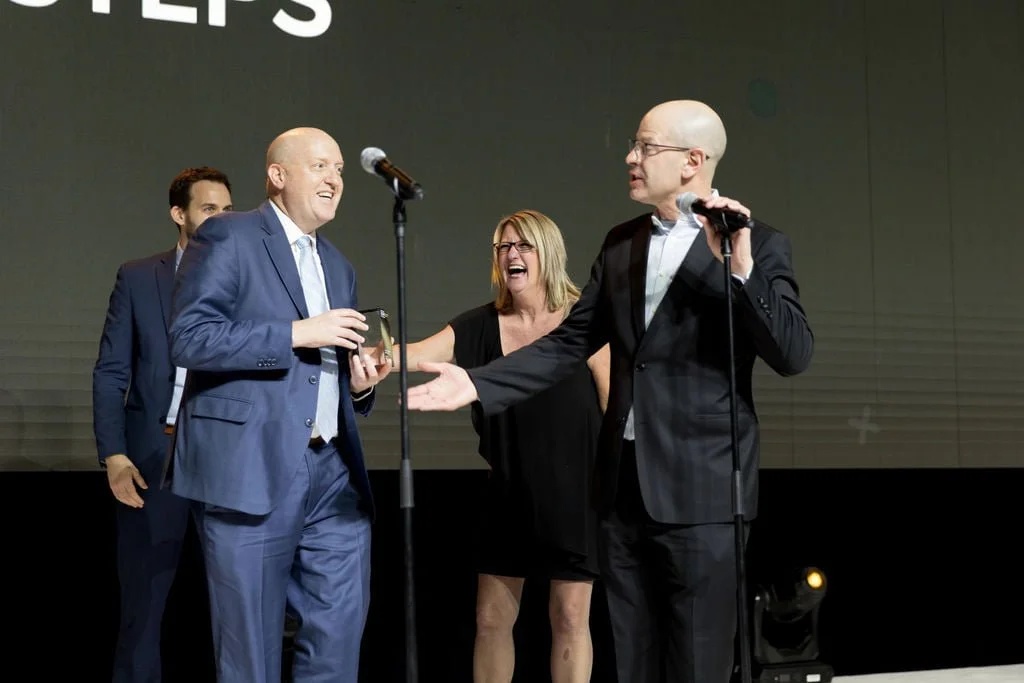
On September 10, ScreenSteps was named one of eight Best of Show winners. Finovate’s voting rules excluded people affiliated with presenting companies; the audience chose favorites based on demonstration quality and potential impact. It was an audience award for the company’s demonstration, a specific achievement rather than a blanket verdict on every possible use of its software.
DeVore’s follow-up article set out three jobs: getting procedures right, helping employees carry them out, and keeping them right as the institution changes. The examples came from credit unions, including Desert Rivers, where the company reports that new loan officers can originate loans independently after one week. Such customer accounts explain the attraction of the approach. They describe particular implementations, with their own starting points and circumstances.
On October 3, he appeared in CUbroadcast’s coverage of the Operations and Technology Councils’ Conference, discussing operational knowledge and AI-assisted work. His recent itinerary gives the long-running idea a concrete audience: the people who have to make a financial institution’s procedures usable on an ordinary working day. The stage changes. The next step remains the subject.
What the composer kept
It would be easy to describe DeVore’s career as an abandonment of music. Teaching composers is a better connecting thread. Before ScreenSteps, he was already concerned with helping someone get from intention to action inside a complicated tool. The software business gave that concern a different setting and a longer list of situations to solve.
His personal biography has a lighter register than the operational vocabulary might suggest. He lives with his wife and four boys, and jokes that this accounts for the number of broken things at home. There is a welcome distance between that household detail and the carefully maintained procedures he recommends at work. Even a documentation company’s CEO cannot certify the living room.
The portrait that emerges from his public work is of someone still teaching, with the lesson directed increasingly at the people who design other people’s jobs. Think about the employee’s task. Make the guidance usable. Leave an answer that the next person can retrieve. Those are modest instructions, but they demand attention from managers accustomed to treating documentation as a finished chore.
A score earns its keep when somebody can play it. For DeVore, a procedure earns its keep when somebody can use it while the work is happening. After more than two decades of building ScreenSteps, that is still the test he keeps bringing back to the desk.
Keep following the thread
Writing, conversations, and a seven-minute demonstration.