In Bandung, Yih Lin Teh sat down for coffee with a reseller who had a botanical theory of business. Pak Fian had been telling friends about Bipi, the company she co-founded, without waiting for a referral reward. A business needed many roots, he told her, if it was going to grow successfully. Teh remembered the conversation. For a founder, an unsolicited recommendation is a pleasing thing. A customer who explains your distribution strategy through horticulture is rather better.
The photograph from that meeting is agreeably unceremonious: two people, a row of windows, a spread of product catalogues. Teh is wearing a Bipi shirt and holding a purple leaflet. It belongs to an earlier chapter of a career now occupied with industrial air conditioning. The distance between household goods and semiconductor cleanrooms looks considerable. Both, however, involve paying attention to how a business actually works.

An economist gets closer to the machinery
Teh describes herself as an econometrician turned climate technology entrepreneur. Her education began in economics at the London School of Economics and Political Science, where she completed a bachelor's degree. By 2015 she was working as an economist at PwC in the United Kingdom. Before the factory controls came the work of understanding economic systems: numbers, incentives, constraints, the conditions under which an enterprise can operate.
Consulting at Dalberg brought her into contact with a more varied Southeast Asia. She recalls travelling through Ho Chi Minh City, visiting smallholder farms in rural Indonesia and seeing laboratories in Singapore. There was also the occasion she introduced her boss, Greg Snyders, to durian. The fruit's contribution to international consulting deserves a small footnote of its own. Teh recounts it as part of a growing attachment to the region.
At MIT Sloan, entrepreneurship already had a practical object. As a member of the 2019-20 Legatum fellowship class, she was working on CapSphere, an asset-based peer-to-peer financing platform in Malaysia. Small-business finance was part of her entrepreneurial life before energy controls entered it. The question then was how companies could get access to capital. Today, her work concerns a different resource passing through their accounts.
Reflecting on MIT, she singles out execution and real-world applicability. The institution's phrase Mens et Manus, mind and hand, suits that emphasis. Her own concise instruction is: “Don’t just think - build.” It is a useful sentence to keep beside an academic credential. A model eventually has to meet an actual customer, an actual building and the consequences of its decisions.
“Don’t just think - build.”YIH LIN TEH / ON HER MIT EXPERIENCE
The shop before the cleanroom
Axross was founded in 2021 and joined Y Combinator's Winter 2022 batch. Teh and fellow co-founder David Chew also built Bipi, an Indonesian business serving neighbourhood retailers and resellers. Its earlier offering helped warung owners access brand promotions, receive rewards and manage their stores through a phone. The reseller proposition opened another route to income through selling products to existing communities.
These were businesses close enough for a founder to sit beside a customer and hear how recommendations travelled. Pak Fian's enthusiasm mattered because it existed before a formal reward scheme. Teh wrote about being grateful for customers who supported the company through the shortcomings of its early days. There is a modesty in that account: the customer has something to teach the founder, and the founder makes room for it.
Her present company sells a very different kind of improvement. Axross develops AI-driven controls for industrial heating, ventilation and air conditioning. It is a Singapore-based company with roles in Kuala Lumpur and an ambition to serve manufacturing across Southeast Asia. Teh, its co-founder and CEO, now spends her time explaining why something as familiar as air conditioning becomes a demanding engineering problem inside a factory.
The air has a job to do
A cleanroom gives air a long list of responsibilities. Temperature and humidity must remain within specified limits. Particles have to be controlled. Pressure matters. Teh has described visits that required protective clothing and an air shower before entry. In such a place, the environment is part of the manufacturing process. An energy-saving idea has to respect everything that the air is being asked to maintain.
When she spoke about industrial HVAC at Intelligent Manufacturing Kuala Lumpur in May 2025, she pointed to systems running continuously, often with fixed schedules or manual settings. Her argument was that these arrangements leave opportunities for efficiency as operating conditions change. A production facility offers plenty of change: equipment starts and stops, doors open, outdoor conditions shift, and the cooling requirement moves with them.
Her preferred explanation is musical. Chillers, pumps, air handlers and valves form an orchestra of interdependent parts. Changing a setting in one place affects conditions elsewhere. In her analogy, AI takes the conductor's position, reading live information, anticipating demand and coordinating adjustments. The appeal of the metaphor is its insistence on relationships. A single instrument can play its part perfectly and still leave the ensemble sounding dreadful.
- 01 / ObserveSensors + building data
- 02 / AnticipateCooling demand
- 03 / AdjustEquipment controls
- 04 / RepeatMeasure conditions again
Axross adds control and optimisation layers to existing infrastructure. Building management data and IoT sensors feed the system; automated controls change equipment configuration and sequencing. The work therefore sits across software and physical equipment. A useful prediction needs reliable measurements, and a useful instruction needs a device capable of carrying it out. The elegance of the algorithm is only one part of the arrangement.
Teh calls the company's autonomous control system AXIOM. Ahead of SEMICON Southeast Asia in May 2026, she described its purpose as reducing consumption while maintaining temperature, humidity and particle requirements. Axross advertises realised HVAC energy savings of up to 30 percent. That figure concerns HVAC energy, with performance dependent on the facility. It gives her commercial argument a concrete form: improve how the system runs while protecting the conditions production requires.
Realised HVAC energy savings reported by Axross.
A company claim, specific to HVAC; results vary by facility.
The roles Axross is hiring for show what that work requires day to day. Its IoT engineers install equipment on site, maintain devices, troubleshoot problems and connect hardware with software. Data scientists develop models for real-time optimisation. These are different kinds of expertise, working on a system that needs both. The organisation has to join them together as carefully as the product joins measurements to decisions.
The commercial team has its own translation task. Axross is recruiting business development staff to expand its presence in Malaysia, Singapore and the wider region, turning industrial interest into engagements. Teh’s role sits across those activities. A customer’s requirements have to survive the journey from a sales conversation to an installation, and from an installation into continued operation. For an economist who became a founder, it is a particularly tangible place to work on the relationship between an idea and its value.
The useful thing about a previous career
The route into that work owes something to a coffee-shop meeting. Through the Imperial APAC Alumni Network, Teh met Jonathan Jing Kit Chin, then a chemical engineer at Shell who had worked on an oil rig in Miri. He was interested in startups. She noticed his curiosity and willingness to try something different. He joined Teh and Chew while pursuing computer science studies at Georgia Tech.
Teh credits him as one of the early people pushing AI-driven HVAC towards the centre of the company. As head of AI and data science, his earlier understanding of industrial systems became relevant to the new work. Her account treats that experience as an asset worth retaining. Pumps and heat exchangers do not become less physical when an AI model enters the room.
The recruitment pitch occasionally leaves the plant entirely. In one post, Teh sought engineers by inviting them to join the company's pickleball team. Technical depth, curiosity, persistence and cooperation all appeared in the invitation. She even offered a successful referrer a round of pickle, both the sporting and edible varieties. There are worse ways to discover whether prospective colleagues can manage a complicated return.
A pitch in Okinawa, a business across borders
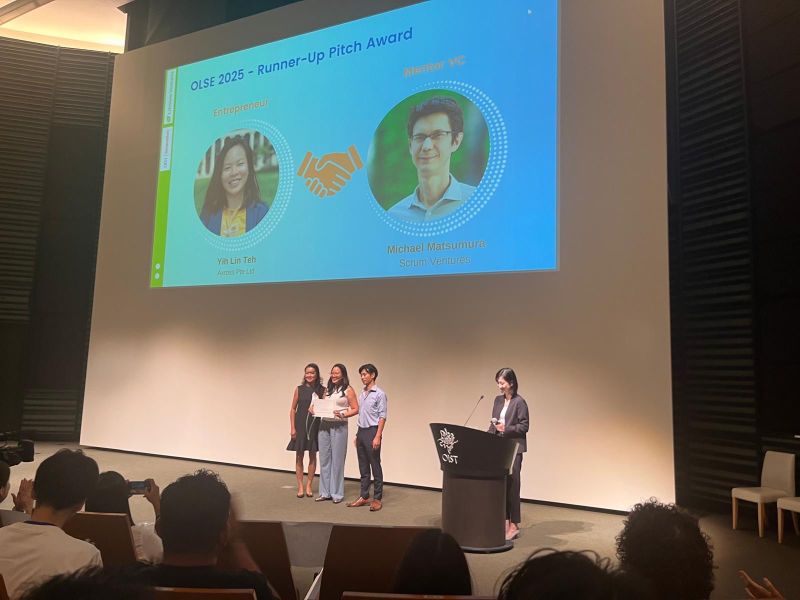
In September 2025, Axross received a runner-up pitch award at OIST-Lifetime Startup Elevate in Okinawa, paired with Scrum Ventures. Teh had presented its approach to industrial energy systems among deep technology finalists. Afterwards, her attention returned to the distance between a research idea and something customers can use. She also thanked a pitch mentor for helping her communicate without losing the technical substance.
By spring 2026, the CEO's hiring descriptions offered a view of the business behind the engineering. Regional expansion meant cross-border payments, tax considerations and financial operations across ASEAN countries. Commercial arrangements included multi-year contracts, project billing and performance-linked structures. She offered a finance recruit direct exposure to cash-flow management, commercial decisions and fundraising. Saving energy still requires a company capable of sending the right invoice.
Her regional ambition is explicit. She wants technology developed close to Southeast Asian manufacturing to help its factories become more efficient and competitive. In her view, cost-sensitive markets create an opening for solutions that can demonstrate a financial return. The economics training is audible here. A customer has to see how a proposed improvement fits the business, alongside the environmental case for making it.
In September 2026, Teh returned to the Y Combinator campus as an alumni founder. Reflecting on Axross's work, she recalled early scepticism about putting AI in charge of critical systems and described combining engineering models with neural networks. The question of trust had become central to the product. For the CEO, the next part of the story is making that proposition work across more facilities and more borders, with the air still doing its job.