At the end of an afternoon discussing leadership, Sam Sledge joined the lowest-scoring team at Topgolf. There were prizes for that distinction, too. It is a pleasing footnote to an executive address: the chief executive of a company built around precision equipment, accepting an award for a rather less precise application of force.
The October 2025 gathering offered a small glimpse of a larger subject. Sledge had spoken about self-awareness and the danger of operating on autopilot. Improvement, he argued, deserved more attention than comparison. Then came the golf. Corporate life occasionally supplies its own punctuation.
By then, he had spent four years running ProPetro. He had also spent considerably longer learning how to change positions. That habit runs through his football career, his progression through the company and the question now occupying its future: how does a business that uses enormous amounts of power become a business that sells it?
A childhood among the machinery
Sledge was born in Midland on January 21, 1987. His parents, David and Sandy, were Baylor graduates. At Midland Lee High School, he played tight end, competed in track and won a district discus championship. Academic recognition included membership in the National Honor Society and the Spanish National Honor Society. The early record contains both throwing things and doing the homework.
Oilfield services were familiar well before they became a profession. He describes himself as a third-generation participant in a family business history rooted in West Texas drilling. As a child, he spent time around welders, truck drivers and equipment yards. Returning to oil and gas after college appealed to him; the particular job was less settled.
That upbringing matters because the oilfield is often discussed from a distance, through prices and production forecasts. Sledge encountered its machinery and the people responsible for it first. When he eventually returned to Midland, he would have business degrees. He would still need to learn the work.
The position was negotiable
At Baylor, Sledge arrived as an invited walk-on in 2005. His football résumé accumulated positions: center, offensive guard, defensive tackle and special teams. In 2009, he was being used as an emergency center and a big slot, a backfield assignment that gave a lineman an unusually expansive job description.
His offensive line coach, Randy Clements, supplied a compact assessment: “He's a team guy.” Sledge eventually earned a scholarship. He also volunteered early for the offensive line's agreed Mohawk haircuts, getting his over the Fourth of July weekend. Solidarity can have unfortunate consequences for a barber's appointment book.
There is a temptation to turn every former athlete into a management parable. A different lesson emerges here. Sledge kept finding ways to be useful without insisting that usefulness come with one particular number or position. The willingness to move is more revealing than an inspirational speech about winning.
Different positions. More responsibility. One company since 2011.
A business degree, then the ground floor
He received both a BBA and an MBA from Baylor and joined ProPetro in 2011. His early roles included frac technical specialist and technical operations manager. The responsibilities were concrete: quality control, planning, logistics and helping develop the engineering program. A business school qualification did not exempt him from learning what happened around a pump.
Over time, the work moved toward finance, corporate development and investor relations. That combination gave him exposure to two kinds of consequence: what happens when equipment fails to perform, and what happens when the financial assumptions behind equipment fail to hold. The subjects belong in the same conversation, even when corporate organization charts place them on different floors.
In March 2020, he became chief strategy and administrative officer. ProPetro was changing its leadership structure, with Phillip Gobe taking the chief executive role and Adam Muñoz moving into senior operations leadership. Sledge's promotion brought another set of responsibilities into a career already spanning field and office work.
He became president in April 2021. In announcing the appointment, Gobe emphasized Sledge's knowledge of the business and experience across operations, finance, human resources, administration and communications. In August, the board named Sledge chief executive and a director, effective August 31. He was 34.
“I just kept raising my hand”
Sam Sledge, on his progression at ProPetro
The phrase is his own explanation of how the jobs accumulated. He has also stressed that several colleagues followed similar paths inside the growing business. It is a useful correction to the solitary executive portrait: a company expands through people taking on work that previously had no department, no established procedure or no obvious owner.
Buying a broader job description
Once Sledge was in charge, ProPetro's own job description began to broaden. In November 2022, it acquired Silvertip Completion Services, adding wireline perforating and pumpdown services in the Permian Basin. The transaction had an implied value of $150 million, with consideration including shares, cash and repayment of assumed debt.
Wireline and pressure pumping sit alongside one another in the work of completing a well. Bringing them into one business offered a way to serve more of a customer's needs. ProPetro also divested its coiled tubing assets. Growth involved choosing which services belonged together and which assets could leave.
The fleet itself was changing. During 2023, the company placed its first two FORCE electric fleets into service. Its 2024 proxy described approximately 60 percent of the fleet at the end of 2023 as next-generation electric or Tier IV dual-fuel equipment. This was a replacement program with machinery, delivery schedules and customer contracts attached.
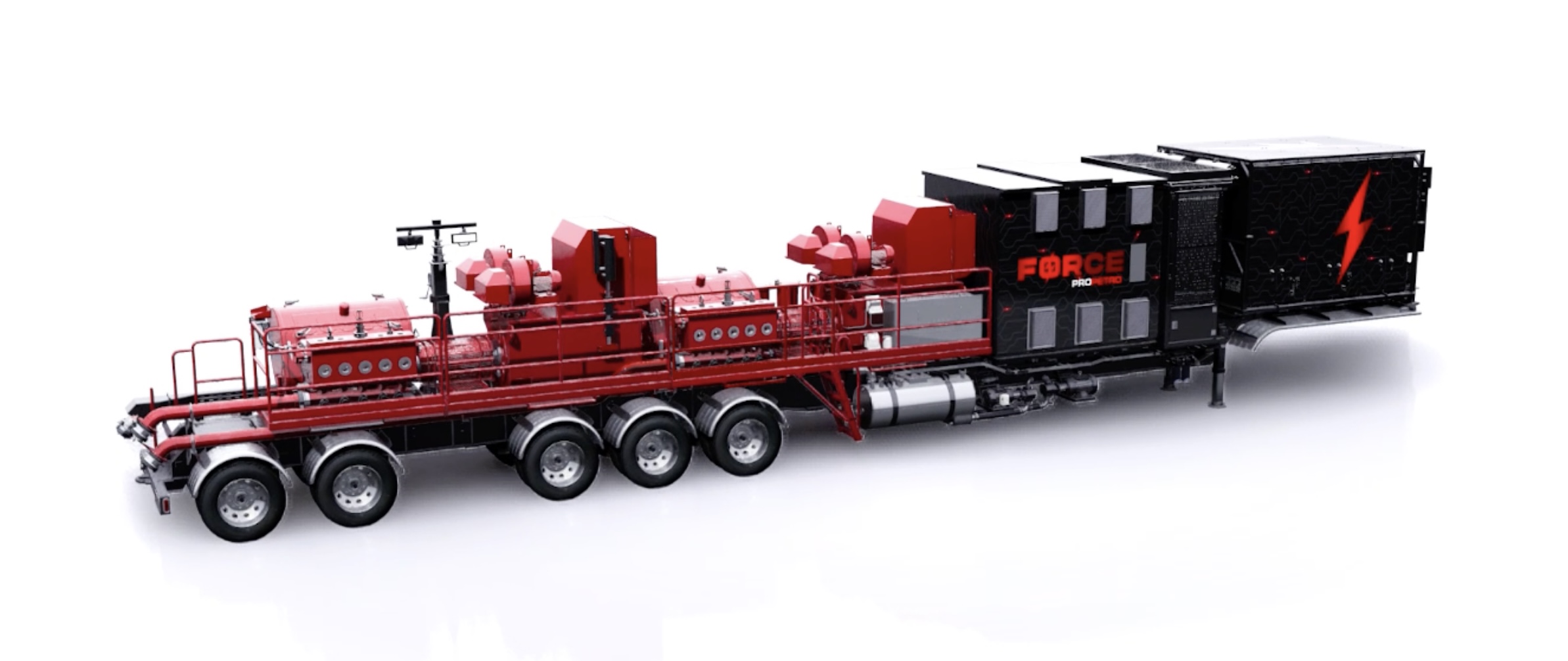
The truck makes the scale easier to picture. Its two independent pump systems provide redundancy on a single trailer. Around it sit the blender, power distribution equipment and data van. The operating problem includes coordinating all of those parts; a powerful motor is only one participant.
Electric also describes how the equipment is driven, rather than promising that its electricity has a particular origin. ProPetro's early electric deployments used natural gas-fueled mobile generators. The company presented the shift as a means of displacing diesel and reducing costs and emissions. Those claims depend on the configuration and fuel supply, which helps explain why power became such an interesting adjacent business.
From consuming power to supplying it
In the fourth quarter of 2024, ProPetro formed ProPetro Energy Solutions, doing business as PROPWR. Its proposed customers extended beyond oil and gas to industrial projects and data centers. At year-end, it had ordered equipment but had not begun revenue-generating activities. The new business started with a plan and a procurement schedule.
The wider company was operating through an uneven period. Full-year 2024 revenue was $1.4 billion, down 11 percent from 2023, and it reported a $138 million net loss. Four FORCE fleets were operating under contract by the time it reported those results. Fleet modernization and commercial uncertainty were happening together.
By the second quarter of 2026, the plan had operating evidence: assets were deployed at a Midwest hyperscaler data center. ProPetro reported quarterly revenue of $306 million and an $8 million net loss. Sledge also acknowledged unexpected downtime on a temporary out-of-basin frac deployment, fleet startup costs and severe June weather in the Permian.
Those details keep the story attached to the ground. A new market does not cancel the demands of the old business. Teams still have to move equipment, establish a location, keep it working and manage interruptions. The work behind a power contract is considerably longer than the announcement.
September 22, 2026Contracted capacity includes future deployments.
September brought contracts committing approximately 230 megawatts to a Targa Resources subsidiary. PROPWR's total committed capacity stood at approximately 510 megawatts, reflecting some previously announced oil and gas capacity that was no longer committed. Full deployment for Targa was expected in early 2028. These are commitments with future work attached, rather than a reading of today's electricity output.
For Sledge, the opportunity places a familiar skill in a broader market: organizing equipment and people to deliver dependable service at a customer's site. The customers may now include businesses whose end product is computing. The operating obligation remains insistently physical.
Keep the learner in the job
In discussing leadership with Oilfield 360, Sledge has encouraged young professionals and interns to think of themselves as learners before attaching themselves to a single profession. Curiosity and a range of experiences, in his account, make it easier to connect with other people. It is advice that fits a career spent crossing departmental boundaries.
 WATCH THE CONVERSATION ↗
His interests also extend beyond the company boundary. He chaired the Energy Workforce & Technology Council for 2025-2026 and became immediate past chair in March 2026. In an August conversation with Tracee Bentley and Krista Escamilla, he discussed the Permian's future, including education, workforce development, infrastructure and collaboration between industry and communities.
Those subjects suit someone whose professional story keeps returning to Midland. A business can buy equipment more readily than a region can develop the people and institutions needed to sustain it. His stated interest in education places the next generation of workers within that larger picture.
There is no need to make the golf score stand for too much. Some afternoons simply end with poor golf. But the willingness to collect the prize, return to work and keep learning belongs comfortably in this story. Sledge has spent years accepting a different assignment. Power is the next one.
Keep the conversation going
- ProPetro · company website
- Sam Sledge · LinkedIn
- Navigating Permian · Caterpillar interview
- Oilfield 360 · watch the August 2026 conversation
- Flipping the Barrel · watch the 2024 interview
- The Permian’s future · podcast with Tracee Bentley
- Targa power contracts · September 2026
- ProPetro financial results · Q2 2026
- Baylor · the 2009 football story
- ProPetro · company LinkedIn
- ProPetro · company Instagram
- ProPetro · company X account
- ProPetro · company Facebook