In the spring of 2020, three Cornell students looked at a world of closed doors and decided the immediate problem was introductions. Sam Brickman, Jordyn Goldzweig and Alisa Lai already had Zing, a product designed to help students in large classes find classmates they might actually talk to. Then classrooms vanished. The team rebuilt the idea for a lonelier setting, pulled two all-nighters, and called the result Quarantine Buddy. Six hundred people signed up early. Within weeks, the number reached 6,000 across 43 countries. By July, Brickman was talking about roughly 30,000 people in more than 120 countries. A system created for unfamiliar faces in a lecture hall had escaped the lecture hall completely.
There is a clean line from that sprint to Ambral, the company Brickman now runs with co-founder Jack Stettner. It is not a line through industries. Campus software, breakfast delivery, consumer operations and enterprise account management make for an untidy LinkedIn collage. The continuity is attention: who receives it, who misses it, and what software can do before somebody quietly drifts away.
The first account was a classmate
Zing began with a modest social discomfort. In a big introductory course, everyone can become familiar without becoming known. Brickman and Goldzweig recognized the absurdity: hundreds of potential study partners, all sitting within whispering distance, and many students still would not ask for help. Their team interviewed more than 300 students at Cornell, Binghamton, Columbia, Syracuse and New York University. Brickman said 76 percent would not simply approach another student and begin a conversation.
The product matched small groups using courses, interests and hometowns, then made the introduction. Four Cornell classes piloted it. Zing won a $5,000 prize and automatic eLab placement at an Entrepreneurship at Cornell kickoff event in 2019. The interesting part was not the algorithm alone. The team had identified a tiny unit of social friction and treated it as a design problem.
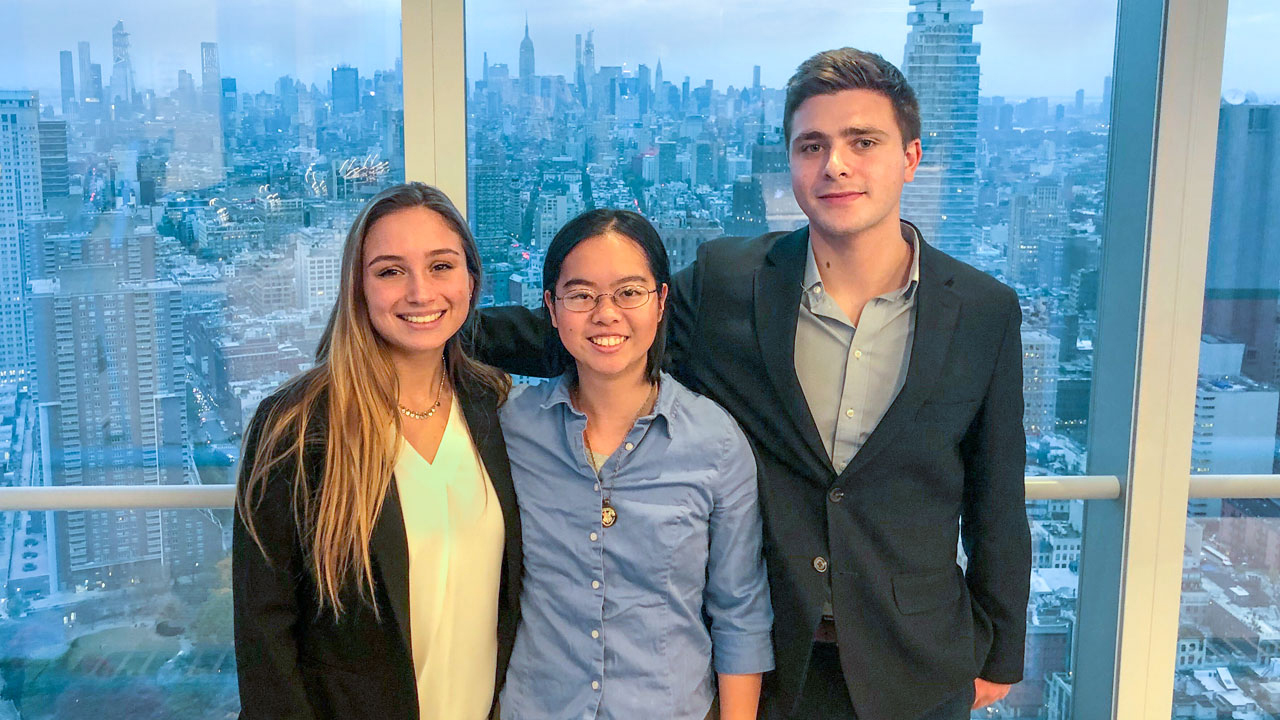
Quarantine Buddy changed the matching goal. Zing looked for useful similarity. Its offshoot could favor difference, pairing people across ages, interests and places. One early match connected a college student whose mother worked long shifts with a 77-year-old widow. Another connected two musicians who sang and wrote together over Zoom. The software worked, then disappeared and left two people with something to say.
We had to be the ones to attack this problem and solve it.Sam Brickman, on building Zing
An introduction travels
Publicly reported participation milestones in 2020. Later founder material describes more than 100,000 daily active users as the platform continued to grow.
The manual work leaves a map
Brickman had already learned the less photogenic side of company building at Suna Breakfast, a Cornell startup where he served as chief technology officer. He has described waking at 4 a.m. for a year to deliver breakfast to customers. The business was acquired near the beginning of the pandemic. Meanwhile, his college platform spread around the world, and Brickman personally handled support from his phone across 167 countries. He jokes that some users still call.
There is a temptation to file these details under founder folklore: no sleep, ringing phone, improbable logistics. The useful reading is more practical. Manual service gives a founder a dense model of the customer. He remembers the odd request, the failed delivery, the person behind the complaint and the moment a small intervention saved the relationship. Growth thins that memory. The queue expands; the context fractures; the customer becomes a row.
After Cornell, Brickman became an early product hire at Wonder as the company grew its early revenue. He later led AI product at Everlywell. Different businesses supplied the same organizational physics. A small team can know nearly everything about its first customers. A large one stores pieces of that knowledge in sales software, support tickets, meeting transcripts, product logs, messages and the recollections of whichever colleague happens to be online.
Suna Breakfast and Zing put Brickman inside delivery operations, product research and classroom matching.
Quarantine Buddy takes the matching idea global; the Kessler Fellows program gives the team a summer to work on it full-time.
Product roles at Wonder and Everlywell expose the limits of customer context inside growing organizations.
Brickman and Stettner found Ambral and join Y Combinator's Summer 2025 batch.
Ambral expands enterprise deployments, announces its ShipBob partnership and grows its engineering team.
Mission control for the overlooked account
Ambral begins where founder memory stops. It connects customer information from the scattered systems where companies keep it, resolves identities across those systems, and builds a continuously changing model of each account. The platform is designed to tell a team which customer needs attention, why the moment matters, and what to do next. For smaller accounts with no dedicated human manager, its agents can take on more of the work, from preparing reports and action plans to drafting outreach. Companies can require human approval or let selected actions run autonomously.
Brickman calls the product an AI account-management army. The military language is lively; the actual job is clerical, analytical and social all at once. A renewal risk may hide in a support conversation. An expansion opportunity may appear in usage data. A change in sentiment may be visible across three systems and obvious in none. Ambral's wager is that a machine can hold the whole account in view long enough for a human team to make a better decision.
From scattered signal to timely action
The product's logic is less chatbot, more control room: assemble the evidence, model the account, then decide where attention belongs.
Stettner makes the control-room analogy unusually literal. Before Ambral, he worked on SpaceX flight software and telemetry systems. He and Brickman had been Cornell roommates. One brought years of repeated exposure to customers and product decisions; the other brought experience finding consequential signals inside demanding technical systems. Their old apartment did not come with a term sheet, but it did provide an extended co-founder interview.
The company arrived at Y Combinator in the summer of 2025 with an early idea. Stettner had left SpaceX days before and drove across the country with his belongings. Brickman flew west with a backpack. Six months later, Ambral had raised a round, moved into a New York office and begun working with large enterprises. The company now lists a four-person team and roles in New York and San Francisco.
A small team with a long memory
Ambral has since announced a partnership with ShipBob, the global fulfillment platform. Within weeks, the system went live across ShipBob's merchant base, supporting account reviews, planning, churn detection and expansion work. Kevin Marvinac, ShipBob's vice president of strategy and operations, compared it to a senior personal analyst doing months of work overnight for every account. The comparison lands because it describes leverage without pretending context is simple.
The Ambral team also uses AI as internal infrastructure. Brickman describes an operating style built around outcome-based agents, prototypes in place of long documents, and rapid iteration in place of bureaucracy. Anthropic included the company in a 2026 playbook on AI-native startups. The point is not merely to write code faster. A four-person company serving enterprises has to compress research, operations and coordination too.
AI makes execution cheaper, but it does not make judgment cheaper.Sam Brickman, on hiring in the AI era
That belief shapes hiring. Brickman looks for engineers who have reached a serious level in something beyond engineering: an instrument, a sport, chess, craft or commerce. Technical skill remains necessary. Outside mastery offers evidence of taste built through repetition and public feedback. It is a revealing standard from someone who played varsity football and tennis, sang a cappella and joined a science research program before studying computer science at Cornell. His own résumé has always wandered beyond the terminal window.
Judgment is the hinge in Ambral's promise. Detecting a signal is only useful if the system understands which one matters. Automation is only welcome if it acts with the right context and restraint. Customer intimacy, in this formulation, is less about sending more messages than remembering why a message deserves to exist.
The long tail has a face
Brickman's projects keep returning to people outside the obvious circle of attention. The student without a study group. The stranger looking for conversation. The customer too small to merit a dedicated account manager. Each lives in what businesses politely call the long tail, a phrase that turns individuals into a shape on a chart. Brickman's work asks what happens when software looks again.
Ambral's ambition is to make the attentiveness of an early founder available after the founder's phone would otherwise melt. It is a difficult balance. Relationships depend on judgment, timing and an awareness of what should remain human. But Brickman's biography has prepared him for precisely this tension. He has built matching systems and made the introductions. He has done the deliveries. He has answered the support calls. Now he is trying to turn those habits into infrastructure.
The lesson is pleasantly unfashionable. Before automating attention, pay enough attention to know what good feels like. The 4 a.m. alarm, the 300 student interviews and the phone calls from faraway users were not detours from the software. They were the specification.
Continue the thread
Follow Brickman's current work, see Ambral in action, or revisit the campus project where the pattern first became visible.