The beanbag was doing quite a lot of work. In the public picture of Sam Bankman-Fried, it helped explain the hair, the shorts, the apparent indifference to the ordinary furnishings of wealth. Here was a financier who could sleep beside his desk. Surely someone so unconcerned with comfort had more interesting things to do with money. The furniture became part of the argument.
By 2022, the co-founder of FTX had acquired something more useful than a recognisable silhouette. He had acquired permission to be believed. Investors backed his exchange. Politicians heard him out. Celebrities helped sell its name. His declared ambition was to make money in quantities large enough to give away. For a while, the ambition seemed to explain almost everything.
Then customers asked for their money back. FTX filed for bankruptcy in November 2022. A jury convicted Bankman-Fried of seven fraud and conspiracy offences in November 2023; a judge sentenced him to 25 years in March 2024. His story now has a distinction that the promotional version lacked: a court has determined what happened to the money.
A physics student with a practical question
Bankman-Fried grew up around Stanford University, the son of law professors Joseph Bankman and Barbara Fried. Arguments about consequences and moral obligations belonged to his childhood surroundings. His younger brother, Gabriel, shared that academic family world. Before there was an exchange or a fortune, there was a household in which what a person ought to do was a question worth discussing.
At MIT, he studied physics, graduating in 2014. A small surviving detail from his student years offers a less familiar introduction. As a freshman, he taught a class for MIT's Splash programme on electromagnetism, advertised with the subtitle “how not to build a railgun.” The description promised an account of how one might attempt such a device, and why the attempt might fail. He was already interested in explaining how things worked.
During college, he encountered the philosopher William MacAskill and effective altruism, a movement that asks how resources can do the most good. One proposed route was “earning to give”: take a well-paid job, then donate substantial earnings. For a student comfortable with numbers, it offered an unusually direct connection between career choice and moral ambition.
After MIT, he joined Jane Street, the trading firm where small differences between prices could become a business. He later said he gave away roughly half his earnings. The work also introduced him to Caroline Ellison, who would eventually lead Alameda Research. Finance supplied both a method for making money and a network of people who would follow him into cryptocurrency.
The gap between two prices
In 2017, Bankman-Fried and Tara Mac Aulay started Alameda Research. Cryptocurrency markets offered opportunities a conventional trading desk might have found difficult or inconvenient to pursue. A bitcoin could command different prices on different exchanges. Buy where it was cheaper, sell where it was dearer, and the difference might pay for the trouble.
Japan became an important part of that early business. Bankman-Fried later explained that restrictions on moving capital limited the Korean opportunity, while Japanese banking transfers allowed more scale. The attraction was practical. He did not need everyone to agree on bitcoin's future value to make money from two markets disagreeing about its price today.
The story has the appeal of a clever answer to an overlooked problem. It also contains a detail that the later mythology tended to flatten: moving money between markets required banks, counterparties and operational work. Even an ingenious trade has plumbing. Its profit depends on the pipes remaining connected.
FTX, which he co-founded with Gary Wang in 2019, moved him from trading on markets to operating one. Alameda and the exchange were different businesses with different responsibilities. A trading firm takes positions. An exchange holds assets for people who expect to be able to withdraw them. The relationship between those businesses would become the central fact of his career.

Shorts, sponsors and a $32 billion valuation
In January 2022, FTX raised $400 million at a $32 billion valuation. SoftBank, Temasek and the Ontario Teachers' Pension Plan participated in the round. These were institutions with reputations of their own. Their presence made the young founder's unusual appearance easier to read as a charming exception to the usual rules of business.
The company bought visibility beyond the trading screen. Its name went on the Miami Heat's arena. Tom Brady became associated with the brand. Larry David appeared in its Super Bowl advertisement. A complicated financial service was acquiring familiar faces, an efficient way to make something unfamiliar feel like part of everyday life.
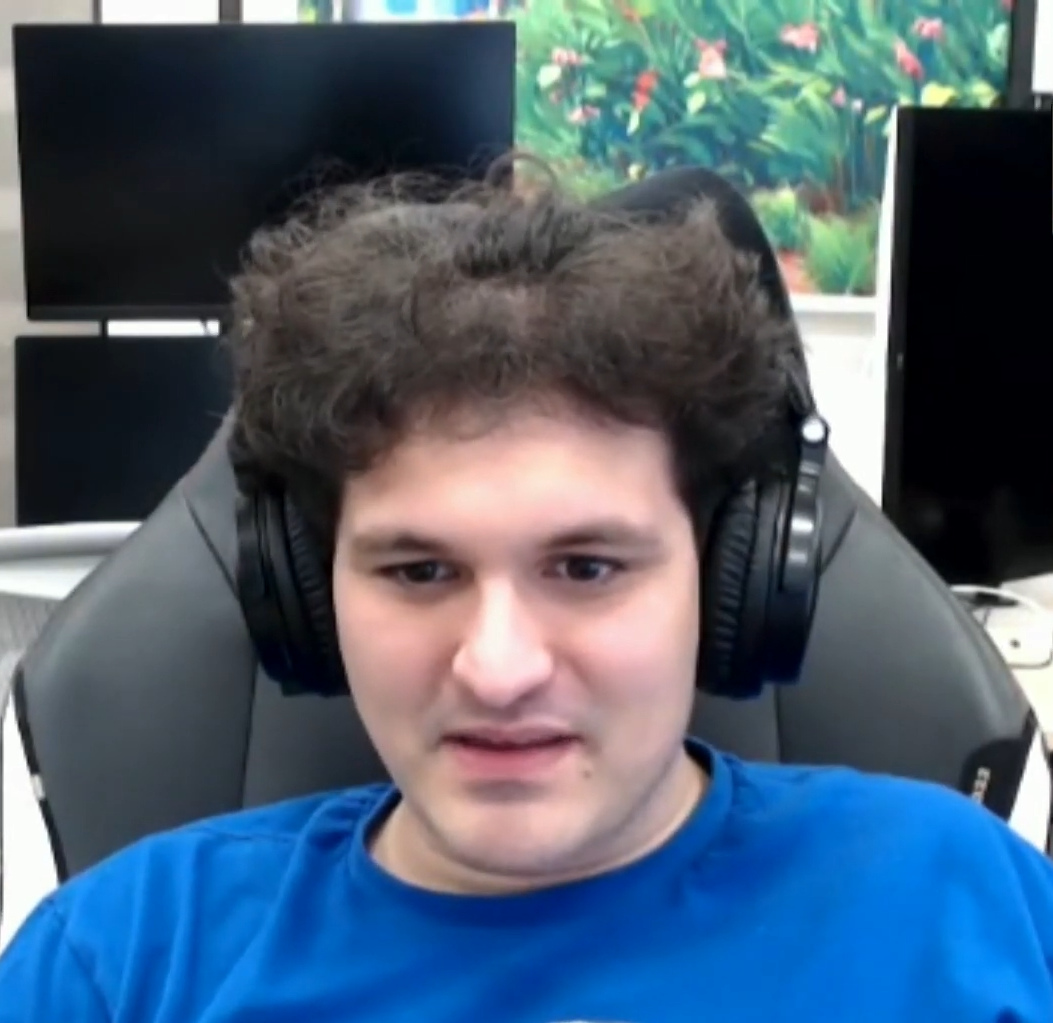
Bankman-Fried supplied the complementary image: someone apparently too busy thinking to bother with presentation. He wore shorts and T-shirts. He liked League of Legends; he played during a pitch to Sequoia investors. A beanbag near a desk could look like evidence of dedication. In another setting, it might simply have prompted a conversation about office furniture.
His interviews from this period preserve the confidence. In August 2022, he spoke with David Rubenstein about cryptocurrency, support for struggling companies and his limited interest in luxuries. The charitable ambition and the business ambition fitted together neatly. More business meant more resources for good causes. Success could be narrated as a public benefit.
The difficulty with this story was its dependence on the teller. Being personally casual about wealth says very little about how a business safeguards other people's assets. A customer could admire the philanthropy and still need an entirely separate answer about custody, conflicts and withdrawals. Those questions had become easier to overlook.
The exception inside the exchange
FTX customers were told their deposits were safe and separate from company assets. Alameda received privileges that contradicted that reassurance. At Bankman-Fried's direction, the exchange's code was altered so the trading firm could withdraw funds on an effectively unlimited basis. The special treatment was hidden from the people whose money made it possible.
Here the story becomes less mysterious than its cryptocurrency vocabulary suggests. Money entrusted to the exchange moved to a related trading firm. It was used for investments, political contributions, property and the repayment of Alameda's lenders. False financial information helped conceal the arrangement. The destination of the funds mattered more than the founder's public explanation of his ambitions.
The mechanism established in the criminal case. This diagram shows destinations, not proportional amounts.
When Alameda's lenders demanded repayment during the 2022 market downturn, customer funds helped meet those demands. What looked from outside like distinct pockets of a financial group were connected in ways customers had not authorised. A balance on a screen could remain reassuring while the money behind it was being used elsewhere.
The November collapse made that gap impossible to ignore. Bankman-Fried resigned as chief executive on November 11, when FTX sought bankruptcy protection. John J. Ray III took over. The founder who had offered assistance to other troubled crypto businesses could no longer meet the demands facing his own.
He kept explaining
Many defendants disappear from public conversation behind a lawyer's statement. Bankman-Fried continued talking. On November 30, 2022, he appeared by video at the DealBook Summit and answered Andrew Ross Sorkin's questions. “I didn't knowingly commingle funds,” he said. It was a denial with a word doing conspicuous duty in the middle.
“I didn't knowingly commingle funds.”
Sam Bankman-Fried / DealBook Summit, November 2022
He acknowledged mistakes while denying intentional fraud. After his arrest, he used Substack to publish a further account of the collapse. Charts and explanations returned him to a familiar position: the technically fluent person telling everyone else how to understand the numbers. The continuing explanations also made his account available to be tested against other evidence.
At trial, former colleagues supplied a very different picture. Ellison, Wang and Nishad Singh cooperated with prosecutors. People who had helped build and run the businesses described their internal workings. The case brought together testimony, records and computer code. The founder's account faced the accounts of people who had been in the room.
The jury convicted him on November 2, 2023. At sentencing the following March, Judge Lewis Kaplan imposed 25 years in prison and a forfeiture order exceeding $11 billion. The consequences could be expressed in years as well as dollars. Neither unit offered much room for the easy informality of the earlier public image.
A petition, and the original question
Bankman-Fried has continued to contest the outcome. In April 2026, Kaplan denied his motion for a new trial. On June 12, the Second Circuit affirmed the judgment against him. He then petitioned the Supreme Court on September 10. As of October 23, 2026, the government's response was due November 16; the Court had not granted review.
That leaves a life once measured in funding rounds moving through a different calendar: motions, decisions and response dates. His declared early aspiration, to earn enough to give away on a vast scale, remains part of the biography. So does the work of the colleagues who helped him build the businesses and later testified against him.
What gives the story its hold is how readily the appealing details seemed to answer the hard questions. The physics degree, the charitable language, the shabby clothes and the sophisticated investors were all real parts of the picture. None established that a customer's deposit would stay where it belonged. The beanbag never had an answer to that.