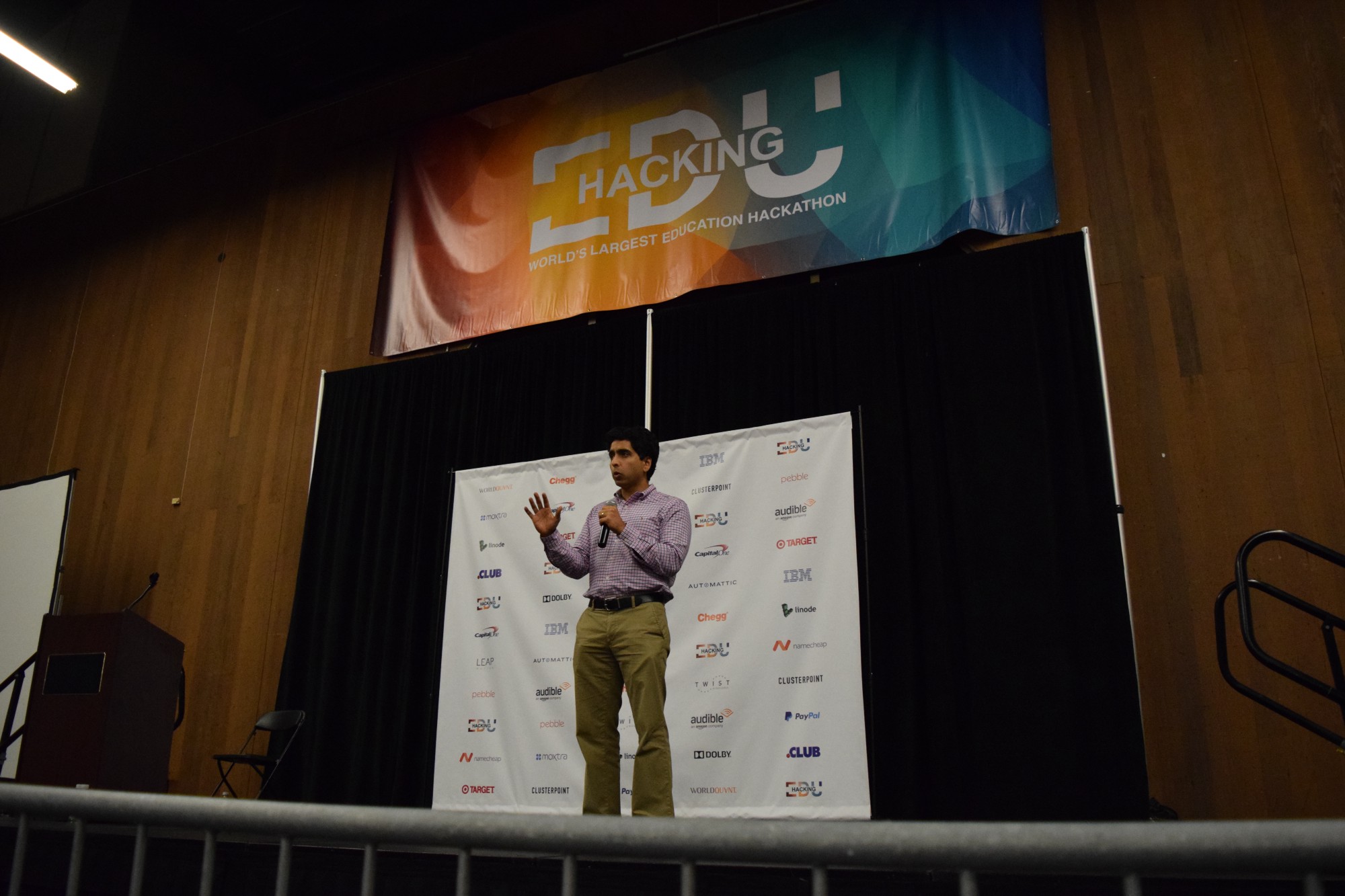
For most of his public life, Salman Khan has been the sunniest man in American education. He built Khan Academy from a set of homemade math videos into a nonprofit that reaches roughly 100 million learners a year. He wrote one of the first AI tutors in the world. His last book, Brave New Words, made the case that artificial intelligence could be the greatest thing to ever happen to teaching. So when a man like that leans across a podcast table and admits, quietly, that he is "increasingly worried," it is worth putting down your coffee and listening.
"Most of not just my books, but most of the things I've ever said, I tend to be pretty optimistic," Khan tells his host in a wide-ranging conversation recorded in the heart of Silicon Valley. "But I am increasingly worried." The reason has a title. His next book is called Job Shock, and it is not a victory lap. It is an argument that the wave of automation now cresting over the economy is not a repeat of any revolution we have survived before — and that pretending otherwise is a mistake we cannot afford.
The Waymo and the Call CenterTwo futures, arriving at once
The turning point, Khan recalls, came a few months before the interview. A college friend — now a prominent venture capitalist in Los Altos — asked to talk about reskilling. Driving to the meeting, Khan passed the Waymos gliding driverless through the valley. "I'm like, oh, that's interesting. This is cool. Look, I live in the future," he remembers thinking. Then he arrived, and his friend told him that one of the firm's portfolio companies had just automated roughly 80% of a call center's workforce — hundreds, maybe thousands of people in the Philippines — with a single generative-AI solution.
That juxtaposition is the whole book in a single afternoon. The convenience of the self-driving car on the way there; the vanished jobs waiting at the destination. Khan is careful to name the stakes. In the Philippines, he points out, business-process outsourcing — mostly call centers — accounts for something like 5, 6, or 7 percent of GDP. "If this becomes a trend, and there's a lot of reason to think it will over the next 3 to 5 years, what are all those people going to do?"
He loves the Waymos. He interviewed co-CEO Tekedra Mawakana at TED and believes autonomous vehicles will save lives. But he cannot un-see the human ledger. "My uncle's also an Uber driver in New Orleans. What's he going to do? That's not people's first choice job. It's usually their last choice job." Driving, Khan notes, is one of the largest employers of men on the planet — and idle, angry men have a way of reshaping politics.
This is where Khan breaks from the comfortable consensus. The reassuring line — that the Industrial Revolution destroyed jobs but created more — gets no free pass from him. "We can't just be like, 'Oh, the Industrial Revolution turned out okay. More jobs,'" he says. "First of all, the Industrial Revolution also had many wars. The 20th century was the bloodiest. We experimented with communism. We experimented with everything. A lot of these things didn't go so well." His point is not that AI dooms us. It is that "things worked out eventually" is what you say after the bloodiest century in history. This time, he argues, we should have a plan.
The BlendingEven the safe jobs are shifting
Ask Khan which jobs are in danger and he does not flinch toward the obvious targets. Drivers, call-center staff, customer support — yes. But then he turns the lens on the very town he lives in. "The writing's on the wall that software engineering, design, product management — these product jobs in all of these tech firms, including at Khan Academy, are changing fundamentally."
Pressed on whether those workers will end up on the street, Khan refuses the easy comfort. "I'm not sure. I'm genuinely not sure." What he is sure of is that the neat divisions of the early-2000s web era — designer here, product manager there, engineer over there — are dissolving. At Khan Academy, designers and product managers are now being handed full development environments so they can open pull requests and deploy code. Engineers, freed from grunt work, are drifting toward customer-facing roles. "These things are all blending," he says. The deep specialist engineer will always have value, "but I think you're also going to see a breed of engineer that can go more customer facing."
So which jobs are actually safe? Khan's answer is consistent and, in an age of chatbots, almost old-fashioned: the human ones. "The people I think are safe are the people who really lean into the human element of it." Teachers top his list — not as "the sage on the stage" dispensing facts, a role textbooks and videos rendered optional long ago, but as planners, architects, coaches and motivators. Nursing, hospitality, and genuine relationship-based sales follow. The salespeople who survive, he says, "aren't like sales people. They're actually smart, thoughtful people where you actually respect their opinion" — the kind who will tell you their product isn't right for you.
Inside the MachineA $1.2 million AI bill — and no layoffs
Khan is not theorizing from the sidelines. Khan Academy is, by Anthropic's own account, near the top of the stack of organizations leaning hardest into AI tools. The numbers he shares are startling. The organization's annual Anthropic bill, he says, runs about $1.2 million and is "growing fast" — roughly the tooling cost of 200 engineers. Some of his engineers now run five, six, seven, eight, nine, ten agents at once, writing and reviewing code in parallel.
One anecdote lands like a thunderclap. His CTO flagged an engineer who had burned $3,000 of compute in a single day. Khan's first reaction was alarm — "what are they doing?" Then came the explanation: in a few hours, that engineer had finished work that would normally have taken three or four months. "Okay, that was a great use of $3,000," Khan concluded. "Go go spend more." (He does draw a line: in a company meeting, he reminded staff to stop using the premium Opus model to pick a local restaurant.)
Naturally, a 350-person team — two-thirds of them product people — hears "be three times more productive" and wonders whether two-thirds of them are about to be shown the door. Khan's answer to them is the emotional core of the interview, and he delivers it flatly, as policy.
The only thing that would force layoffs, he says, is money — a shortfall in philanthropy or earned revenue — never the arrival of a better tool. "If you can automate yourself out of a job," he tells his people, "we're going to give you a better job with better pay." But there is a condition baked into the deal: adaptation is now mandatory. Khan Academy has written "learning new tools and adapting" directly into its career rubric. Most of his team, he senses, is already there or eager to get there. A few are not — "I don't know if I like this, I don't know if I want to do this" — and it is those workers, unwilling to change, whom he quietly counts among the vulnerable.
The velocity is real. Features that once would have been slotted for "maybe next school year" now get vibe-coded at a hackathon in a day and shipped in a month. Proposals that took a week to draft now emerge in first form within ten minutes of a meeting ending. Khan's own research time for his financial-literacy videos has collapsed — though he insists on verifying every AI claim against a real source before hitting record. "Oh, it's from IRS.gov. All right, I will now make that video." His estimate of the organization's overall speed-up? "At least 50% faster, maybe 100% faster than we were" — and accelerating.
The $10,000 DegreeReinventing the diploma
If Job Shock is the diagnosis, the Constellation Institute is Khan's prescription. Announced at TED and built with TED's outgoing steward Chris Anderson and testing giant ETS, it is an attempt to reinvent the degree itself for a world where the old signals no longer signal much. The ambition is audacious on price alone: an accredited bachelor's or master's degree for a maximum of $10,000 — and Khan says they intend it to cost "a good bit less than that." Because it is competency-based, a motivated student might finish in two years instead of four, banking the opportunity cost as extra earning years.
The response has been immediate. In just two or three weeks, about 3,000 people expressed interest in enrolling — and, tellingly, most already hold bachelor's degrees, many a master's. "You can sense the fear that they have," Khan says. They are not first-time students. They are professionals afraid of becoming irrelevant.
The design is where it gets interesting. Beyond a traditional academic core — history, civics, accounting, statistics — the heart of the program drops students into live group simulations. On a video call with four hours on the clock, a team might have to build a business: create a prototype, make an ad, write the plan, survey customers, run competitive research. Afterward, peers review not just the output but each other — on communication, collaboration, creativity. These are the "durable skills" that Khan, borrowing the ETS framework, keeps returning to: communication, collaboration, creativity, critical thinking, with sub-frameworks for things like leadership. Skills, in other words, that a chatbot cannot fake on your behalf.
The payoff, Khan argues, is a fundamentally different resume. Consider a Stanford graduate with a 3.9 GPA, he says. "Probably smart, got into Stanford, good GPA. I don't know if those skills they learned are going to be directly transferable." Leadership? You're guessing from whether they captained the lacrosse team. Contrast that with a Constellation graduate who ranks in the top 10% of communication, collaboration and critical-thinking skills — backed by video artifacts of them actually doing the work, rated not by one interviewer but by 50, 60, a hundred peers. Khan's bet is that employers will come to treat that signal as at least the equal of an elite degree.
He is candid that the choice to partner with aspirational employers is strategic. Higher education, he observes, is brutally polarized: elite universities that reject the vast majority of qualified applicants at one end, and online programs still fighting a stigma at the other. Constellation is meant to prove a third path exists — online yet intensely human, cheap yet high-signal — usable both by ambitious students who got a full ride to San Jose State and want an edge, and by those who will never set foot on an ivy-covered quad.
The Existential QuestionCould AI just build another Khan Academy?
The host asks the question hovering over the whole enterprise: in three years, couldn't AI simply build another Khan Academy by itself — no humans required? Khan gives two answers, and he is refreshingly honest about the order. "My emotional ego response is, yeah, I do worry about that," he admits. You could vibe-code something that looks like Khan Academy, but not, he argues, with the rigor, the efficacy data, the hard-won school-system data-privacy agreements, or the real-world proof that it works.
Then comes what he calls "the correct answer," the one he repeats to his team. If someone builds a solution as good as — or better than — Khan Academy, and can actually prove it, then as a nonprofit "we should be happy about that. We should say, good. One of the many problems in the world has now been solved. What other problems are there to be solved?" And there are plenty: real standardized assessment with genuine psychometrics, high-school credentials, credit recovery, pathways into jobs. These, he notes, are exactly the unglamorous, years-long problems that markets tend to ignore — "it's a lot of work, and it'll take years to get the right psychometric validation" — which is precisely why a tech-focused nonprofit should own them.
The AdviceWhat to actually do on Monday
For all the alarm, Khan closes on something usable. Asked how much time an Uber driver watching has, he estimates a "real dent" in five to ten years — slower than the evangelists claim, but "before your kids go to college." The dislocation, he predicts, will start showing up for real within four or five years, even as modest four-or-five-percent unemployment in certain sectors. That may sound survivable, but "that will be very painful," and it will bleed into politics. His warning to industry, government, and the nonprofit sector is blunt: start building solutions now, "because the AI is accelerating. If we don't start having some solutions to scale at that point, we're going to be in trouble."
What can one person do? Overcome the activation energy. "None of this stuff is rocket science," he says. Look at your own workflows, spot the thing you do over and over, and build an agent to do it — carefully, in a sandbox, with you in the loop. He shares the prompt that reshaped the host's week: ask your AI to analyze your inbox and calendar and name the top five repetitive tasks worth automating. And he offers a hard-won caution about the machines' bottomless flattery. "I have learned to say, be critical of me. Really push back." Even then, he laughs, it resists — "it'll say, you're so humble for wanting to be pushed back."
The metaphor he ends on may be the one that sticks. In 1996, Khan says, putting "I have a webpage" on your resume made people want to hire you on the spot — they knew what was coming. Today's equivalent is arriving now. "You can say, I come with 100 agents. Or, why don't you interview my agents first? Or here's a Loom video of a day in my life where I've automated my life with agents." Anyone who shows up like that, Khan says, he would hire for Khan Academy tomorrow.
His own son is likely to major in computer science. Five years ago, Khan would have called that a golden ticket. Now? "Oh, computer science. I don't know. Maybe." He'd still encourage it — not as a guaranteed career, but as a signal "that you can do hard things." And alongside it, the durable, unfakeable, deeply human things: communication, collaboration, mentorship, connection. The optimist, it turns out, has not stopped believing in people. He has simply stopped assuming the future will take care of them on its own.