The taxi driver in Cairo was working twelve-hour shifts to pay for private tutors for his four children. Fadl Al Tarzi remembered the conversation years later, when explaining why he had decided to start a university. The driver was buying his children a chance at a different life, one fare at a time. For the future education entrepreneur, the question was what that chance ought to cost.
Al Tarzi had already spent years on the other side of the employment bargain. He built businesses, hired people and encountered graduates whose qualifications left awkward gaps. An engineer needed to communicate. A designer needed to plan. The certificate and the job description appeared to have been introduced at a party and then lost touch.
His eventual answer was Nexford University, co-founded with Mo Rayes in 2018 and launched in 2019. It would offer degrees online, with a curriculum shaped by demand for skills. The unusual part was the order of operations. Al Tarzi wanted to examine the destination before designing the journey.
A teenager finds a more interesting classroom
At sixteen, while attending high school in Egypt, Al Tarzi travelled to UCLA for a course in web development. He had been educated across France and the Middle East. Two years later, he started his first technology business. He subsequently studied at the American University in Cairo, continuing to take short courses elsewhere to acquire practical skills.
School had been a less comfortable fit. He has said he was expelled from three high schools, attributing the trouble to his attention in class rather than his grades. Starting a company at eighteen changed his behaviour. Looking back, he described boredom and connected that experience to his interest in making education more engaging.
There is a temptation to turn such a history into a tidy fable about the rebellious founder. His later choices complicate it. He went to university. He took additional courses. He eventually built an institution that awards degrees. His quarrel concerns how education is organised, priced and connected to the life a learner hopes to lead.
First, learn to listen at scale
Before higher education came software, digital marketing and the business of understanding what people say online. Under News Group International, Al Tarzi launched and grew SOCIALEYEZ from two people to more than 120 across several countries. His work included digital projects for businesses and governments, with clients ranging from Starbucks to the US State Department.
That background matters more than the familiar description of a repeat entrepreneur. A social listening business has to turn a messy stream of human behaviour into something a customer can act on. It teaches an operator to look for patterns outside the organisation. A university could use a similar habit when deciding what belongs inside a course.
In Dubai, while working with the producers of the 2015 World Governments Summit, he encountered discussion of the mismatch between education and employment. The original plan with Rayes was comparatively modest: build software that analysed job postings and sell the resulting intelligence to universities. After several months, they concluded that institutions were insufficiently ready to change their curricula. They decided to build the university themselves.
- 01Read the workAnalyse employer demand
- 02Name the skillsDefine learning outcomes
- 03Build the courseTeach toward application
How employer demand becomes a learning plan.
The syllabus begins outside the building
Al Tarzi describes this process as backward design. The founders consulted prospective learners as well as employers, speaking with people whose circumstances were unlikely to fit one residential campus: high school students in the Philippines and people driving for Uber in the United States while studying. Research and advisory firms helped turn those conversations into a plan.
His own advice to entrepreneurs is rather less theatrical than his school record. In a 2019 essay on product research, he urged founders to study the customer experience of other businesses, including companies outside their industry. Someone building a subscription service could learn from the sign-up process, introductory emails and interface of a service they actually liked using.
He also drew a distinction between what customers say and what their behaviour reveals. Both deserve attention. Applied to education, that means an attractive prospectus is only the beginning of the conversation. The institution must discover whether its courses fit the learner’s time, ambitions and working habits. Al Tarzi’s preferred vocabulary calls students learners, a small linguistic choice consistent with that emphasis on their activity.
A university with a different shopping list
The operating model followed the argument. In an essay explaining Nexford’s affordability, Al Tarzi points to the cost of maintaining physical campuses, administrative structures and inherited systems. Building online from the start allowed the university to make different decisions about where money went. He describes technology handling large volumes of analysis, with faculty and experts supplying judgement and context.
There is a fairly stern practicality here. Many people want the skills and credential but cannot pay for the entire residential experience. His model serves that audience. It also puts a continuing obligation on the operator: economies in delivery must coexist with useful teaching. A cheaper degree has to survive questions about what the graduate can actually do.
Investors supplied room to develop the model. Nexford announced an $8 million Series A in September 2022, co-led by New Markets Venture Partners and Learn Capital. The planned uses included expanding into additional markets, developing academic offerings and strengthening its technology. Jason Palmer and Greg Mauro joined the holding company’s board.
July 2024 snapshot
By July 2024, Nexford had close to 6,000 enrolled students across 110 countries. The scale made Al Tarzi’s question more concrete. Could a single educational model serve people whose employment prospects, incomes and daily schedules differed so sharply? Global access was the ambition; accommodating actual lives was the work.
Even the payment model can change
The early Nexford proposition included monthly tuition, allowing learners to spread payments and progress at their own pace. It was an attempt to make the calendar of education less forbidding. For someone balancing employment with study, the timing of a bill can matter alongside its total.
Al Tarzi’s October 2025 account of the redesigned Bachelor of Business Administration introduced another arrangement: payment by course. Learners could begin a course when ready and take breaks when needed. The redesign also included AI tools and learning, alongside career support through BeyondNXU. The distinction matters because the founder’s willingness to revise education extends to his own product.
He remains interested in the credential itself. In an October 2025 essay about degrees and value, he recalled interviewing an applicant whose salary expectations were tied to an expensive MBA and the loans used to obtain it. His objection concerned the relationship between the price paid for education and the value an employer could justify paying for the resulting skills.
That is a recognisable employer’s perspective, and he has a commercial stake in the alternative. It also explains a persistent feature of his argument. He sees a degree and practical capability as things that should reinforce each other. Cost belongs in the same conversation. The university cannot decide the graduate’s salary simply by sending a large invoice.
The online university still has a graduation day
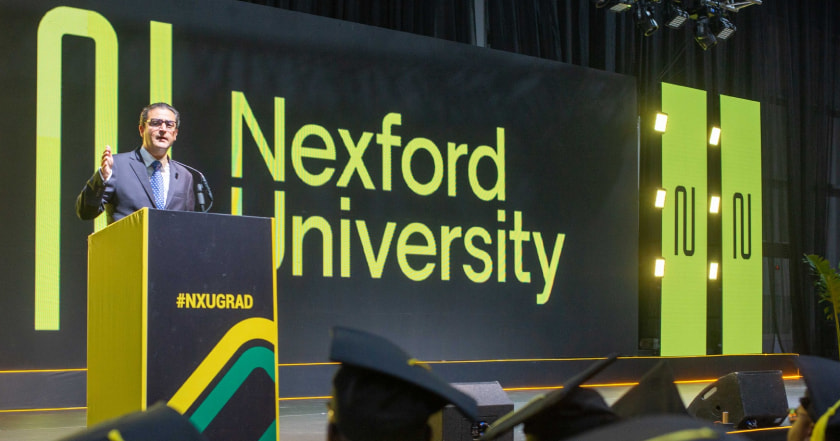
For all the talk of data and delivery, Nexford’s story also contains gowns, awards and people meeting in a room. At the Lagos celebration for its Class of 2024, reported in January 2025, Al Tarzi appeared alongside Peter Obi, Oby Ezekwesili and chief academic officer Jennifer Scott. The university celebrated 1,200 graduates and recognised seven Nigerians for academic performance and contributions to its community.
The awards included peer mentoring and volunteering. Oluwasegun Ogundiran was named valedictorian with a 4.0 CGPA. Those details provide a useful counterweight to the language of platforms and market demand. An online student body still develops relationships, helps other learners and finds reasons to applaud someone else’s work.
For the founder, these encounters offer a more personal measure of the institution than enrolment alone. He has described learner feedback as the rewarding part of building Nexford. The people responding are living with the consequences of the design decisions: whether to enrol, how to keep studying, when to take a break and what to attempt afterward.
Now the job description is moving again
AI has given Al Tarzi another version of the problem that first interested him: the workplace changes, and education has to decide how to respond. In a November 2025 discussion with Absa Bank Ghana’s William Easmon and Blue Space Africa’s Samuel Amanor, he emphasised the ability to keep learning. Communication and empathy also featured in his account of what teams need.
These are useful admissions from someone who has spent years in technology. Knowing a tool is only part of being useful to other people. An employee must understand a problem, explain a decision and adapt when the next tool arrives. The syllabus has to make room for those habits alongside technical knowledge.
“AI is no longer a technical specialty reserved for engineers.”
Fadl Al Tarzi, January 2026
In January 2026, Nexford announced a Master of Science in AI and Technology Management aimed at working professionals. The program focuses on applying AI and guiding organisational change, without requiring learners to stop working or learn to code. Al Tarzi presented AI as a leadership capability, widening the audience beyond the people building the underlying systems.
His stated ambition is greater social and economic mobility through access to education. Asked what the world needed more of, he once answered, “Doers.” It is an appropriately impatient answer from someone who grew tired of waiting for universities to buy his software. The longer test of his own work will arrive in the choices graduates can make after they close the laptop.
Follow the conversation
Interviews, writing and the work in progress.