At sixteen, while still at high school in Egypt, Fadl Al Tarzi flew to California for a web-development course at UCLA. The trip supplied a useful lesson long before it supplied a résumé line: six focused weeks could alter the direction of a life. By eighteen, he had started his first technology company. The conventional order of things had already begun to look optional.
That instinct became a career. Al Tarzi moved through Arabic natural-language-processing software, digital media and social analytics, building businesses across the Middle East and the United States. He led COLTEC from Washington, D.C., then launched SOCIALEYEZ under News Group International. The social-listening operation began with two people and grew beyond 120 across several countries. Its work was essentially interpretive: take millions of scattered public signals and turn them into something an organization could use.
Years later, the same habit would reappear in an unlikely place: a university syllabus.
The question in Dubai
In 2015, Al Tarzi was running a major digital-media agency in the United Arab Emirates and working with producers of the World Governments Summit in Dubai. Among the problems under discussion was a stubborn mismatch. Young people were training for jobs that did not exist in sufficient numbers, while global companies had remote roles they struggled to fill. Education and employment occupied the same planet, but often behaved like distant relatives who exchanged cards at Christmas.
Al Tarzi saw a technology problem inside an education problem. He and Mo Rayes first imagined a software product for existing universities. It would mine millions of job postings, identify the skills employers were seeking, and tell institutions how to adjust their courses. This was SOCIALEYEZ logic applied to the labor market: listen at scale, find the signal, act.
Then came the awkward discovery. Information does not reform an institution merely by arriving at its door. After several months, Al Tarzi concluded that many universities were not prepared to alter their course mix or methods at the speed the data required. If the tool could not change the university, perhaps the tool needed a university of its own.
“We start with the end in mind.”Fadl Al Tarzi on curriculum design
Nexford University was co-founded in 2018 and launched its programs in 2019 after securing a license in Washington, D.C. It did not begin with ivy, a quad, or a fight over where to put the new student center. It began with outcomes.
Ten thousand answers, one blunt message
Before launch, Nexford surveyed 10,000 people around the world about what they expected from higher education. The answer was not coy. Learners were going to university principally to get a job or advance a career, and they judged the investment by whether it improved their employability. The finding exposed what Al Tarzi called a conflict between buyer and seller: students bought an economic future, while universities often believed they sold knowledge and left the future to chance.
Nexford's answer was competency-based education. Students advance by showing mastery rather than merely accumulating time in a seat. A finance learner might build a financial model instead of writing an essay about one. Courses are designed backward from the task a graduate should be able to perform, and labor-market data is meant to keep those tasks from becoming museum pieces.
The other design choice concerned everything students would not receive. There would be no stadium, residence hall, or handsome library staircase on which a brochure photographer could arrange three cheerful undergraduates. Al Tarzi calls those amenities frills for the audience Nexford serves: working adults who want the education, cannot afford the surrounding estate, and have no spare Tuesday afternoon to admire the shrubbery.
Tuition is charged monthly. That small change does more than split a bill. It lets learners control pace and cost, and it avoids the large payment at the beginning of a semester. Nexford has also stayed outside the federal student-loan system, arguing that its reporting and administrative burden would raise prices. There is an austere logic to the model. If an expense does not improve learning or career readiness, it must defend its existence.
A campus measured in time zones
Nexford initially concentrated on emerging markets, where fast-growing youth populations meet a shortage of university places. Nigeria became an important early market. Yet Al Tarzi resists describing the institution as either American or African. The ambition is global, and the practical premise is that a learner should not have to migrate before qualifying for work that crosses borders electronically.
By 2021, Nexford had learners in 70 countries. A 2024 count put enrollment near 6,000 across 110 countries. The expansion is not simply geographic decoration. A global classroom must teach to a common professional standard while charging prices that make sense in profoundly different local economies. It must also serve adults whose lectures begin after the working day and whose assignments compete with children, bills, and sleep.
A university spreads without moving
Countries with enrolled Nexford learners, based on reported snapshots from 2021 and 2024.
This is where Al Tarzi's rhetoric becomes less glossy than the usual online-learning pitch. Flexibility does not mean easy. He has written that online study removes the commute but not the commitment. Indeed, succeeding without a professor physically waiting in a classroom may reveal an especially useful workplace skill: the ability to manage oneself when nobody is watching.
AI, minus the theatre
Al Tarzi's enthusiasm for technology comes with a selective memory of past fashions. Higher education rushed toward gamification, augmented reality, and virtual reality, he has observed, without much evidence that students attended college to play games in headsets. AI is different in scale, but he rejects both the carnival and the panic.
At Nexford, artificial intelligence has analyzed job data, helped automate administrative processes, supported grading, and reduced the cost of creating course material. Students are encouraged to use and critique it because their employers will expect them to do both. The boundary is tersely expressed: let technology handle functions it performs more efficiently; keep people responsible for work that requires people.
“Functions that technology can do more efficiently than humans, we do them using technology, and things that humans need to do, humans do.”Fadl Al Tarzi
That formula sounds almost disappointingly reasonable, which may be its charm. In Al Tarzi's view, prohibition will fail because students will use AI regardless. The interesting work begins after institutions accept that fact: changing what they teach, redesigning assessment, and asking learners to exercise judgment over the machine rather than pretend it has not entered the room.
Cairo, Paris, Washington, Dubai and London have all appeared in Al Tarzi's working life.
His public profile lists English, French and Arabic.
SOCIALEYEZ grew from two people to more than 120 across multiple countries.
Nexford asks whether graduates can earn three to five times their tuition within three to five years.
The useful allergy
Al Tarzi introduces himself online with a joke about having a mild allergy to the phrase “that's how it's always been done.” His posts also tease the solemn little fables of executive social media. Spilling coffee, he notes, does not necessarily teach a profound lesson about leadership. Sometimes you simply missed the cup.
The humor matters because the larger project could otherwise become unbearably earnest. Nexford is a public benefit corporation with a declared mission of social and economic mobility. It has raised substantial venture financing, received investment from IFC, and earned institutional accreditation in 2023. Those are serious structures. They do not guarantee the outcome, but they make the experiment measurable.
Al Tarzi has also been candid about a lesson from failure. Years ago, he pitched companies on digital transformation and watched meeting after meeting end with polite interest and no deal. He blamed the market, price, and timing before deciding the flaw was his: he had been selling information rather than belief. Being right was not enough to move anybody.
Nexford is his attempt to join the two. The information lives in job data, learner outcomes, and the exacting arithmetic of return on investment. The belief is that birthplace need not set the radius of a career. Between them sits a degree stripped of much of the ceremony that traditionally announced it was a degree.
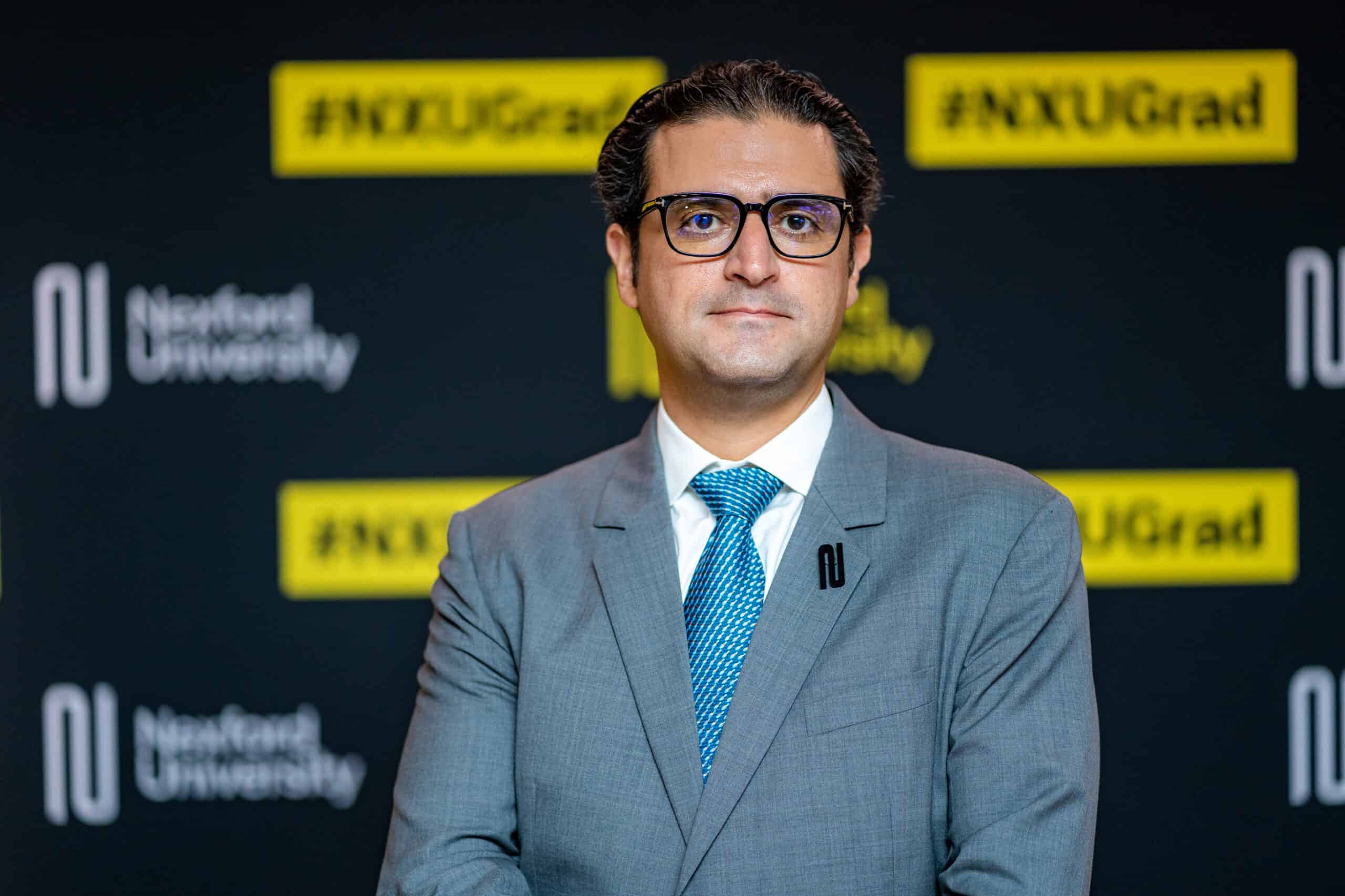
At graduation, the ceremony returns. Online learners finally occupy the same room, cross a stage, take too many photographs, and allow their families the ancient privilege of embarrassing them. Al Tarzi has written that this part never appears in a KPI. He is right. A spreadsheet can count graduates. It cannot quite contain the late shift, the sleeping child, the assignment opened at midnight, or the stubborn decision to log in again tomorrow.
A university that starts at the end eventually discovers that the end is a person walking forward.