Ronald J. Packard wanted to buy a math course. His daughter was six, and he thought she could use more than her school was giving her. The internet offered plenty of supplementary activities. A complete, high-quality course was another matter. For a parent with a credit card, this was inconvenient. For a former investment banker already working in education, it looked like an opening.
By the autumn of 1999, the search had become a twenty-page business plan. Packard carried it on a train from New York to New Haven, where he hoped to enlist people who could help turn an idea into a school. In his later account of the journey, the other passengers were busy with newspapers, laptops and the paperwork of established businesses. His briefcase contained a proposal for a business whose customers still had baby teeth.
The company became K12, now known as Stride. Packard went on to take it public, leave it, and begin another education venture. The original frustration is a useful way into that longer career: a father finding a gap, then treating the gap as something that could be built around. Education would supply considerably more complicated problems than a missing purchase button.
The engineer’s son takes the long route
Packard grew up in Thousand Oaks, California. His father worked on radar and weapons systems at Hughes Aircraft. At Thousand Oaks High School, Packard played football, wrestled and ran track; he also graduated as valedictorian. Summers brought engineering work at Hughes, and Berkeley brought studies in economics and mechanical engineering.
His first professional destination was Goldman Sachs, where he worked in mergers and acquisitions from 1986 to 1988. He completed his MBA at the University of Chicago in 1989, then joined McKinsey. He later explained that he wanted to get closer to operations and eventually create a business. Advising other people’s companies was a route toward that ambition, rather than its final destination.
His route also included Chile. Between 1994 and 1997, he worked on getting a forestry project through government permitting. It is an unexpected entry on an education entrepreneur’s résumé, but a useful reminder of how little a tidy career summary tells us. Before he was dealing with school approvals, he had already spent years dealing with approvals of another sort.
Knowledge Universe brought him into education. There he evaluated businesses serving children and took on leadership of preschool operations. He was learning the sector through its practical workings: investment, management and the daily business of running places where children learn. By the time the math-course search began, he had experience on both sides of the proposition, as an operator and as a parent.
A school takes more than a website
Packard considers April 2000, when the first employee arrived, the beginning of K12. The task went well beyond putting a few lessons on a screen. A full school year needs sequence, continuity and enough material to bring a child back tomorrow. Multiply that requirement across grades and subjects, and the attractive simplicity of “an online school” begins to look like a very large production schedule.
In a 2009 interview, he described an operation that had built 21,000 hours of content, with lessons covering the school calendar from kindergarten through twelfth grade. The early investment paid for both that curriculum and the systems that delivered it. There was a particular commercial logic here: build material and technology that multiple schools could use.
The distinction between company and school mattered. In the public-school business, families enrolled in nonprofit schools. K12 supplied curriculum, technology, management services and training. Public funding supported the student’s education. In the private market, the company also had its own school. Calling the whole arrangement a website would be rather like calling a railway a timetable.
By 2001, K12 was serving children in Pennsylvania and Colorado. Michael Milken and Larry Ellison were among the financial backers behind Packard’s plans. The company went public in December 2007. An idea that began with one parent looking for one subject had acquired shareholders, public-school partners and obligations stretching well beyond the family that inspired it.
Even the supposedly virtual product had a physical side. Families received boxes of materials for their courses. K12 also explored hybrid schooling, including a San Francisco Flex Academy that combined online curriculum with a place to attend. The screen was a tool for organizing instruction; it did not make every book, paintbrush or classroom disappear.
“We provide the curriculum, technology, management services, and training.”Ron Packard, describing K12’s role in 2009
The argument behind the expansion
Packard’s argument was that instruction could fit a student more closely. A child ready to move ahead should have the material to do so. A family needing a different arrangement should have an alternative. His business was tied to that conviction, and he became a public advocate for it as well as its executive.
Growth brought scrutiny. By late 2011, K12 faced pointed questions about academic performance, costs and the experience of teaching in its affiliated schools. Packard answered publicly in December. He argued that a snapshot of proficiency could be misleading when many newly enrolled students arrived behind grade level, and that progress over time deserved more attention.
He also insisted on the importance of teachers and the demands placed on families. Online schooling, in his account, involved serious work and a substantial commitment of time. Those points complicate an easy sales pitch. Flexibility can make an education more accessible while leaving the actual work of learning very much intact.
The dispute identifies a tension that runs through his career. Enrollment tells us that families have chosen a service; revenue tells us that a business has grown. Educational progress requires its own evidence. Packard’s willingness to argue about measurement belongs alongside his ability to raise capital. A school operator’s promises eventually meet the much less accommodating business of what students have learned.
A book, then another beginning
In 2013, Packard published Education Transformation. Its subtitle made his position plain: online learning represented a major change in schooling. The book argued for individualized learning and examined the opportunities and difficulties of building education businesses around technology. He was putting a founder’s thesis between covers while still running the company that embodied it.
That was also a moment when his work had attracted institutional recognition. He received an Ernst & Young Entrepreneur of the Year award in the Greater Washington IT category in 2008. Other recognition included the Education Industry Association’s James P. Boyle leadership award and a Distinguished Alumni Award from Chicago Booth. The honors reflected entrepreneurship and leadership; the classroom questions continued on their own timetable.
In January 2014, Packard stepped down as K12’s chief executive. In June, he and investment firm Safanad announced Pansophic Learning. The new company acquired several K12 assets, including an international physical school, a higher-education platform business and operations in the Middle East, along with curriculum and technology licenses. It began with an operating base across three continents.
Maria Szalay, who had joined K12 in 2000 and worked across product, operations and development, became Pansophic’s co-founder and chief operating officer. The next business therefore carried forward experienced colleagues as well as assets. Starting again can involve a surprising amount of continuity.
Back inside the building
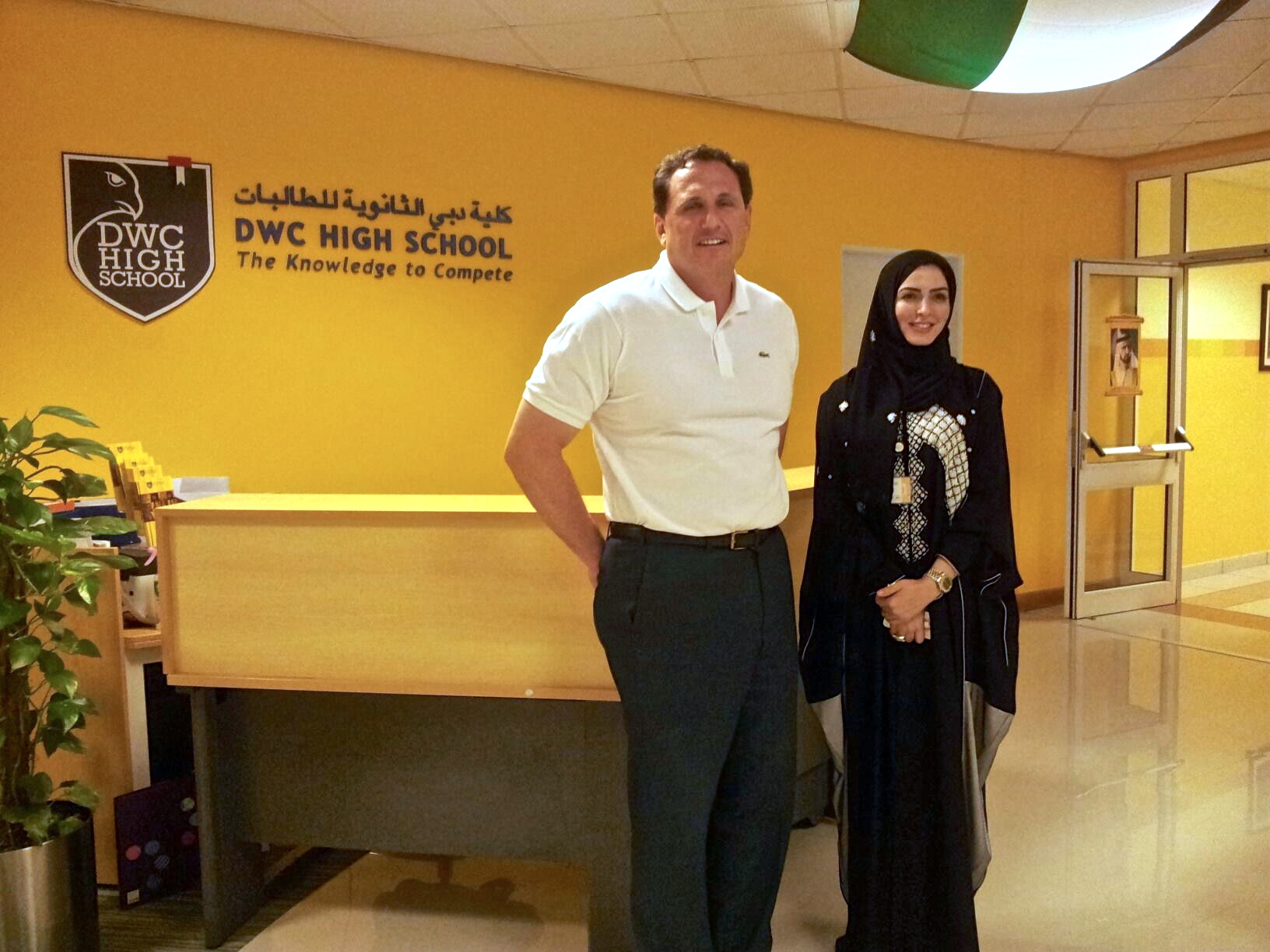
A photograph from February 2014 catches the transition neatly. Packard stands beside the school’s Ms. Maya at Dubai Women’s College High School, in a reception area with a bright yellow wall. He was visiting to see its blended model, which used K12’s American curriculum with instruction on campus. Here was an online-school founder inspecting how the online part worked inside a building.
Pansophic’s name reached further back than the internet. It drew on the pansophic movement associated with the seventeenth-century educator Comenius, and the idea of making knowledge broadly accessible. There is something pleasingly unfashionable about giving a technology-enabled education business a name borrowed from a centuries-old educational philosophy. The distribution tools change faster than the ambition.
A March 2021 profile supplies a smaller, more personal view. Packard was in his office, on his second coffee, with sports memorabilia behind him and trees beyond the window. The conversation described a leader who wanted contact with employees, made school visits and held virtual conversations with staff. The details bring an operator into focus: travel, conversations, another cup, more schools to see.
The work now encompassed physical schools, online programs, early learning and university partnerships. That breadth makes the later career harder to summarize with a single device or teaching format. His stated ambition centers on access and matching the way education is delivered to the needs of each student. The organizational machinery needed to pursue it has become a substantial part of the story.
Operations across the United States, Europe, the Middle East and Africa. Company-reported scale at the investment announcement.
The next version of the same question
Today, Global School Management identifies Packard as its founder and chief executive. In June 2025, GSM announced growth investment from BDT & MSD Partners, alongside the continued backing of Safanad. At that announcement, the company reported more than 190 schools and approximately 55,000 K-12 students across the United States, Europe, the Middle East and Africa.
The investment was intended to support international expansion and development of the company’s platform and curriculum. AMP, its integrated technology ecosystem, combines curriculum, reporting, analytics and operational functions. The scope is wider than the online course Packard once hoped to buy. It includes the infrastructure that lets schools deliver courses, keep records and function day after day.
There is a consistent preference running through these ventures: give families more ways to obtain an education, and build organizations capable of supplying them. Packard has pursued it through public markets, private investment, partnerships and acquisitions. Each method brings its own measures of success. The student still arrives with a more immediate concern: whether this lesson makes sense.
That brings the career back to the daughter and the math course. His first question was specific enough for any parent to recognize. The answer became a company, then another, with many more people involved in delivering it. Whatever the scale of the organization, the educational promise remains personal. Somewhere, a child needs the next piece explained.