James Rhyu had reached the job he wanted. He was a chief financial officer, a position that made sense for someone who had begun in accounting and spent years working his way through finance. Then his mentor asked whether he would consider becoming chief executive. Rhyu spent months saying no. In the conventional business biography, ambition knows exactly where it is going. His needed a little persuasion.
That hesitation makes a useful beginning for a career that eventually put him in charge of Stride, the online education business formerly called K12. Rhyu became CEO in January 2021. He left that position, along with his board seat and chairmanship, on July 29, 2026. Between those dates, he became a public advocate for an idea that sounds unremarkable in a shop and rather provocative in a school: treat families as customers.
The proposition deserves a closer look because Rhyu arrived at it from outside the teaching profession. His experience lay in financial controls, consumer businesses, product decisions and the awkward business of getting people to try something unfamiliar. He brought those experiences into a field where the customer is a child, the decision maker is often a parent, and the consequences last rather longer than a subscription.
An accountant with an unusual address book
His professional itinerary passes through an assortment of businesses that rarely appear together in an education executive’s introduction. He worked for Ernst & Young in the United States and South America, spending six years as an auditor. He served as corporate controller at GrafTech International and at XM Satellite Radio and its successor, Sirius XM. There is a certain education in being the person expected to make the numbers agree.
At Dow Jones, where he was senior vice president of finance from January 2009 to May 2011, his responsibilities covered the global finance function. He moved to Match.com in June 2011 as chief financial officer and chief administrative officer. His remit there extended beyond accounts to functions including human resources, legal, information technology and operations. The finance specialist was acquiring a working knowledge of the rest of the building.
His academic credentials were a bachelor’s degree from the University of Pennsylvania’s Wharton School and an MBA from London Business School. Put beside his cheerfully unflattering descriptions of himself as a student, they make an amusing pairing. Rhyu calls himself a “C student.” That is his recollection, rather than a published transcript. The joke matters because he uses it to explain why the standard picture of educational success never quite satisfied him.
Eight years before the corner office
Rhyu joined the company in June 2013 as CFO. He held that position until April 2020, when he became president of corporate strategy, marketing and technology. His work also included a period as president of product and technology. Those titles describe a gradual widening of responsibility: from recording the results to helping shape what the company sold, how it worked and whom it reached.
When Nathaniel Davis handed him the CEO role in 2021, the relationship already had a long history. Davis said he had known Rhyu and his work for fifteen years. His endorsement was unusually specific. He pointed to Rhyu’s involvement in enrollment trends, acquisitions and changes in marketing, all areas in which business information had to become an actual decision.
Rhyu inherited an existing operation and an existing direction. Davis had already pushed the company toward career learning and investments in workforce development businesses, including Galvanize, MedCerts and Tech Elevator. The distinction matters. A succession story can become a founding myth remarkably quickly; Rhyu’s was a story about taking responsibility for something already in motion.
- 2013Joins as CFO
- 2020Strategy, marketing & technology
- 2021Becomes CEO
- 2026Leaves Stride
The customer arrives in the classroom
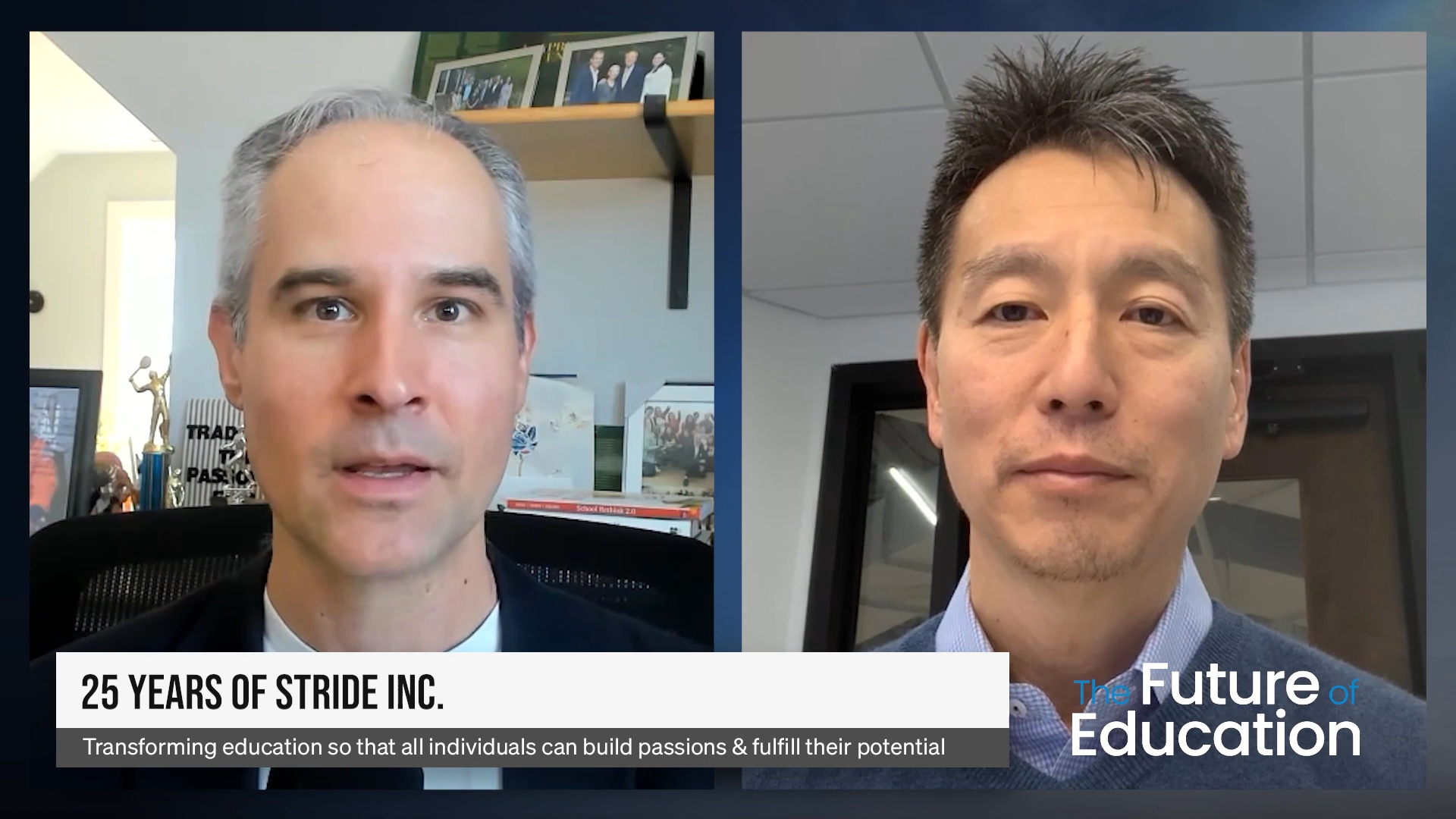
In conversation with education writer Michael Horn in March 2025, Rhyu described how his Match.com experience informed his thinking about online education. Online dating, he observed, had once carried a stigma. Familiarity changed that. He saw a related challenge in persuading families that an education delivered differently could still be an education worth choosing.
The comparison is about acceptance, rather than a claim that dating and schooling work alike. It reveals the consumer executive underneath the education title. Before a service can prove itself, someone has to be willing to try it. Before someone tries it, the provider has to understand the doubts they bring with them.
His use of the word customer carries a second argument. A family might want a diploma that opens the way to employment, a different daily schedule or a workable route toward a particular career. Rhyu argued that the provider should start by understanding those priorities. An institution can have a splendid theory of success and still misunderstand the person sitting in front of it.
There is a useful tension here. Families’ preferences deserve attention; academic learning still requires evidence. Listening well does not make those obligations disappear. It makes the job more demanding, because the institution must explain what it offers and then deliver something the family has reason to value.
What choice looked like in practice
Within days of his appointment, Stride announced the first recipients of its We Stand Together Scholarships. Forty-seven Black students received tuition-free enrollment at K12 Private Academy for the rest of the 2020-2021 school year. The awards formed part of a previously established, multiyear $10 million commitment. Rhyu spoke about removing racial and economic barriers to educational access.
In April 2021, the company announced a partnership with the National Association of Black Male Educators. It would provide recruitment opportunities and professional development resources for Black male educators in online and hybrid schools. Rhyu connected representation among teachers with the role models available to students. It was a practical addition to the language of choice: the adults in a classroom are part of the educational experience, too.
By July, a separate college scholarship announcement named twenty-two recipients, with awards totaling up to $250,000 for the coming academic year. Two recipients were to receive $25,000 each to attend historically Black colleges and universities. These initiatives do not settle every question about access. They do show some of the specific commitments attached to the public argument Rhyu was making.
A bigger business, a harder test
The company grew during his tenure. By fiscal 2023, annual revenue was $1.84 billion. In fiscal 2025 it exceeded $2.4 billion. The figures describe the scale of the operation he led; they cannot, by themselves, tell us what happened in any particular student’s education. A balance sheet can answer a great many questions. Whether a teenager understood the lesson is a different examination.
The career emphasis produced another set of numbers. Stride’s 2025 annual report said that 84,000 students gained career-specific skills and college credits through Career and College Prep in the 2024-2025 school year. It reported more than 20,000 certifications and 25,000 dual credit hours. Those measures make the argument more concrete: the offer included things students could take beyond the school day.
Then the machinery became part of the story. In October 2025, Rhyu told investors that technology platform implementations had gone less smoothly than expected. Customers’ experiences had suffered, contributing to higher withdrawals and lower conversion than anticipated. Together with decisions to restrain growth in some programs, the problems meant an estimated 10,000 to 15,000 fewer enrollments than the company otherwise might have achieved.
This was a particularly uncomfortable test for an executive who had made customer experience central to his explanation of the business. The phrase becomes very tangible when a family encounters a platform that disappoints them. The episode exposes the distance between an attractive strategy and a dependable school day. Closing that distance is part of the work a CEO accepts.
Company revenue measures business scale. It does not measure an individual student’s learning.
The students get a turn
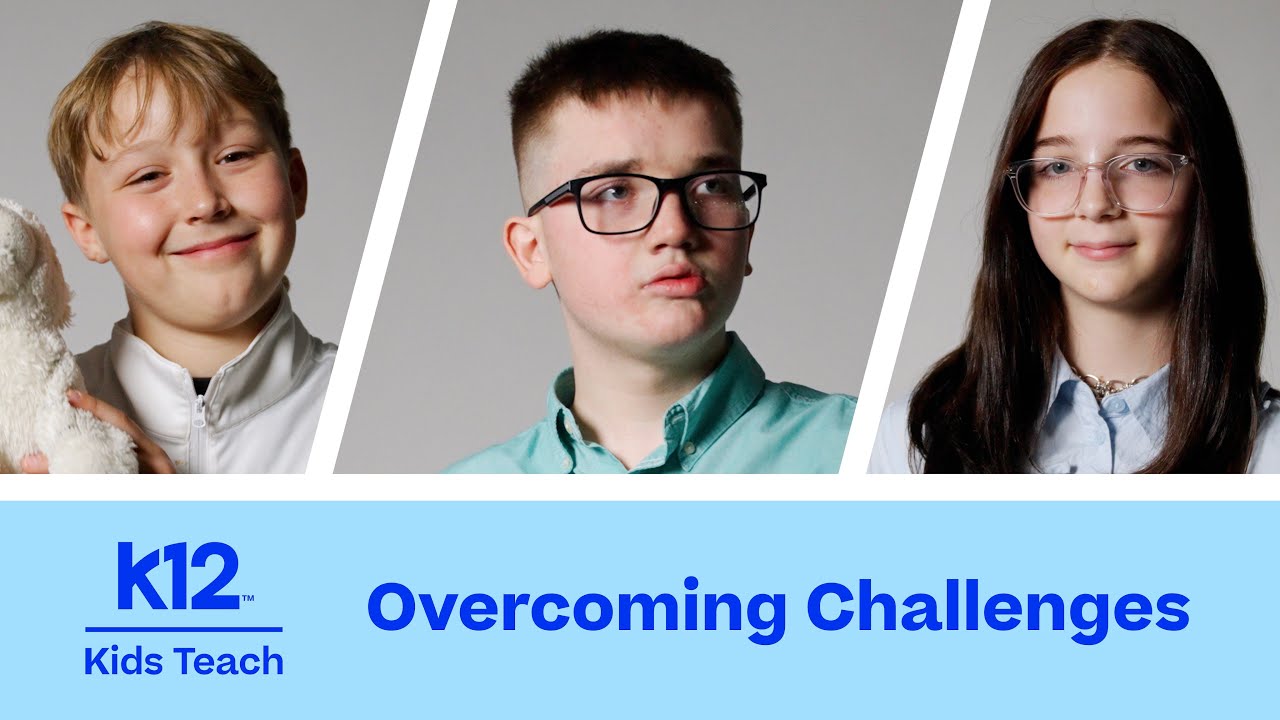
One of the more revealing formats associated with Rhyu’s tenure was K12’s Kids Teach series. In an installment about overcoming challenges, he sat down with students who discussed adapting to difficult situations and the support they received from mentors, friends and teachers. The conversation also allowed the students to turn their attention to his experiences and approach to leadership.
That reversal suits the former finance executive’s public persona. He had entered education without a teacher’s biography and remained willing to describe himself as someone learning the chief executive’s job. Giving students a turn to ask the questions makes for a more interesting exchange than another adult presentation about what young people need.
A morning question, and an unfinished argument
Rhyu’s approach to technology included caution as well as enthusiasm. In a September 2024 conversation with Mike Palmer, he warned against rushing AI into K-12 settings without considering the consequences of errors. He discussed individualized learning and tools that could help teachers with tasks such as lesson planning. He also urged listeners to combine passion and risk-taking with thoughtful planning.
The advice is consistent with an accountant’s interest in what happens after the announcement. A new tool has to work within the routines of teaching. A new learning format has to fit the people using it. The attractive possibility is only the beginning of the operating problem.
He was similarly direct about his own habits. An early riser, Rhyu said he regularly made time for reflection. His recurring question was “how can I be better?” He applied it to being a husband, father and executive. He put self-awareness first among the leadership attributes he discussed with his team, and described humility and gratitude as qualities worth actively protecting.
“how can I be better?”
James Rhyu’s recurring morning question
His tenure ended in July 2026, when Robert Knowling succeeded him as CEO and Steven Fink became board chair. Stride thanked Rhyu for more than thirteen years of service. Its SEC filing said his departure did not result from a disagreement over company operations, policies or practices.
The reluctant candidate had spent more than five years in the job. His record contains expansion, specific efforts to widen access and the practical difficulties of running the technology on which the promise depended. His most useful question travels beyond that record. Once a school asks what a family hopes to gain, it has something particular to answer for. The conversation becomes harder to finish with a slogan.