Brian J. Stephens once helped choose a school because of a librarian. He and his wife, both lawyers, were starting to earn money. The private school made its librarian part of the pitch. They liked what they heard. They enrolled their daughter. A profession devoted to arranging information had, rather neatly, become the selling point.
Years later, Stephens was advising public schools on how to explain themselves to families. In one New Jersey district, parents wanted extracurricular activities. The district had 186 of them. It had neglected to put that abundance on its website. In Stephens’s telling, the school system had plenty to offer and remarkably little to say about it.
Those two memories make a useful introduction to the founder and CEO of Caissa K12. He understands school choice as a parent who has exercised it, a strategist who earns money responding to it, and an author who objects to how it operates. His business occupies the gap between what a school provides and what a family knows.
In Stephens’s New Jersey example, the offering already existed. Making it visible was the assignment.
A law practice learns to campaign
Stephens’s route into education consulting passed through military service, business, and law. He attended Marion Military Institute and served in the United States Army, reaching captain. His studies at Appalachian State University covered business management and psychology. He earned his law degree at the University of Tulsa, where he also taught law students as a legal fellow.
The combination suggests a career spent around the same practical problem: people receive the same instructions and do different things. An officer has to get an order understood. A lawyer has to anticipate objections. A business owner has to persuade somebody to buy. Stephens eventually brought those concerns together in a communications firm.
He and Paige Walkup converted the Stephens Group Law Firm, whose work included corporate affairs, business, and land use, into Caissa Public Strategy. The change widened the available tools. Representing a client could involve community outreach, political strategy, public relations, or managing a crisis as well as legal argument. A favorable position was of limited use if nobody outside the room understood it.
By April 2013, Stephens had developed and sold three startups. He was already settled in Memphis, having moved there from Florida more than fourteen years earlier. His public identity was that of a serial entrepreneur who helped other organizations plan their next move. Public education would give that work a particular constituency.
The family becomes the audience
Caissa K12 grew out of the political and crisis communications business. The translation was straightforward enough to be uncomfortable: a school district could no longer assume that living within its boundaries meant enrolling in its classrooms. Families had alternatives. Public schools needed to understand those families, reach them, and help them complete a decision.
Stephens’s firm applies the habits of a campaign to that work. There is research before messaging, targeted outreach, and repeated contact through calls, texts, advertising, events, and visits. The objective is a student enrolled. A parent who admires an advertisement but never finishes registration leaves the central problem unresolved.
For a political strategist, that distinction is familiar. Favorable opinion does not automatically produce a vote. For a school administrator, the equivalent difficulty can sit between a pleasant conversation and a completed form. The work therefore extends into service: how a school answers a question, welcomes a visitor, and follows up when someone needs help.
Stephens leads alongside people with separate responsibilities. Adrian Bond is Caissa K12’s president and a co-founder. Walkup leads Caissa Public Strategy. EmaDella Conners is chief operations officer. The structure matters because a national enrollment business requires more than a founder who can give a persuasive speech. Someone has to make the next call, organize delivery, and keep promises across districts.
- 01ListenFind out what families value.
- 02ExplainMake the school’s offering visible.
- 03Follow throughHelp interest become enrollment.
An invoice with a student attached
The recruitment pitch includes a financial proposition. Caissa uses a performance model in which districts pay for students who actually enroll. For an administrator watching enrollment fall, that connects a contractor’s bill to a tangible result. It also creates an obvious responsibility: the district has to know what counts as a recruited student.
By August 2025, the business had more than 100 district clients. Stephens was operating in a sector where recruitment had become an administrative concern, alongside teaching, staffing, and budgets. His company’s expansion showed that school systems were willing to purchase a skill that political campaigns had long considered essential.
The appeal is understandable. So is the question that follows it. A successful recruitment count needs a clear definition, and a good school experience has to survive the campaign that brought a family through the door. Marketing creates an expectation. The people answering the phone and teaching the classes inherit it.
That is where Stephens’s background in leadership development joins the enrollment work. Training materials describe group sessions, individual coaching, and digital tools for school employees. His teaching has covered customer service, cognitive bias, performance, and interpersonal communication. Recruiting families and preparing staff to serve them belong in the same conversation.
The title does not whisper
Stephens had already announced his preference for direct language with Only Morons Say “No Comment.” It is a book about crisis communication, planning ahead, and responding when an organization’s reputation is under pressure. The title would be difficult to mistake for a request to form a subcommittee.
His later book, A Level Playing Field: Strategies to Ensure Public Schools’ Success, published in 2025, carries the subtitle A 2035 Prediction for Public Education. It considers competing futures for public schools and argues for changes in recruitment, retention, local autonomy, and the terms of competition. The consultant’s daily assignment becomes a longer argument about the institution he serves.
The tension is central to his position. He wants public schools to compete effectively while questioning whether the surrounding rules are fair. His professional interest is plain: districts buy the services his company sells. His policy position also has to stand on its own, as an argument about how public education should function.
He has taken that argument into writing and public appearances, including a July 2026 opinion piece on fairness in school choice. His earlier writing ranged from strategic planning to the etiquette of taking phone calls in bathrooms. A reader looking for a uniformly solemn education spokesman may have opened the wrong filing cabinet.
“Slow down and provide more context.”
Brian J. Stephens, on communication within his own team
Turning the microphone inward
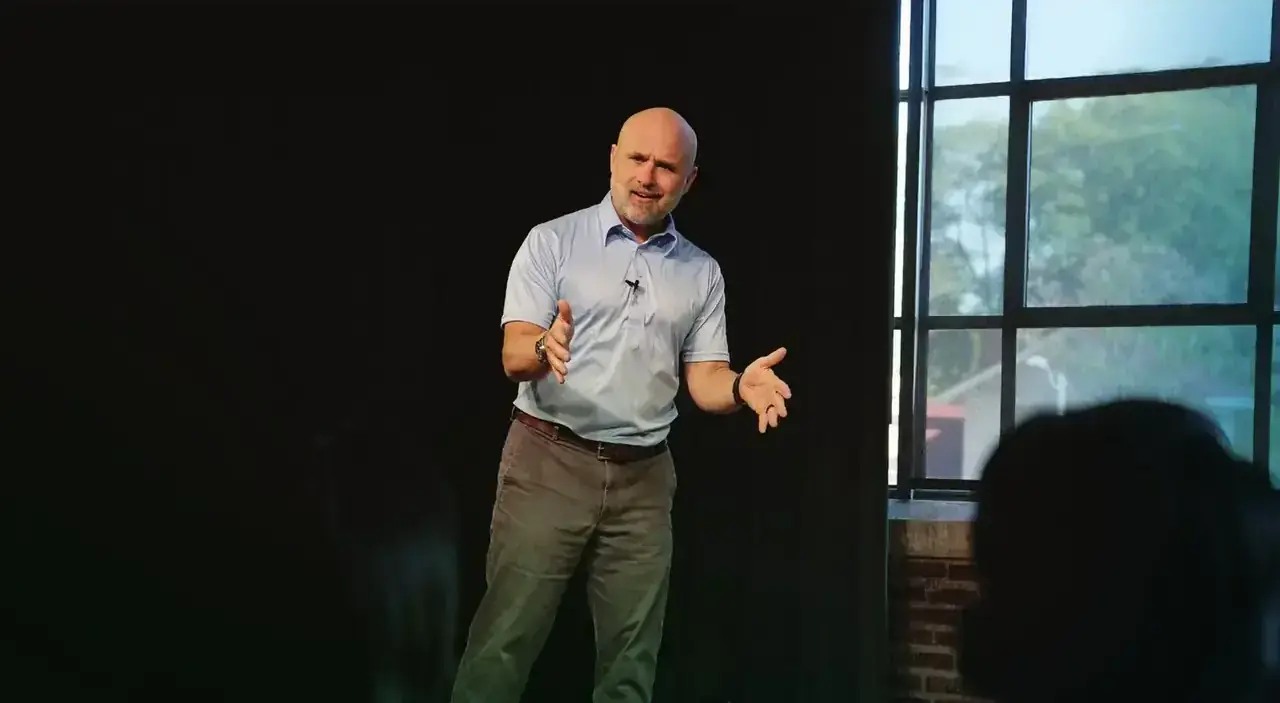
On Unfiltered Education, the podcast he hosts, Stephens talks with superintendents and other education leaders about enrollment, funding, school choice, and family engagement. The guest list gives him access to the people who have to turn broad arguments into decisions about particular schools.
In September 2026, he spoke with Sarah Hernholm, founder of WIT, about entrepreneurial thinking among teachers and greater ownership for students. Later that month, superintendent Jerry Hollingsworth joined him to discuss community trust. The conversations broaden his public role beyond selling enrollment campaigns, putting him in the position of asking questions as well as supplying answers.
One September episode went inside a communication session for Caissa’s own team. It dealt with unclear expectations, divided attention, and the difference between delivering a message and having it understood. In a related clip, Stephens acknowledged that he too could move too quickly. The advice was useful partly because he included himself among the people who needed it.
There is continuity with his Memphis work. In 2019, he taught a Greater Memphis Chamber session on building a business plan with limited resources. The audience was small-business owners. The practical concern was recognizable: decide where you are trying to go, understand the constraints, and make the next steps intelligible to other people.
Public arguments, public accountability
Stephens’s public record also includes a federal employment lawsuit brought by former employee Madison Nelson against him and Caissa Public Strategy. Her complaint alleged harassment and unlawful termination. An April 6, 2026 order granted a partial motion to dismiss specified claims, including individual statutory claims against Stephens and a state-law tort claim against both defendants. The order addressed the legal sufficiency of those claims; it did not establish the truth of the allegations or resolve the entire case.
For a professional whose work concerns trust and reputation, that litigation belongs alongside the books, business, and public advocacy. The distinction between an allegation and a finding matters, as does the distinction between a partial ruling and a final resolution.
A familiar school, a fresh introduction
Stephens’s working premise remains close to that librarian. A family makes a choice using the information it notices, the people it encounters, and the things it cares about. A district can possess a program, an accomplished teacher, or a crowded calendar of activities and still fail to make those things visible.
His response has become a business, two books, training sessions, and a continuing conversation with school leaders. The ambition is to help public schools make their case and improve the experience behind it. For all the strategic vocabulary, the assignment can be surprisingly modest: tell a parent what is available, answer the question that follows, and stay long enough to help.
Keep the conversation going
Books, conversations, reporting, and the channels where Stephens’s work continues.