The Kettle People Who Asked Why Your Boiling Water Touches Plastic
A Newport Beach family took a doctor's habit - remove the source of the problem, not just the symptom - and turned it into plastic-free kettles, Turkish tea makers, and samovars now brewing in nearly 20 countries.
Most kitchen brands start with a trend. Saki started with a defect. Around 2018, a physician named Omer Deveci looked at the electric kettle on his own counter and asked a question most of us never bother to: why is my boiling water sitting inside a plastic reservoir? He had spent a career trained to fix the source of a problem rather than manage its symptoms. The kettle failed that test. So his family started a company to build a better one.
That company is Saki Products, run out of Newport Beach, California, with an office listing in nearby Irvine. It is small, family-owned, and stubbornly single-minded about one idea: nothing plastic should touch the water you drink. Everything else - the temperature presets, the light rings, the retail deals with Amazon and Macy's - grew outward from that one rule.
01 / The QuestionWhy does boiling water have to touch plastic?
It sounds like a marketing line. It was actually a diagnosis. Deveci's read was clinical: most consumer kettles run near-boiling water past plastic lids, windows, valves, and spouts, and heat is exactly the condition under which plastics are most likely to shed compounds like BPA, BPS, and PFAS. His fix was not a filter or a warning label. It was removal. Design the water path so there is no plastic in it to begin with.
Saki backs the claim the unglamorous way - by paying for it. It sent the Luna kettle to Light Labs, an ISO/IEC 17025-accredited lab, and published the result: every analyte tested - heavy metals, bisphenols (BPA, BPS, BPF), 16 phthalates, and 30 PFAS compounds - came back “Not Detected.” On the Luna's own product page the company also gets literal about it: “Every part your water touches (chamber, lid, spout, gauge) is 304 stainless steel. The spout is welded, not glued. There is no silicone in the water path.” In a category full of vague “BPA-free” stickers, that specificity is the whole pitch. It is trust, sold by the ounce.
“A complaint is not a crisis. It's the most valuable innovation opportunity there is.”
Company philosophy, drawn from founder Omer Deveci's earlier ventureThat last line has a backstory worth knowing. Before Saki, Deveci founded Sikayetvar, Turkey's largest consumer-complaints platform - a place where the entire business was people telling companies what went wrong. Saki inherits that reflex. Product reviews are not damage control here; they are the raw material for the next revision.
02 / The OriginIt started with a samovar, not a coffee gadget
Here is the detail that surprises people. Saki's first hit was not a pour-over kettle or a sleek gooseneck. It was an electric samovar - the traditional Russian and Turkish table urn used to brew and serve tea to a room full of people. Deveci's family rebuilt the 300-year-old object with modern electronics and safety features, and it found an audience among tea-drinking communities who wanted the ritual without the fuss.
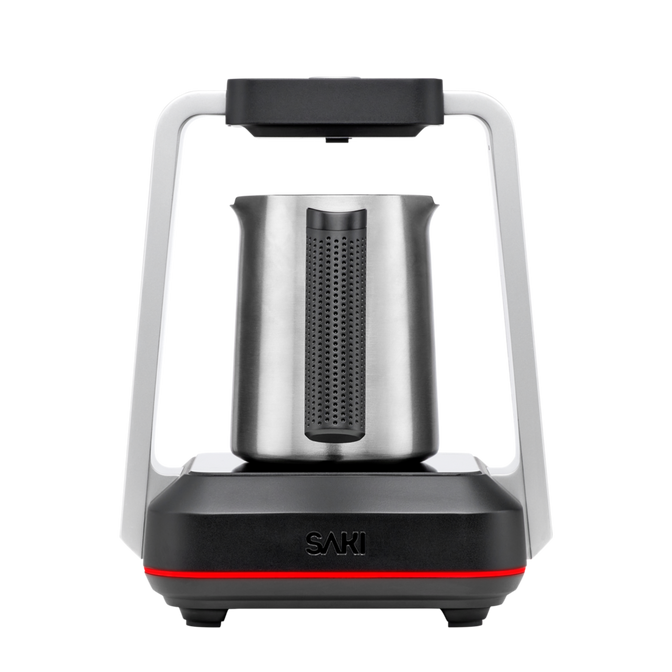
The samovar did two things. It gave the young company revenue, and it set the design language for everything that followed: take a brewing tradition people already love, keep the ritual intact, and quietly fix the parts that were never that good - the plastic, the guesswork, the babysitting. Turkish coffee makers and pour-over gear followed the same recipe.
03 / The ProductsKettles that show you what they're doing
The clearest expression of the Saki idea is the Baristan, a 1-liter, 1200-watt gooseneck pour-over kettle aimed squarely at people who are new to home brewing. Its signature is a light ring at the base that glows as the water heats and then “breathes” - fading in and out - once it reaches your target temperature. It is a small piece of theater with a real job: it turns the invisible feedback that experienced baristas rely on into something a beginner can just look at. Saki holds a utility patent on the LED indicator and a design patent, and entered the kettle in the Specialty Coffee Association's Best New Product Awards. It lists at $129.
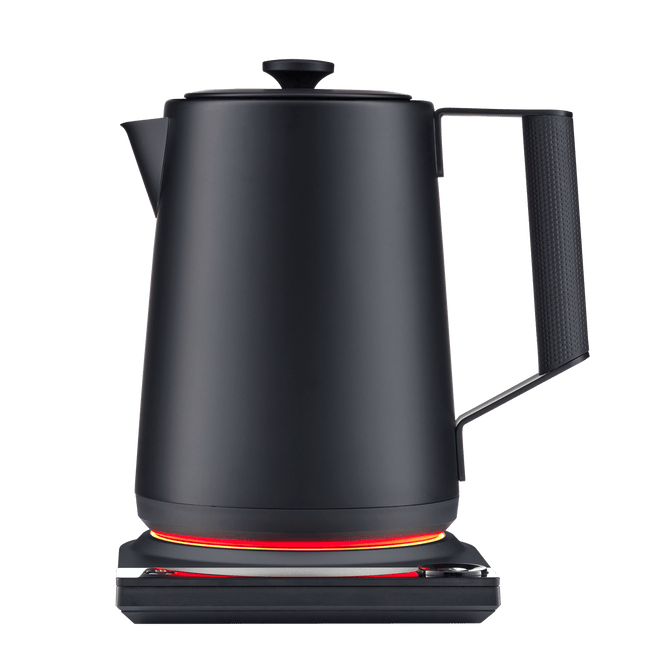
The Luna Electric Kettle Pro is the everyday workhorse: 1.75 liters, 1500 watts, 100% plastic-free 304 stainless construction, six one-touch temperature presets, an altitude-calibrated LCD, up to two hours of keep-warm, and auto shut-off. It comes in Matte Black, Pearl White, Sage Green, and Midnight Blue - a small tell that Saki thinks of a kettle as furniture you look at every morning, not a hidden utility.
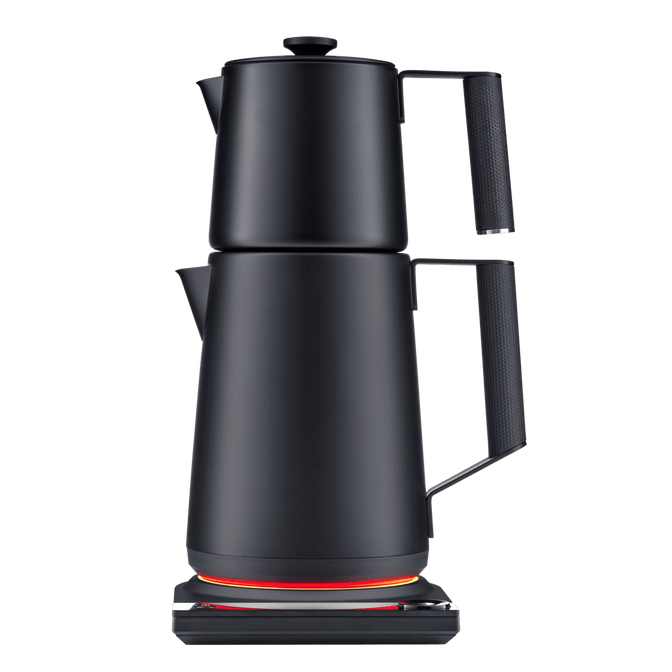
Then there is the tradition line. The Turkish Tea Maker Pro is an electric double-pot caydanlik - water boils in the lower kettle while tea steeps in the upper pot, so each person controls the strength of their own pour. It carries a 1.75-liter capacity, a two-hour keep-warm, auto shut-off, boil-dry protection, and an LED brew ring. Alongside it sit the electric samovar, the automatic Turkish coffee maker, and a 24-ounce BPA-free glass pour-over carafe with a permanent stainless mesh filter.
What you can actually do with this stuff: hit 175°F for green tea without a thermometer; pour a slow, even pour-over without dribbling; brew Turkish coffee without hovering over a stovetop; or run a samovar at a family gathering and let everyone dial their own strength - all without plastic in the water path.
04 / The DifferenceWhere Saki sits in a crowded aisle
The premium-kettle shelf is not empty. Fellow owns the aesthetic and the influencer coffee crowd with the Stagg EKG. Breville and Bonavita own the spec sheets. Cosori and OXO own the value end. Saki is not trying to out-cool Fellow. It is competing on a question the others mostly do not raise out loud: what is your kettle actually made of, and does that matter at 212 degrees?
Where each brand plants its flag
There is a second edge that is easy to miss: heritage. Very few Western appliance startups build a serious Turkish tea maker or an electric samovar. Saki does, and it does it credibly, which opens a door to Turkish, Russian, and broader diaspora kitchens that the Fellows of the world simply do not knock on. It is a niche, but it is a defended one.
“When will the person who buys this product be disappointed?”
The internal design test Saki says it keeps building against until the answer disappears05 / The ModelDirect first, then everywhere
Saki runs a straightforward hardware business. It sells direct from its own store - built on Shopify Plus - with free US shipping, a two-year warranty, and 30-day returns, which are the terms of a company that expects to keep the customer rather than flip them. From there it fans out onto Amazon, Walmart, and Macy's for reach, and wholesales to independent retailers through Faire. There is no disclosed outside funding; this is a margin-on-product business, not a burn-the-cash-for-growth one.
The customers are who you would guess: home coffee and tea enthusiasts, gift buyers, and diaspora households looking for authentic gear. The scale is modest and real - roughly 27 products across five categories, shipping to nearly 20 countries, run by a small team led by three members of one family.
Saki is founded in Newport Beach
The Deveci family launches with a reimagined electric samovar and the question that defines the brand.
Turkish coffee, automated
An automatic Turkish coffee maker extends the tradition-meets-technology approach beyond tea.
Into specialty coffee
A BPA-free glass pour-over carafe with a permanent mesh filter broadens the catalog.
The Baristan kettle launches
The gooseneck pour-over kettle with its light-ring display earns coverage in Sprudge and Daily Coffee News.
Luna Pro and Turkish Tea Maker Pro
Fully plastic-free flagships push the range to about 27 products across five categories.
06 / The PeopleA family with a clear division of labor
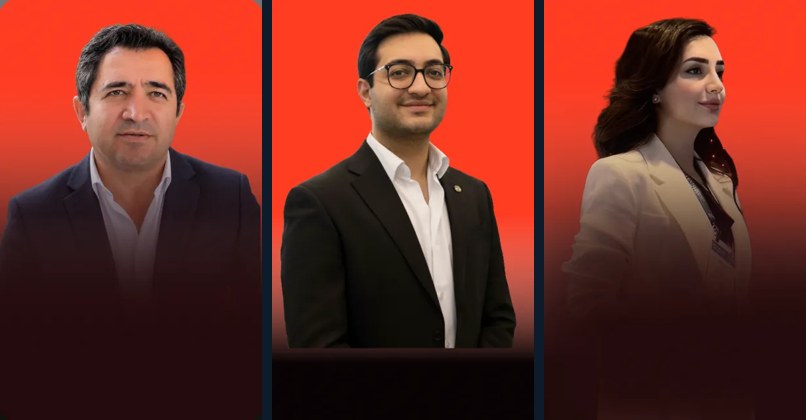
The org chart is short and legible. Dr. Omer Deveci, the physician and serial entrepreneur, is founder and CEO. His son Arda Deveci, a Pepperdine Graziadio graduate, is product director and the technical architect behind the products. His daughter Almina Deveci, also a Pepperdine Graziadio graduate, is marketing director and shapes the brand's voice. The family motto - “Life is better together” - is not just a wall decal; it shows up in the product line itself, in a double-pot tea maker built for a table full of guests.
Their guiding lines are borrowed from two different worlds. From medicine: “First, do no harm.” From the brand's own shorthand, printed across its channels: “What touches your water matters” and “Pure Engineering. Pure Taste.” It is unusual for a small appliance company to have a stated ethics before it has a stated feature list. Saki did it in that order on purpose.
What a founder can steal from Saki: pick one defect everyone else tolerates, make removing it your entire identity, and prove it with an outside lab instead of a slogan. Then treat every complaint as a free R&D brief. It is cheaper than a growth team and it compounds.
07 / The CatchWhere the pitch has limits
Honesty helps here. Plastic-free construction is a genuine differentiator, but it is not magic - a stainless kettle can run hotter to the touch and costs more than a $30 big-box model, and a $129 gooseneck is a hard sell to someone who just wants hot water. Saki is also small. It does not have Breville's feature sprawl or Fellow's cultural gravity, and its heritage products serve a specific audience rather than a mass one. The bet is that a clear, testable promise beats a louder, vaguer one. So far, in a niche, it is holding.
What Saki has really built is less a kettle catalog than an operating principle: the old brewing rituals were right about the ceremony and wrong about the materials. Fix the second part, leave the first alone, and prove your work. For a family that started by rescuing a samovar, that is a surprisingly modern idea.