In 1998, before Sakebomb had much paid work, it had an office. This is backwards in the conventional order of business formation. First comes the customer, then the revenue, and only after several cautious spreadsheet exercises does someone buy a second chair. Greg Shewchuk and Paul Hastings chose a cheap room above an antique dealer on Chung King Road in Los Angeles. The office, Shewchuk later wrote, would make them take the thing seriously.
The room was shared with the American operation of Tokion, the bilingual culture magazine, and Slabco Records. It had wood floors, Chinese lanterns, alley cats nearby and enough unreality to make a young internet company feel plausible. Hastings was doing film-studio work on the side. Shewchuk was writing science fiction and enjoying the office. Then the blanket fort acquired a client.
The useful Sakebomb idea was not “build a cool website.” It was simpler: understand the joke before you touch the software.
Then Spike Jonze called
The first large assignment was the official website for Being John Malkovich. Jonze's film already behaved like a website from the experimental era - doors inside doors, a celebrity used as architecture, institutional seriousness wrapped around a ridiculous proposition. Sakebomb did not flatten that premise into a poster and a release date. Its account of the project lists security-guard cameras, production-assistant journals, covert material from Italy and letters to the editor. The marketing became another floor in the building.
That project opened a route into studio work. Sakebomb later built sites for Jackass: The Movie, Mean Girls, Team America: World Police, Jackass Number Two, Let's Go to Prison and Role Models. It worked with Paramount, Universal, Dickhouse and other production outfits. A contemporary reprint in a Keenspot press archive shows Sakebomb represented among web-animation properties as early as 2000. By 2011, a profile of Hastings named Universal Pictures and Mad Decent as clients.
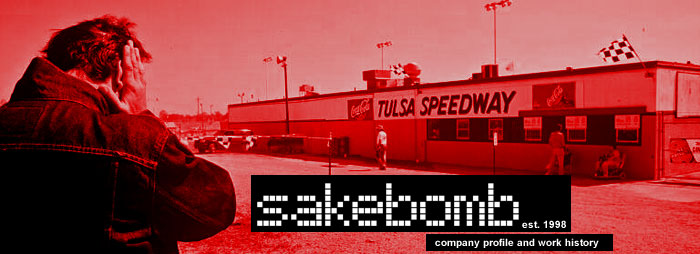
A speedway, a camera and a pixel wordmark: subtlety was available, just not mandatory.
A premise, translated
The portfolio is most revealing when it explains the choices. Mean Girls became an online teen magazine because adolescent gossip, quizzes and status anxiety already belonged to that form. The company said the site drew one million hits a day before release - an impressive but self-reported figure from its archived profile. Team America called for restraint: the filmmakers wanted the movie to speak, so Sakebomb packaged it with the bombast of a Jerry Bruckheimer production. The second Jackass campaign faced the opposite puzzle. How do you convey transgression when ratings rules limit nudity, drugs, profanity and bodily functions, and when showing the best stunts would spoil them?
These were not merely design problems. They were problems of editorial judgment: what can be revealed, what must be withheld, and which piece of the fictional world can survive outside the film? The software mattered - Flash animation, sound clips, games, PHP and databases - but the premise carried the work.
That distinction explains why the studio could move sideways. It built an Xzibit site whose content a fan could operate, an ecommerce shop for Undefeated, a site for musician and producer Michael Andrews using paintings by Geoff McFetridge, and a Mad Decent iPhone DJ app. It also made an experimental game called Jet Pack Monkey. The deliverables changed. The small-team logic did not.
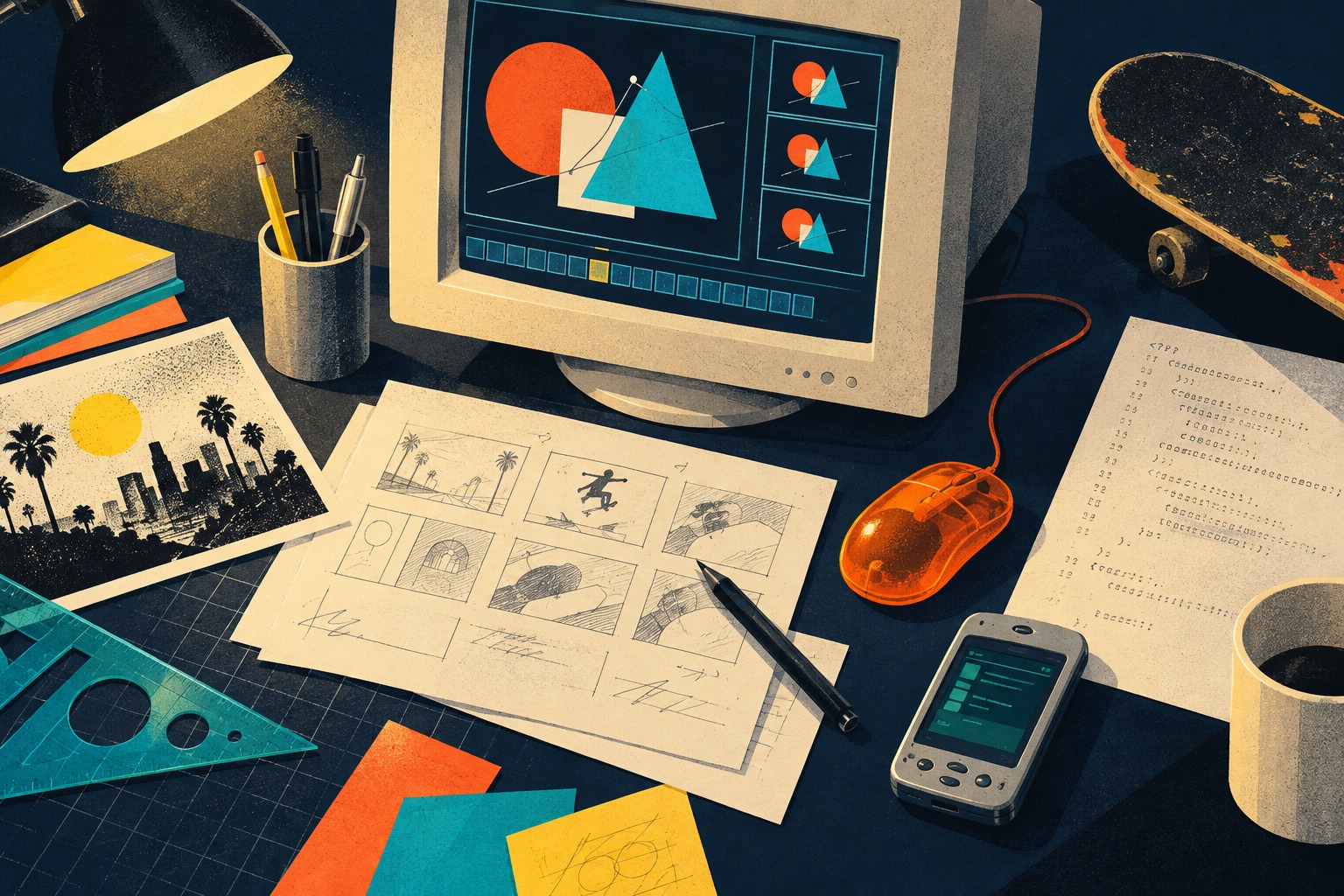
The whole internet on one desk: draw the gag, code the page, roll away before the plugin asks for an update.
The cheapest serious gesture
Sakebomb's first office is worth dwelling on because it was both foolish and disciplined. The rent was described as cheap, though no figure survives in the public account. The expense bought a deadline that arrived every month. It also put the founders beside editors, musicians, designers and skaters who could become collaborators, material or simply company. Later there was a satellite workspace in Shibuya, Tokyo; then home offices; then a Glendale Boulevard space with a pool table and a Coke machine filled with beer; then an Echo Park guest house.
The founders take an office before steady work, using rent as a commitment device.
The first major film campaign turns a loose creative partnership into a functioning studio.
Jackass, Mean Girls, Team America and Universal projects turn premises into places to explore.
Ecommerce, databases and iPhone apps begin replacing the Flash-era campaign.
The first thing to fail was not the central model. It was the surrounding boom. After Being John Malkovich, Sakebomb booked Propaganda Films' corporate site and imagined larger new-media ventures with the production company. In the studio's later telling, “the bottom dropped out.” An original piece from 2000 mocked the implosion of heavily financed entertainment startups. Sakebomb's counterposition was modest: finance the life, keep the structure loose, and do not confuse somebody else's grand theory of the internet with your own reason for making things.
What the studio actually sold
Film studios, producers, labels, artists, streetwear and skateboard brands.
Turn a release or brand into a digital experience people would visit voluntarily.
Concept, design, code, animation, games, stores, apps and original content.
Project fees for creative production and development, with no public price list.
This is a project-service business, not a software platform. Its customers bought a compact production unit: people who could read a script, find the playable idea, draw it, animate it and make the database behave. Larger agencies could offer more capacity. Freelancers could offer a lower bill. An internal studio team could offer control. Sakebomb occupied the useful middle - small enough for the founders' taste to reach the pixels, broad enough to finish the thing.
The copyable part is not the beer machine. Start with the material, not the channel. Put creative and technical decisions close together. Use a small fixed cost as a forcing function only when real work can plausibly cover it. Choose clients whose language the team understands. Give the audience something to do besides click “watch trailer.” These ideas travel well beyond Flash.
Make the campaign feel as if it came from inside the product's world.
The conditions matter. This model loses its edge when approvals require every joke to pass through a long corporate chain, when regulation rewards documentation over improvisation, or when a team sells cultural fluency it does not possess. It also breaks when craft is mistaken for nostalgia. Flash itself is obsolete. Many Sakebomb projects are now fragments in an archive, and the live company site is an almost empty black page. The artifact disappeared; the decision behind it remains legible.
The web as a place again
A curious thing happened as web marketing became easier to measure. The movie site became more efficient and less visitable. A campaign could now send a viewer straight to a trailer, a ticketing page or a social feed. Each click acquired a name. The little worlds - the fake advertisements, games, diaries and secret rooms - became harder to justify.
Sakebomb belongs to the earlier bargain. Curiosity went in; entertainment came out. The studio was neither large nor tidy, and its own writing cheerfully resisted both qualities. But its best work understood that attention is not captured by demanding it. Attention is earned by making a corner of the internet feel like somewhere.