The whiteboard was chart paper held up with Scotch tape. In a dorm room at IIT Roorkee, Sachin Gupta and Vivek Prakash were working on the project that would become HackerEarth. They could not afford the proper office accessory, so they improvised. Years later, Gupta showed the makeshift board in a talk to students. It was a useful corrective to the polished version of entrepreneurship: before there is a company, there is often a wall that someone has persuaded to behave like stationery.
Gupta studied computer science at Roorkee from 2008 to 2012. In his 2017 TEDx talk, he argued that college gave aspiring founders unusually practical advantages: somewhere to live, food, and a concentration of potential collaborators. Prakash had lived just three doors away. The first recruiting problem was therefore fairly easy to solve. Finding a partner required a walk down the corridor.
A good programmer, a bad result
The problem that interested them was less convenient. During campus placements, a friend they regarded as exceptionally capable failed to land offers from the companies everyone expected him to join. Gupta had watched a good programmer perform badly in the machinery designed to identify good programmers. It seemed an odd arrangement.
The experience became a recurring reference point in his account of HackerEarth. Technical hiring could be arbitrary. A candidate's ability and the outcome of an interview were not always closely connected. Gupta wanted developers to demonstrate what they could do, with a process that put practical programming skills closer to the centre of the decision.
That concern had an advantage: he understood the people on one side of the transaction. He was a developer preparing for interviews himself. MyCareerStack, the precursor to HackerEarth, offered interview preparation material. The founders were learning how to build a website while helping other students prepare to enter the profession. A useful project and an education were happening on the same screen.
Gupta eventually got a Google job. The preparation project had worked rather well for its own creator. It also left him with a question that a job offer could not settle: what should happen to everyone whose ability the hiring process overlooked?
Three months at Google, then the unfinished business
In July 2012, Gupta moved to Bengaluru to work at Google. He had previously interned at Microsoft. These were recognisable steps on an engineer's career ladder, and he had reached them soon after university. Meanwhile, he and Prakash continued working on their own project.
GSF Accelerator offered a different route, with a practical condition: the founders had to work full time on the company in Bengaluru. Gupta would leave his job. Prakash still had a semester to finish. The university allowed Prakash to complete that semester from Bengaluru, making the decision possible for both of them. A startup's first negotiation may be with a university timetable.
Gupta's own retrospective dates HackerEarth's official start to November 2012, after the accelerator accepted them. The move was abrupt, but the project behind it had been taking shape before graduation. The Google chapter was brief; the university collaboration became the work of more than a decade.
The logo could wait
Some founders begin with a brand book. Gupta and Prakash began with a name in a font on a background they liked. The first HackerEarth logo performed the necessary duties: it could go on a visiting card, a laptop, a T-shirt, or a startup competition entry. Nobody needed a lengthy explanation of its symbolism.
For three years, the company deliberately postponed a more considered identity. Time was one reason. A small team had other things to do. The larger reason, Gupta later explained, was that the company was still discovering what it was. Products, experiments and changes had to happen before an identity could honestly describe them.
When HackerEarth introduced a new logo in September 2015, Gupta treated it as an expression of that accumulated understanding. There is something appealingly literal about the sequence. Build the thing; learn what people use it for; give the thing a better badge. The stationery department had once again been asked to wait its turn.
In 2016, Forbes included Gupta in its Asia 30 Under 30 list for enterprise technology. Recognition had arrived. The work that earned it had already been under way for several years.
A community has to offer a reason to return
HackerEarth gave developers a place to practise, compete and test themselves. Companies could use its software to assess candidates. These two audiences were connected, but they needed different reasons to show up. A recruiter had a vacancy. A programmer might simply want to get better.
By February 2022, Gupta described a community of 6.5 million developers. His account of building it was unusually willing to discuss the maintenance. Early advocates included respected programmers at universities, where coding contests helped establish the platform. Later came tools such as CodeMonk and Competitive Coding. Regular contests alone could not satisfy every kind of developer indefinitely.
At a million members, the team recognised the need for smaller communities. Scale brought differences in interests and experience into sharper view. Gupta also acknowledged that most of roughly 15 crowdsourced initiatives had failed to last because the team could not maintain the quality. Gathering a crowd was one job. Giving that crowd something consistently useful was another.
“talent is universally distributed and opportunities are not”
Sachin Gupta, 2020
That conviction helps explain why the community belonged in the business at all. HackerEarth's original ambition reached beyond a college placement season. A developer with the ability to do the work should have a way to make that ability visible. Geography and institutional pedigree should not settle the question before the code gets a hearing.
The engineer learns to sell
Gupta's responsibilities expanded with the company. His work came to include marketing, sales, product and operations. A browser could run a candidate's code, but somebody still had to persuade an employer to use the browser. The software did not arrive at the customer's desk by moral force.
In a 2020 conversation with Nathan Latka, Gupta described the two sides of the product: paid assessment software for employers and a community version where developers could improve their skills or prepare for interviews. The distinction mattered. The people who used a product, the people who recommended it and the people who paid for it did not have to be the same people.
Going to the United States brought another education. In 2018, Gupta was already discussing HackerEarth's expansion toward the Bay Area and its enterprise innovation business. Hackathons had opened a route for companies to work with talent on challenges, extending the company beyond its original assessment offering.
His ambitions were becoming international in very concrete ways: customers, partnerships, where he spent his time. Building a global product from India had become a matter of understanding several markets, rather than putting a globe in the presentation.
The room where everyone still fitted
Gupta remembers HackerEarth's in-person all-hands meetings running for 60 to 90 minutes. Even after the team passed 100 people, employees crowded into the room: interns, newcomers and colleagues who had been there longer. A senior vice president once drew his attention to the faces of the newer employees. His stories were helping them believe in the company's mission.
He later called that feedback the best compliment he had received as a founder. Revenue had not supplied it. A colleague noticing what happened in a room had. For an engineer who had gradually taken responsibility for selling, this was another kind of persuasion: explaining a shared purpose well enough for other people to act on it.
His preference for working in an office follows the same thread. He has openly defended it, remembering the friendships and sense of mission in HackerEarth's early team. It is a firm preference, grounded in his experience. One can disagree with the prescription while recognising the scene he is trying to preserve: colleagues who know one another beyond a scheduled call.
A founder needs someone who will answer plainly
The work also taught Gupta to seek advice. After moving to the United States to grow HackerEarth, he brought Ram Gupta onto the board as an independent member. He values the direct counsel Ram offered and the chance to discuss questions he could not easily raise with employees, investors or fellow founders.
That relationship sits beside his enthusiasm for inspiring a team. The person responsible for giving others confidence also needs a place to ask unfinished questions. Gupta describes the value of finding someone experienced who is willing to help without an agenda. It is a quieter connection than a customer announcement, but one he has chosen to make public and thank.
Outside the job, his HackerEarth speaker biography lists travel and reading among his interests. They are modest details in a career full of business vocabulary, and welcome ones. A person can oversee product strategy and still want a book.
HackerEarth hands over the baton
In July 2024, Gupta announced that he was becoming HackerEarth's executive chairman. Vikas Aditya would take over as CEO. After 11 years building the company, Gupta planned to spend more time on product vision, adjacent opportunities, customers and partners.
The handover came with a question about artificial intelligence. If the work of a software developer changed, the skills employers needed to understand and assess would change too. Gupta had spent months discussing those possibilities with Aditya. The role transition was therefore also a conversation about what the company should build next.
His own next company would come from a different part of the same education. He had started HackerEarth knowing how to code. Sales had been the difficult skill to acquire. Having learned it across the customer journey, he now had a set of frustrations worth turning into another product.
The next unfinished job
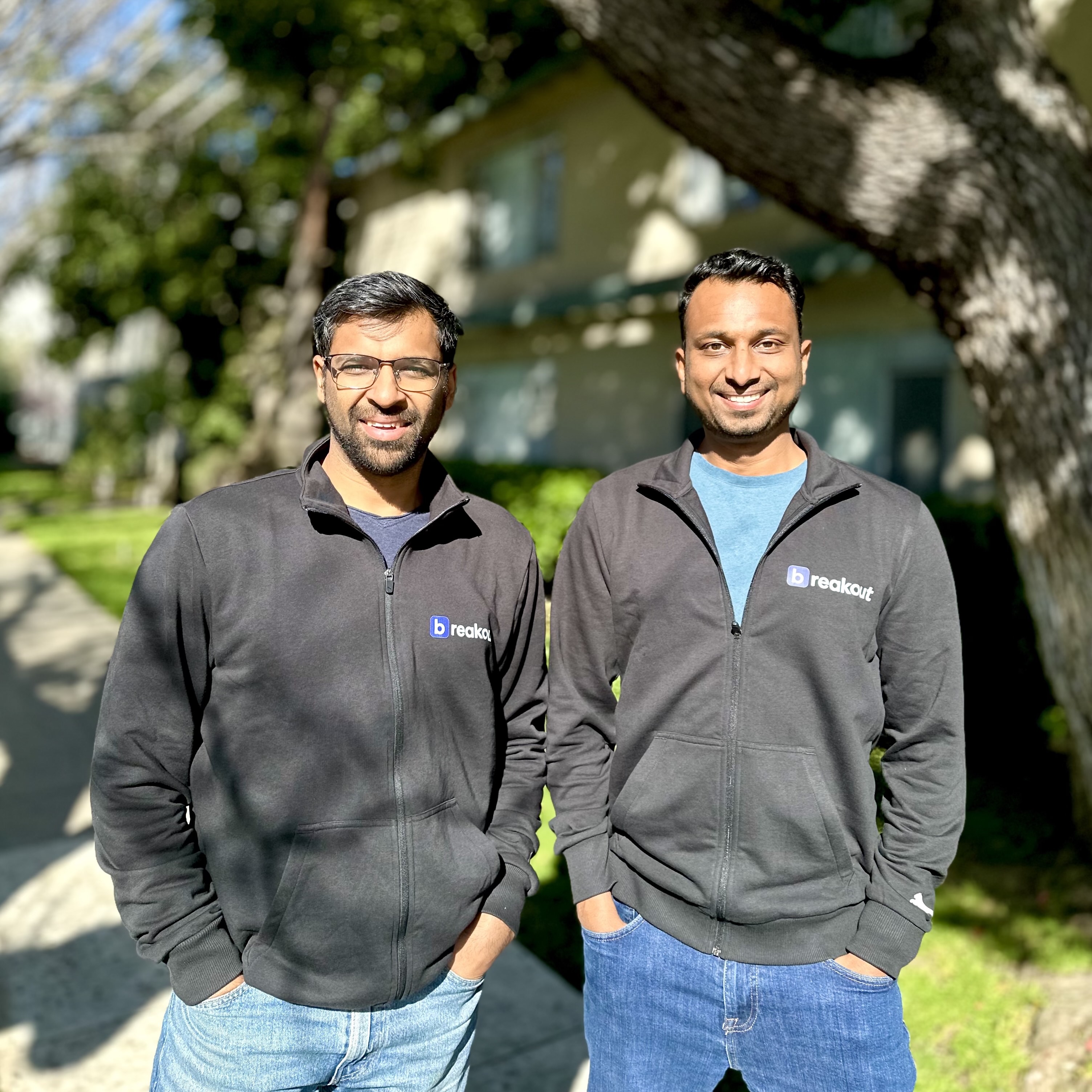
Breakout emerged from stealth in February 2025. Gupta was co-founder and CEO; Hitesh Aggarwal was co-founder and CTO. The company announced $3.25 million in seed funding led by Village Global, with Recall Capital and Z21 Ventures participating. Its initial proposition was an AI sales representative that could engage website visitors, qualify interest and provide demonstrations while a prospective buyer was still there.
By June 2026, Gupta was introducing Spoc, a product aimed at coordinating work across a marketing team's software. The problem he described was familiar to anyone moving lists and data between tools: an experiment could spend hours in preparation before a customer ever saw it. Breakout wanted to reduce that coordination burden.
The distance from the taped-up dorm-room board is considerable. The habit underneath it remains recognisable. Gupta notices a process that makes capable people wait, then tries to build a better route through it. First the programmer waiting for an opportunity. Later the team waiting for its tools to cooperate. The office supplies have improved. There is still unfinished work on the wall.