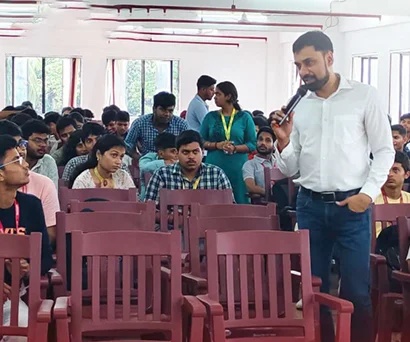
Sabyasachi Saha is standing between rows of classroom chairs, microphone in hand. Around him, students are listening and watching the speaker. The setting is Brainware University in Barasat, where he joined a seminar on generative AI and prompt engineering in March 2025. It is an ordinary enough scene for a technology executive. It also offers a good way into his story. Here is someone whose working life keeps returning to the distance between learning a technology and doing something useful with it.
Saha co-founded Techno Exponent in 2011. Today, his role combines CEO and Chief AI Scientist. Between those titles sits a familiar business headache: software can demonstrate a possibility long before an organisation knows how to use it. His career has taken him through web development, mobile applications, an art marketplace, technical training and AI research. The recurring question is what happens after the demonstration earns its applause.
A business begins before the fashionable part
The early geography was West Bengal. Saha prepared for the engineering entrance examination and studied at Kalyani Government Engineering College. In 2011, he and Avoy Debnath co-founded Techno Exponent. The company's original working vocabulary included PHP, CodeIgniter, WordPress, Drupal and Joomla. These were tools for building the websites and systems that businesses actually needed. A working checkout rarely receives a standing ovation. Its absence, however, can empty a room rather quickly.
Over time, the technical vocabulary expanded to include mobile development, Node.js, React, Flutter, blockchain and artificial intelligence. That progression matters because it gives the AI work a longer backstory. Saha had already been building for customers before generative AI became a boardroom conversation. Each additional technology arrived alongside the older obligations of delivery, communication and maintenance.
His recollection of the beginning is modest in scale: a team of three, with recruitment difficult for a young company. The problem was persuading people to join something that had yet to prove itself. Years later, he would describe clients returning for further projects, some relationships extending beyond a decade. A repeat engagement is a quieter form of approval than a launch announcement. It also comes with another deadline.
The client who became a colleague
One relationship took him into the art world. Saha worked on All Public Art, an art marketplace associated with artist and founder Graham Goddard. His involvement included technical leadership; public team records identify him as CTO and software engineer. It is a useful detour in a career otherwise easy to describe with enterprise software terminology. Art gives the work a different set of people to answer to.
A marketplace has to accommodate several intentions at once. Someone wants to show work. Someone else wants to discover it. The platform must make those encounters possible without turning the visitor into a systems administrator. That tension between technical machinery and an understandable experience runs through Saha's later advice to entrepreneurs. He urges them to make products easy to grasp.
Goddard also appears in Techno Exponent's team directory as a growth partner. The connection illustrates how the boundaries around a services business can shift: a project becomes an ongoing relationship, and technical delivery opens the door to a broader role. Saha's story includes co-founder Debnath and colleagues across engineering, design and delivery. The organisational chart is a useful antidote to the lone-founder photograph.
“Keep your product simple.”
Sabyasachi Saha
Teaching the people he once needed to hire
Euphoria GenX gives another part of the story a concrete address. The technical training initiative connects Saha's software business with students preparing for employment. Its courses have covered programming, web and mobile development, cloud deployment and other practical skills. The connection is easy to understand alongside his account of early hiring difficulties. An employer needs people who can build. A student needs a credible route to becoming one.
In April 2022, Brainware University's computer science and engineering department hosted an online technical session with Euphoria GenX and T-Web Exponent Services. Saha was among the experts discussing industry trends, portfolios and routes into cloud computing, data analytics and AI. The format was a virtual industry visit. It brought the workplace into a student session without requiring a bus.
Euphoria GenX's account of its 2022 activity lists more than 40 industry visits and more than 40 seminars. Its curriculum ranged from Java and web design to AWS and blockchain. Those details show the breadth of the training effort, though an activity count is only an activity count. The consequential moment for a learner comes later, when a task arrives without a worked example attached.
Saha's advice to prospective entrants is similarly practical: read regularly, practise coding, complete real projects, put work on GitHub and approach experienced people about internships. There is little ceremony in that prescription. It asks students to leave evidence of what they can do. For someone hoping to join a software team, a repository can make a more useful introduction than an adjective.
Twelve years, and another address to learn
On 9 April 2023, Techno Exponent marked its twelfth foundation day at Novotel Kolkata. Saha attended with Debnath, vice president Jyoendrisa Tagore Saha, CTO Michael Collins, clients and colleagues from across the company. The gathering included speeches, a discussion with clients and a conversation hosted by delivery colleague Anwesha. The anniversary brought people who usually occupied different parts of a project into the same room.
Saha announced a new head office at Imagine Tech Park in Kolkata. Such announcements can sound like real-estate footnotes. Within a company, an office also supplies a tangible answer to a question that follows a young business for years: is this thing going to last? An anniversary measures elapsed time. A new office points towards work still to come.
The previous year had brought Saha recognition in the Most Influential Young Leaders 2021-22 awards. Awards belong in the chronology, but the foundation-day scene is more revealing about the kind of company he was running. Developers, testers, designers, sales staff and clients were all part of the occasion. Software delivery involves enough handovers to make the relay race feel understaffed.
When the examiner is also software
By 2025, Saha's interest in education was appearing in published research as well as training sessions. His paper on the move from traditional examinations to AI-driven assessment considers efficiency, personalised feedback, reliability and bias. It also discusses differences in how students and teachers trust automated evaluation. That last concern complicates the sales pitch for any system promising to make marking effortless.
A faster assessment is useful only if people can understand and rely on the result. In the paper, the educational question extends beyond whether a machine can assign a score. Fairness and accountability remain part of the work. The same person who advises students to demonstrate their skills is examining what happens when software participates in judging them.
Another 2025 paper explores blockchain and AI in learning systems, with attention to privacy, data integrity and personalised education. Taken together, these projects connect several strands of his career: software construction, training and research. They also place practical limits alongside the promised benefits. A classroom is full of people who will notice if an elegant technical arrangement gives an unreasonable answer.
A result worth checking twice
In September 2026, Saha published PERA-Tutor, a study of personalised, explainable retrieval for educational questions. The test benchmark contained 240 curriculum chunks and 1,200 questions. Its ranking method considered semantic relevance, topic, difficulty and misconceptions. At the initial setting, Recall@5 increased from 0.550 to 0.624 compared with semantic-only ranking.
Then came the awkward detail. Topic names were present in the answerable question templates, making some of the retrieval task easier. A further test that removed the topic contribution produced a much smaller gain. The paper consequently limits its conclusions: it supports better matching of difficulty to the learner, while declining to establish broader superiority in retrieval or hallucination control.
There is something instructive about that sequence. A promising number arrives, followed by a reason to be more careful with it. Readers can see the qualification beside the result. The discipline is especially relevant when the proposed user is a learner: a fluent explanation and a sound explanation can look remarkably similar on a screen.
Following the work beyond the chatbot
His August 2026 research mapped literature on retrieval-augmented generation and AI agents using 73,862 OpenAlex records. The collection spanned multiple document types, including preprints, with a cutoff of 14 August. The study traces a shift towards systems that coordinate tools and actions, alongside questions of oversight, security and evaluation. It is a map of research activity, rather than a count of successful commercial deployments.
That distinction matters for a founder who also has to deliver software. A research trend can help identify where attention is going. It cannot decide whether a particular organisation has the data, workflow or staff to benefit from the next implementation. The distance between those two questions is where much of Saha's current work sits.
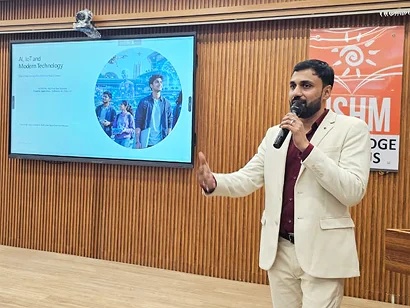
His 2026 speaking calendar continued to put him in front of students, including sessions on AI implementation, full-stack development and career preparation. At NSHM's August inauguration, his subject was the scope of BCA and AI-ML careers in Indian and international workplaces. The career that began with building websites now includes explaining the workplace those students hope to enter.
Saha describes his consulting priorities in operational terms: cost, throughput, defects, cycle time and risk. The list has a pleasing lack of theatricality. These are things a business can inspect after the presentation is over. His work now ranges across executive decisions, technical architecture and research, but those ordinary measures keep the ambitions attached to a task. Somewhere beyond the prototype, someone still has to use the thing.