Sabrena Gartland has a translation problem. A client asks for something to look more exciting, or imagines a campaign with the confidence of Apple and the resources of a much smaller business. Somewhere between the request and the finished work, somebody has to discover what the client actually means. Gartland enjoys that part. The puzzling brief, in her telling, belongs to a person who cares about a business and lacks the language to describe the picture in their head.
She can make a joke of it. Her catalogue of familiar client requests includes the supposedly tiny revision that consumes an afternoon and the search through endless versions that ends at the first design. Anyone who has approved a brochure may feel a slight urge to look away. But her affection for the people making those requests survives the joke. The task is to translate concern into a useful decision.
That is a revealing introduction to the founder and CEO of Frogman Media Group. The California marketing business handles social accounts, content, advertising and design. Gartland also carries the title of Creative Director, a combination that puts her near both the business decisions and the sentences clients will eventually read. Her work asks her to understand an owner’s intentions well enough to let somebody else carry them out. Her own career has tested how difficult that handoff can be.
Before the brief, a restaurant job
Gartland grew up in San Pedro, California, watching her mother work to support the family. At thirteen she took a job at her grandfather’s restaurant, Sorrento’s. By sixteen she was working two jobs. The early lesson was concrete: work was how the household kept going, and earning a living was something she expected to do for herself.
At twenty, she joined Contessa Premium Foods as a receptionist. A promotion into a marketing assistant role introduced her to the part of business that held her attention: inventing promotions and seeing whether they changed what customers did. She pushed for a social media strategy and eventually became Social Media and Promotions Manager. Business use of social platforms was still developing, leaving room for someone willing to learn while doing the work.
That sequence helps explain her practical vocabulary. A promotion needed a purpose. An audience needed a reason to respond. The job connected creative decisions to the business paying for them. Later, when she would be responsible for an agency’s direction as well as its output, those two kinds of attention would sit in the same chair.
A blanket business hands over the conversation
One of Frogman’s more telling client relationships involved The Comfy, the wearable blanket business founded by Brian and Michael Speciale. After appearing on Shark Tank, the brothers faced the problem of a company becoming too busy for its founders to manage every exchange themselves. Each inquiry and complaint still felt personal. Delegating the replies required trusting another team with the company’s manner.
In a 2019 conversation with investor Barbara Corcoran, Brian described handing social media responsibilities to Frogman. His compact assessment of the agency was that “They spoke in our voice.” He also credited the arrangement with freeing time for other parts of the business. For an agency, that is a particularly useful compliment: the customer recognized the company after its founders stepped away from the keyboard.
The relationship offers a different way to read Gartland’s occupation. Writing a caption is visible work. Learning when to reassure a customer, when to ask an owner a question and how to keep a reply recognizable is less easily displayed in a portfolio. Yet those decisions make delegation possible. The outside team has to exercise judgment without making the business sound as though it has acquired an entirely new personality.
For a founder, handing over that conversation can feel like giving somebody else the last word at the family dinner table. The Comfy example shows why a capable substitute matters. The owner gets time back; the customer still expects an answer that belongs to the brand.
“They spoke in our voice.”
Brian Speciale, co-founder of The Comfy
Then her own agency needed room to breathe
Gartland’s account of running Frogman includes a less photogenic episode: she nearly closed the agency in its third year. She describes taking care of client relationships, content, overdue invoices and late emails herself. After one client call, she sat in her car questioning the move away from corporate employment. The freedom of ownership had arrived with a rather demanding supervisor: the owner.
Her retrospective divides the experience into stages. The early years were about staying afloat, the middle years about building systems, and the later period about finally benefiting from that groundwork. It is her description of the path she took, rather than a timetable every agency can follow. The distinction matters. A calendar alone will not redistribute anybody’s workload.
The change she emphasizes was becoming more selective about clients and the results their budgets could support. Saying yes had kept work coming through the door. Learning where to draw a boundary made the work more manageable. The account gives her advice some weight because it includes the part where her own habits were contributing to the problem.
Today, Frogman’s public team includes operations management, account coordination, strategy, consulting, video editing and internships. Ginger Liu is listed as Operations Manager; Karoline Lujan handles account coordination and strategy. These are the kinds of roles that put distance between a founder and every individual task. The business can ask clients to delegate while building the capacity to do the same inside its own walls.
The surprisingly useful shared album
Gartland’s description of a content shoot has the appeal of advice given by someone who has had to locate the photographs afterward. Every two or three months, she says, the team plans a session and gathers material in batches. Different setups and outfits give the resulting collection a longer working life. While the photographer prepares another shot, phones capture informal clips.
She makes room for both kinds of material. Finished photographs can serve a website or publicity request. The footage between setups can show a more relaxed side of the people doing the work. In her experience, some of those phone recordings attract especially good engagement. A camera waiting for the perfect arrangement need not prevent another camera from noticing what is already happening.
Then comes the detail that makes the routine feel lived in: put the files in a shared album. A colleague preparing social posts can retrieve them. A colleague writing a newsletter can do the same. The founder no longer has to serve as the human attachment button for every request.
It is an ordinary piece of organization, and that is its charm. Agency life offers plenty of opportunities to discuss ideas in impressive language. A photograph that the right person can find on Tuesday morning has a quieter usefulness. This is how an intention to delegate becomes a working habit: somebody else knows where the material is and can get on with the job.
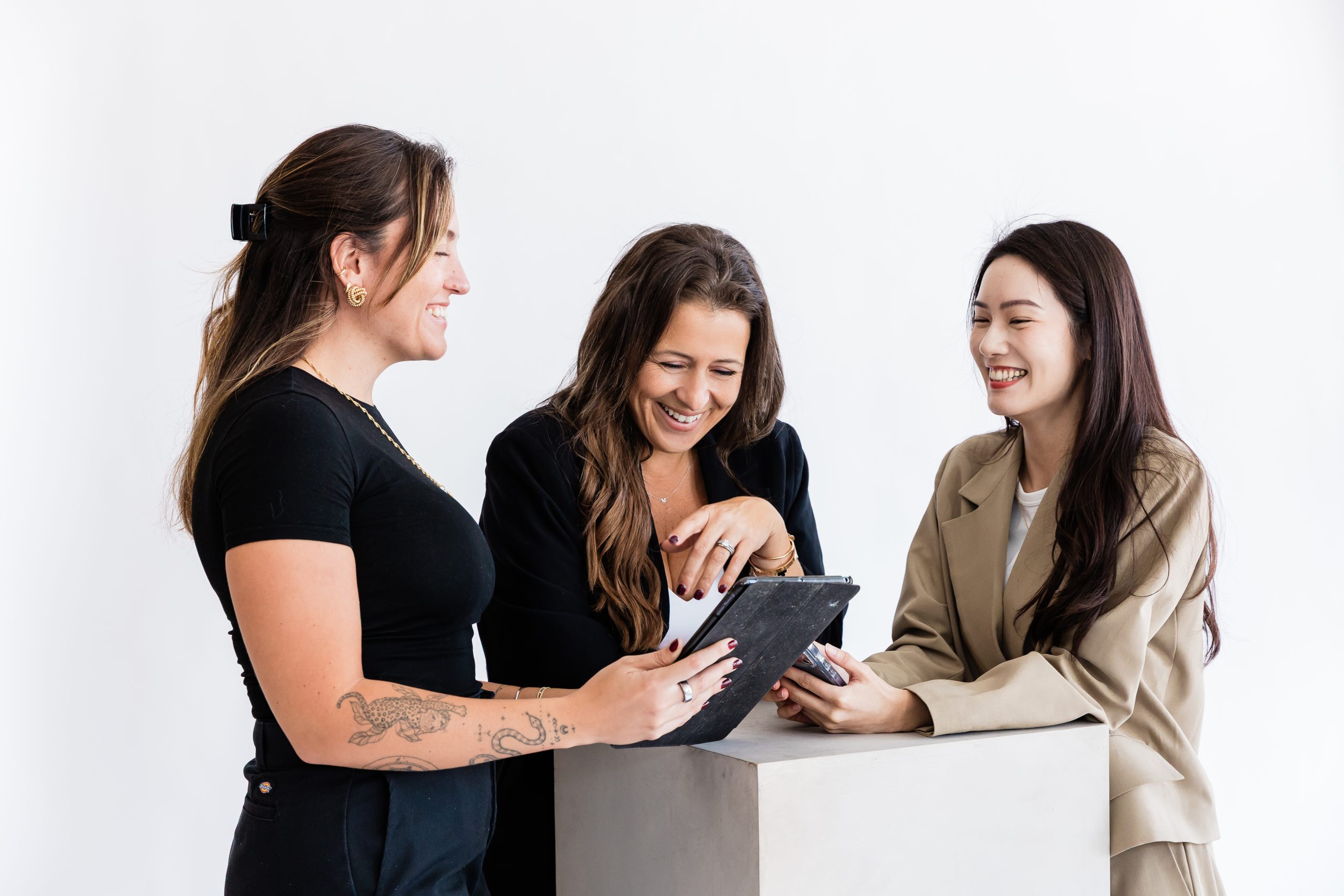
A Frogman branding photograph gives the group project a better reputation. Gartland is at center. Photograph: Frogman Media Group.
A wider circle of assignments
Frogman is one part of Gartland’s professional life. In August 2021, Peninsula PR & Influencer Services announced its launch with her as a co-founder running daily operations. The business joined publicity and influencer relationships, extending the work of communicating through a company’s own accounts into the work of reaching other people’s audiences.
Its description of her role combines immediate responsibilities with decisions about longer-term growth. That combination recurs across her career. There is the thing that must go out today, and there is the question of what kind of business all those days are adding up to. Clients buy the first while depending on the second.
Other assignments show the range without requiring a grand theory of it. Be That Spark identifies her as its Social Media Director, responsible for strategy and operations. A January 2024 announcement for the travel photography app PhotoSpot names her as the media contact through Frogman. Reveald, a cybersecurity company, has published work under her name and identified her as Director of Marketing.
An education initiative, a travel app and a cybersecurity business present different problems of explanation. The audience brings different knowledge, different doubts and different reasons to care. Across those settings, the useful skill is understanding enough about the subject to choose what another person needs to hear first. Gartland’s career has repeatedly placed her at that point of translation.
Make room for a person in the post
The agency’s more recent writing returns to the people behind company accounts. A June 2026 essay argues for a larger role for founders and employees in public communication, alongside a maintained brand presence. An August essay urges teams using AI to retain their own opinions, particular examples and personal responses. Both recommendations leave an important assignment with the client: supply something specific enough to be worth editing.
There is a useful tension here for an agency owner. An outside team can organize production, write and distribute material. The founder still has the experience of making the difficult decision, meeting the customer or changing course. Getting that experience onto the page requires some participation from the person who had it. Delegation works better when it includes a conversation before the handoff.
Gartland continues to publish her own marketing roundups. Her August and September 2026 LinkedIn articles cover platform developments and their possible uses for businesses. The format keeps her close to the ongoing maintenance of her trade: reviewing changes, deciding which deserve attention and explaining them to people who have other work to do.
She has also described packaging her marketing process into a spreadsheet dashboard, a short guide and reusable scripts and templates for owners who cannot yet pay someone to build the system for them. It is a modestly concrete ambition: make some of the working method available before a business can afford the full service.
The receptionist who discovered marketing through promotions now spends her time helping owners communicate, organize and share responsibility. Her own account includes the price of trying to carry too much alone. The shared album, the operations role and the carefully chosen client all belong to the same unfinished work: arranging things so that a founder can step away for a while, and somebody else can answer well.