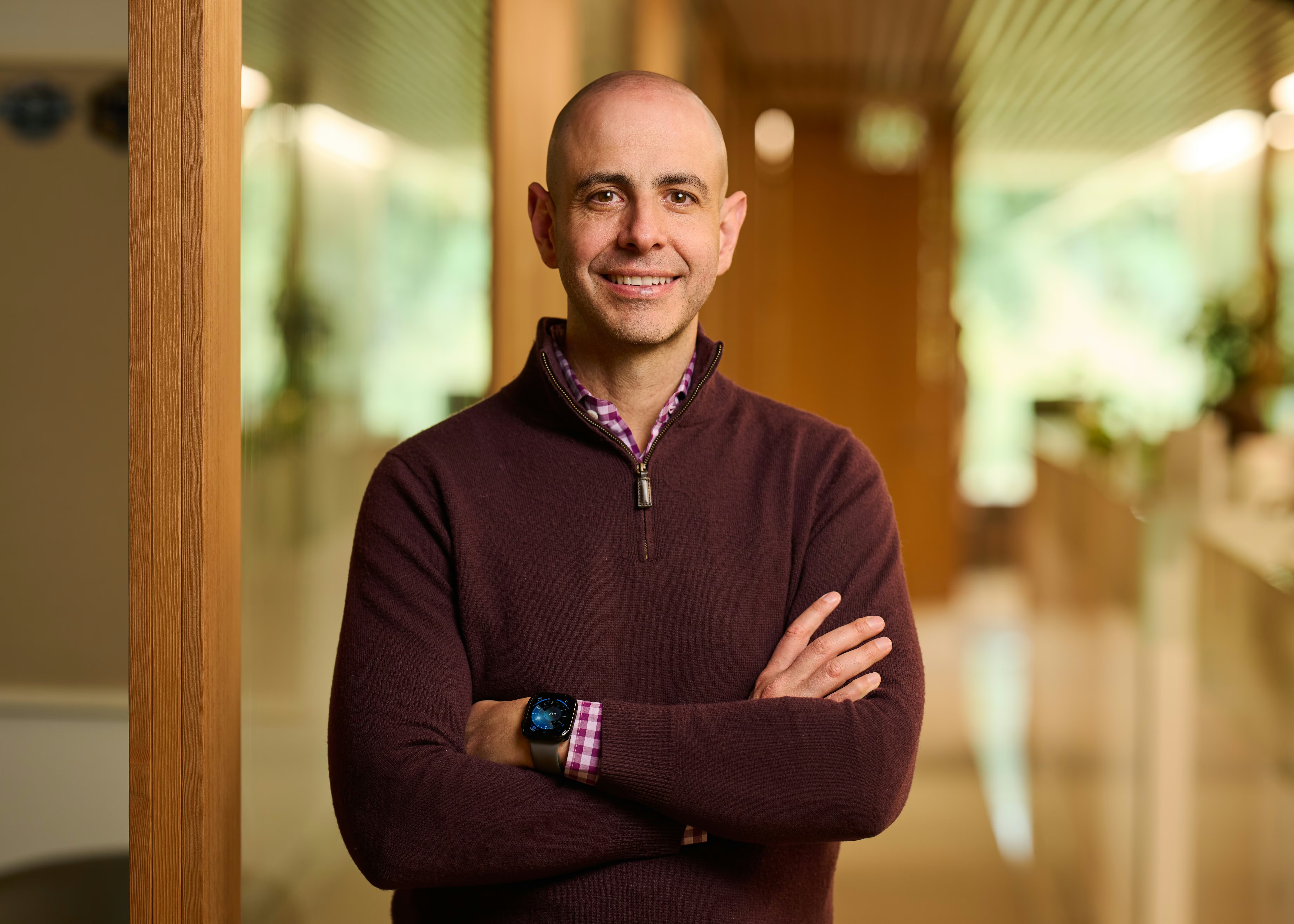
Before "operating partner" became a Silicon Valley title, Ryan Scott was already doing the job - turning raw growth numbers into repeatable systems at Grubhub, Etsy, SoulCycle, and Slice. Now at Khosla Ventures, he's the person founders call when the product works but the market doesn't know it yet.
Ryan Scott is the kind of person who, as a teenager, was quietly running a domain-flipping business on the early internet. While most kids were on AIM, he was buying and selling web addresses - an obsession that never fully stopped. Today he owns roughly 19,000 domains. Most of them are inactive. All of them are a window into how his mind works: always scanning the horizon, always naming things before anyone else knows they need a name.
That instinct for early positioning is exactly what he's brought to every job since. At Grubhub Seamless, he arrived when the company was doing $100 million in gross sales and left after its IPO with $6 billion on the ledger. At Etsy, he was the company's first-ever CMO - it took Etsy fourteen years to decide it needed one, and when it did, it chose Scott. He grew GMV from $3 billion to $14 billion, tripled the active user base, and pushed the brand into 220 countries. The year 2020 was not easy for most businesses. Etsy earned AdAge Brand of the Year.
Since joining Khosla Ventures as Operating Partner, Scott has been the person Vinod Khosla's portfolio companies call when the product is real but the market hasn't found it yet. His thesis is deceptively simple: fix the brand positioning first, measure product-market fit through retention and PMF scoring rather than vibes, and hire growth leaders who think in systems rather than just channels. He presented this framework at the Khosla Ventures CEO Summit in May 2025 - a session that's now available as a video and document for founders to study.
His career reads like a tour through the decade when digital consumer behavior rewired itself. He's had senior roles at American Express, DIRECTV, Acxiom, StubHub, and TheStreet. He served as CMO and CCO at SoulCycle when it was redefining what a fitness brand could be. He ran the same dual role at Slice. He co-led Pond5 as CEO until Shutterstock acquired it. At each stop, the pattern repeats: he finds a company where the product has outrun its marketing, and he closes the gap.
He holds a seat on Google's Retail Advisory Council and Meta's Leadership Council. He's on the board of Rover, the pet care marketplace. He's a two-time Webby Award winner, an AdAge Marketer of the Year, and a Search Marketer of the Year. Forbes put him on their Entrepreneurial CMO 50. He has a BA from the University at Buffalo in biological anthropology and marketing - two fields that are, if you squint, the same discipline - and an MS in strategic advertising and communications from Columbia.
He listens to The Daily on his commute, values its skill at making hard stories accessible, and considers that kind of journalistic clarity a model for great marketing. He's been doing Ashtanga yoga since 2019 and has logged over 450 classes. He's been married 21 years. He is, in all measurable ways, someone who plays the long game and is very good at it.
"Keep commerce human has never been more relevant or more important."
- Ryan Scott, on Etsy's brand mission"It's very hard for mass retailers to be the place people want to go when they want something to feel special. That's where Etsy steps up."
- Ryan Scott, The Drum"We've focused on shifting to more emotional advertising as a way to build top-of-funnel awareness."
- Ryan Scott, on Etsy's marketing evolutionFrom his May 2025 CEO Summit presentation at Khosla Ventures: four pillars for building durable, compounding growth.
Durable growth doesn't start with channels. It starts with a clear, defensible position that tells your audience why you and not anyone else. Weak positioning is the silent killer of otherwise working marketing budgets.
Don't rely on vibes or top-line acquisition to declare product-market fit. Use retention curves and PMF scoring. The truth about fit lives in whether people come back - not whether they first arrive.
The worst growth hires are channel specialists pretending to be strategists. The best understand how brand, acquisition, retention, and monetization compound over time. Hire for the model, not the tactic.
From Etsy's TV pivot to Grubhub's brand campaigns, the through-line is consistent: emotional advertising builds the top-of-funnel that performance marketing can't. The two aren't in conflict - one fuels the other.
Ryan Scott at the Khosla Ventures CEO Summit • May 2025 • "Growth Lessons That Matter"
"Keep commerce human has never been more relevant or more important."
"We've focused on shifting to more emotional advertising as a way to build top-of-funnel awareness."
"It's very hard for mass retailers to be the place people go when they want something to feel special. That's where Etsy steps up."
"Being part of a team that had the power to evoke such a strong emotional reaction was incredibly rewarding."
"We're seeing great success with TV - driving powerful brand impact while generating sales."
"My team and I are tasked with taking all of the incredible work being done to enhance the Etsy experience and sharing it with the world."
As a teenager, Scott ran a profitable business buying and selling website domains. The habit never fully stopped. He now owns approximately 19,000 domains - most inactive, all a sign of a mind that names things before markets catch up.
Since 2019, Scott has attended more than 450 Ashtanga yoga classes. That's roughly two sessions a week for six years straight. The same person who builds compounding growth models is apparently also very good at showing up.
Etsy was founded in 2005. It didn't hire its first CMO until 2019, when it chose Ryan Scott. The company waited fourteen years to need the role, then grew GMV from $3B to $14B in the five years after. Timing is everything.
Scott recommends The Daily podcast as a model for marketers. Not for the news - for the craft. Its ability to make complex topics accessible is, in his view, exactly the skill great marketing requires.
He studied biological and physical anthropology at Buffalo and strategic communications at Columbia. On paper, very different. In practice: both are about understanding why humans behave the way they do and what to do about it.
21 years married. A portfolio of ~19,000 domains. A yoga practice measured in years, not weeks. This is someone who does not confuse short-term results for actual wins.