Ryan Magnussen once answered a question about changing a tire with a rather good definition of delegation: “Depends how quickly AAA responds.” At the time, he ran Ripe Digital, whose Octane TV channel catered to people considerably more interested in cars than that answer suggested. His own garage, he said, paired a Lexus hybrid for business with a 1966 Corvette for fun. Practicality had its parking space. So did pleasure.
That small exchange catches something the job titles miss. Magnussen has spent much of his working life taking emerging technologies seriously without sounding entirely solemn about himself. He built an internet agency, moved into on-demand entertainment, and now leads Wonder Sciences. Along the way, the things people could do with a screen kept changing. His companies tried to turn those changes into businesses.
One venture was acquired. Another closed. In 2025, his work included advising entrepreneurs and helping convene a summit in Antarctica. A career beginning with a university business plan had acquired a fairly unusual travel itinerary. The useful question is how those episodes fit together: what carries over when the product, the audience, and even the continent change?
The assignment that escaped the classroom Magnussen grew up in Palo Alto. His father was a car dealer and entrepreneur, an influence he has explicitly credited when discussing his own career. At the University of Southern California, he also found an influential teacher in Matt Davis. These were concrete examples of people making something happen, close enough to observe rather than admire from a distance.
At USC’s Marshall School of Business, Magnussen developed the plan that became Zentropy. He graduated in 1995; his public education record lists a Most Outstanding Student Award and recognition for the year’s best business plan. A class assignment can enjoy a perfectly respectable retirement in a filing cabinet. This one found customers.
Zentropy was co-founded with Patrick Bradley in 1995, when companies were working out what an online presence should look like. Its work put the founders in the business of translating an unfamiliar medium into something established organizations could use. That is a particular sort of entrepreneurship: explaining the new thing while building it, then persuading someone to pay for both activities.
The name combined Zen and entropy. As business names go, it allowed a little philosophy into the purchase order. There is a pleasing tension there: an agency selling usable websites under a name concerned with order and disorder. The internet would supply plenty of both.
A buyer, then another beginning In 1999, Interpublic acquired Zentropy. Magnussen had moved from a student business plan to a sale to an established advertising group within four years. The transaction gave his early career a definite commercial result, beyond the agreeable language of promise and potential.
Zentropy’s work also expanded through other businesses, including Digital Café, Shandwick Interactive, and the French MDEO. In 2001, the agency was merged into McCann’s relationship-marketing operations. A founder’s company can keep changing after its sale; the name on the door and the organization behind it need not travel together forever.
The next venture took Magnussen and Bradley toward entertainment. Their names appear together as producers of the 2003 documentary Jon E. Edwards Is in Love, released through Ripe Entertainment. The American Film Institute lists the film at 85 minutes, with a Los Angeles opening that August. It is a useful detail in a career often described through internet businesses: there was actual film production here, as well as distribution strategy.
By March 2004, RipeTV was outlining its proposed on-demand model. Television, broadband, and audience participation would be parts of one operation. Magnussen was once again working where an established industry met a new way for its customers to behave. This time, the customer held a remote control.
The remote control gets a vote RipeTV’s early proposition took the viewer’s ability to choose seriously. Programs would be available on demand; the online version would invite voting and polling. Audience responses could influence which shows appeared across the platforms. The plan gave viewers something to do besides watch and gave the company information besides a schedule.
There was another design problem: viewers could skip advertisements. Ripe proposed embedding advertising into the program’s packaging. A sponsor could remain visible while the show played. Magnussen called the approach “TiVo-proof.” The phrase belonged to its moment, but the business concern is easy to understand. Someone had to pay for free entertainment, and that someone wanted evidence of being seen.
The initial programming plan included short films, entertainment reviews, extreme sports, and behind-the-scenes material. Shows were designed for brief viewing sessions. The company was arranging content and distribution together, with each shaping the other: the device mattered, the duration mattered, and so did the amount of patience a viewer brought to either.
An on-demand network therefore involved more than uploading a program. It required a way to find it, a reason to choose it, and an advertising arrangement that survived the viewer’s choices. Ripe was attempting to build that whole chain. Every extra freedom for the audience became another practical question for the business.
Three channels, several screens RipeTV launched in October 2005. Octane TV followed in August 2006, and Flow TV in April 2007. They served distinct interests: general entertainment aimed at young men, automotive programming, and hip-hop. Their separation let the company offer advertisers more specific audiences than a single undifferentiated video collection.
The programs travelled through cable on-demand systems, broadband, and mobile services. Comcast, Time Warner Cable, and FiOS were among the distribution routes; Sprint and Helio carried mobile content. The same company had to think about the television in a living room and the device somebody took out the door.
In 2006, a Cingular campaign illustrated how thoroughly advertising could inhabit Ripe’s shows. Messages appeared around a short program rather than waiting politely for a conventional commercial break. The sponsor occupied the viewing experience itself. That approach made the commercial bargain visible: the audience received free programming, and the brand received repeated opportunities to be noticed.
Ripe’s model also put a price on individual views. Advertising was offered through several embedded formats, including screen surrounds and branded features. Counting a viewing event is different from selling a place in a broadcast schedule. It encourages a business to ask who actually pressed play, and what that action is worth.
The money arrives with instructions In October 2006, Ripe received $32 million in Series B financing. The investors included Hearst-Argyle, Time Warner Investments, Columbia Capital, and Rho Ventures. The announced uses were practical: more networks, broadband and mobile development, measurable advertising, and programming.
Those names placed Ripe alongside organizations with substantial experience in television and investment. Hearst-Argyle’s subsequent public reporting described a 25 percent equity interest and noted Flow TV’s launch. This was a venture with established industry participants behind it, as well as a founder making a case for a different format.
By March 2008, Ripe presented 24 celebrity-centered shows at a New York event attended by an estimated 500 media buyers, advertisers, and producers. Episodes ran four to seven minutes. The event put the company’s product in front of the people who might commission or fund more of it.
The duration is revealing. A four-minute show has little room for ceremony. It asks for attention quickly and must justify keeping it. A slate of two dozen such programs also turns a broad conviction about short video into production decisions: subjects, talent, budgets, and a sales pitch. The founder’s theory had become work for a roomful of other people.
“It is really programmed for instant gratification.”Ryan Magnussen, 2004
The experiment had an ending Ripe Digital’s services ended in June 2009. The closure belongs beside the acquisition in Magnussen’s career, because both are outcomes. A profile that includes the sale and omits the shutdown would leave the reader with a conveniently edited understanding of the work.
Short programming, distribution across devices, and embedded advertising were recognizable ideas. Ripe’s fate demonstrates the distance between having a plausible direction and sustaining a particular company. The record does not require a tidy moral about being too early. It supplies a business that operated, attracted investment, produced shows, and then stopped.
That ending also changes the way to read the preceding numbers. The financing bought an attempt. The channel launches marked execution. The presentations gathered prospective customers. Each was meaningful, and none amounted to a promise of permanence. Entrepreneurship is rather good at producing milestones; it is less accommodating about guaranteeing what comes after them.
Magnussen’s later career includes founding and leading Grail, before his current role as founder and CEO of Wonder Sciences. The sequence shows him continuing to work through different organizations. It does not turn the earlier closure into a disguised victory. It gives the story another chapter, which is a more useful thing.
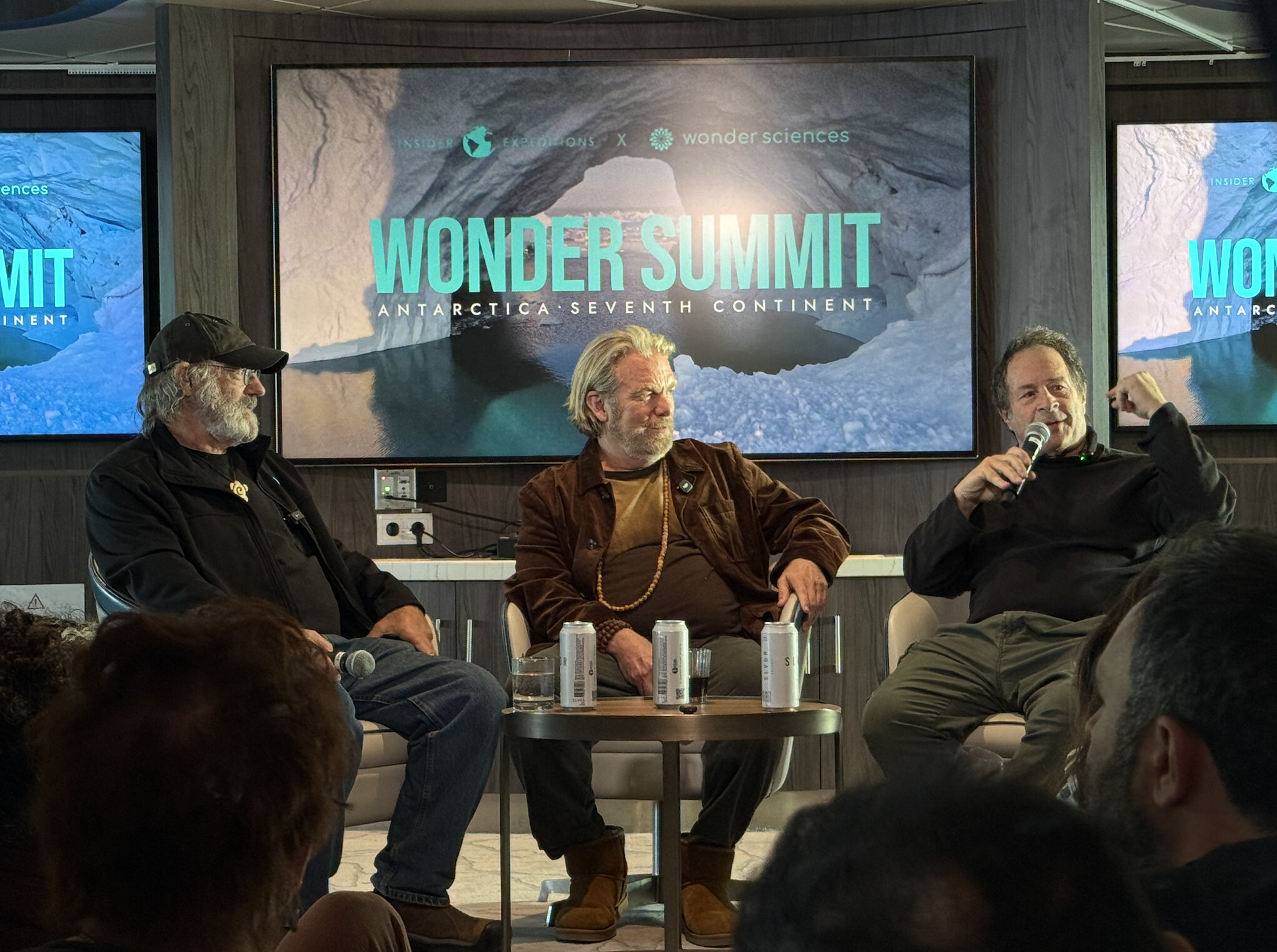
A meeting with a different horizon In November 2025, Wonder Sciences and Insider Expeditions convened 190 participants for the inaugural Wonder Summit in Antarctica. The ten-day event ended on November 25. The guest list included comedian Chelsea Handler and documentary filmmaker Lucy Walker, alongside researchers and technologists. A gathering that might ordinarily require a hotel ballroom had taken to an expedition vessel.
The event photograph shows Magnussen with a microphone, seated beside Paul Stamets and Rick Doblin. The backdrop announces the Antarctic summit. It is a long geographical journey from USC, and a different kind of production problem from putting short shows on several screens: bring people together, give them a shared setting, and organize the encounter.
His work that year also included Unreasonable Impact UK & Europe. As an Unreasonable mentor, he has advised more than 14 companies. That brings his experience into other founders’ decisions, where a career containing both an acquisition and a shutdown has something practical to contribute.
The through-line is visible in the work: university ideas becoming an agency, audience choices becoming a television model, entrepreneurial experience becoming advice. Magnussen’s career leaves room for ambition and for the consequences of trying it. And somewhere in its margins sits that wonderfully economical answer about AAA. Knowing what to build matters. Knowing when to call someone else has its uses, too.