A virtual sneaker has an agreeable advantage over a physical one: it does not require another cupboard. For Ryan David Mullins, who reported owning more than 400 pairs in 2020, this was hardly an abstract distinction. He had been collecting since his teens. By the time he helped create Aglet, a game built around digital footwear, he knew the pleasure of acquiring a shoe and the peculiar machinery that could make acquiring it miserable.
The collector’s problem was competition. A desirable release could vanish into the hands of resellers and purchasing bots. Getting dressed had acquired some of the administrative difficulties of buying concert tickets. Mullins saw a game already operating inside the shopping experience: scarce objects, rivals, strategies, the anticipation of a successful hunt. A phone could make that structure explicit and give people somewhere else to play.
Today he is co-founder and CEO of Onlife, whose Smart Map combines the geography of a day with its calendar. The journey between these products is more interesting than a change in fashionable technology vocabulary. Aglet asked people to move through the world to collect something. Onlife now wants to help people move through the world to do something. The street has remained in the picture.
Four hundred pairs, and a problem
Mullins’s interest in shoes came with an interest in games. He and his team played across consoles, computers and phones. Pokémon Go offered a particularly useful encounter between those interests. Playing it in Germany in 2016, he wondered why a location game could not become a commerce experience. People were already competing to obtain objects they wanted. The map could supply a setting for that competition.
“It’s like shopping is now a game.”
Ryan David Mullins
Aglet gave the idea a compact form. Players explored physical surroundings, earned in-game currency and collected digital sneakers. Different shoes brought different attributes to the experience. A collection could be displayed on a virtual shelf; the shoes being worn became part of the player’s progress. Footwear had escaped the cupboard and found a second career as equipment.
There is something nicely literal about the name. An aglet is the tip of a shoelace, the small piece that allows a loose end to pass through a narrow opening. As a name for a company’s first consumer experiment, it came with an accidental visual argument: a connection can be small and still make the rest of the object work.
First, the phone learned to tell stories
Sneakers were a familiar subject for Mullins, but he had already worked on other ways to put culture into a pocket. He left academia for the startup world in 2012, co-founding readfy, an advertising-financed eBook application. The question there concerned access to books and the business model around reading. A phone was becoming a place where a publishing business could be rearranged.
With oolipo, the interest moved toward stories designed for the device itself. The platform combined different media in mobile series. Its 2017 introductory video described an ambition to bring together elements of Snapchat stories, Kindle and Netflix. These were experiments in how a narrative might behave when the screen, the delivery system and the reader’s habits changed together.

His subsequent role at adidas gave that interest in digital experiences a different set of objects and customers. As Director of Future Trends, he worked on innovation, blockchain and creator economy initiatives. It is a job title that sounds as though it ought to come with a telescope. In his next venture, the object of scrutiny was closer: the way people actually sought, collected and cared about sneakers.
In 2019, Mullins resigned from adidas. That October, he and Owen Batt began building Aglet full-time. They assembled a small team across Australia, Germany, the United Kingdom and the United States. The worldwide release followed on April 12, 2020. Books, stories and shoes were different products, but each project involved a phone changing someone’s relationship with something they valued.
The shoes needed looking after
Aglet’s virtual footwear was allowed to become inconvenient. Shoes wore out as players used them. Repair and deadstock stations gave people places to visit and reasons to maintain their collection. Treasure stashes added the possibility of discovering a reward in a particular location. The game gave walking a set of consequences inside the screen.
That care mattered to Mullins’s account of virtual commerce. A digital object could be worn, maintained and traded, rather than simply looked at. He saw the possibility of releasing a design in a game, learning whether people wanted it, and then producing a physical version. The sequence would give a brand information before it committed to manufacturing.
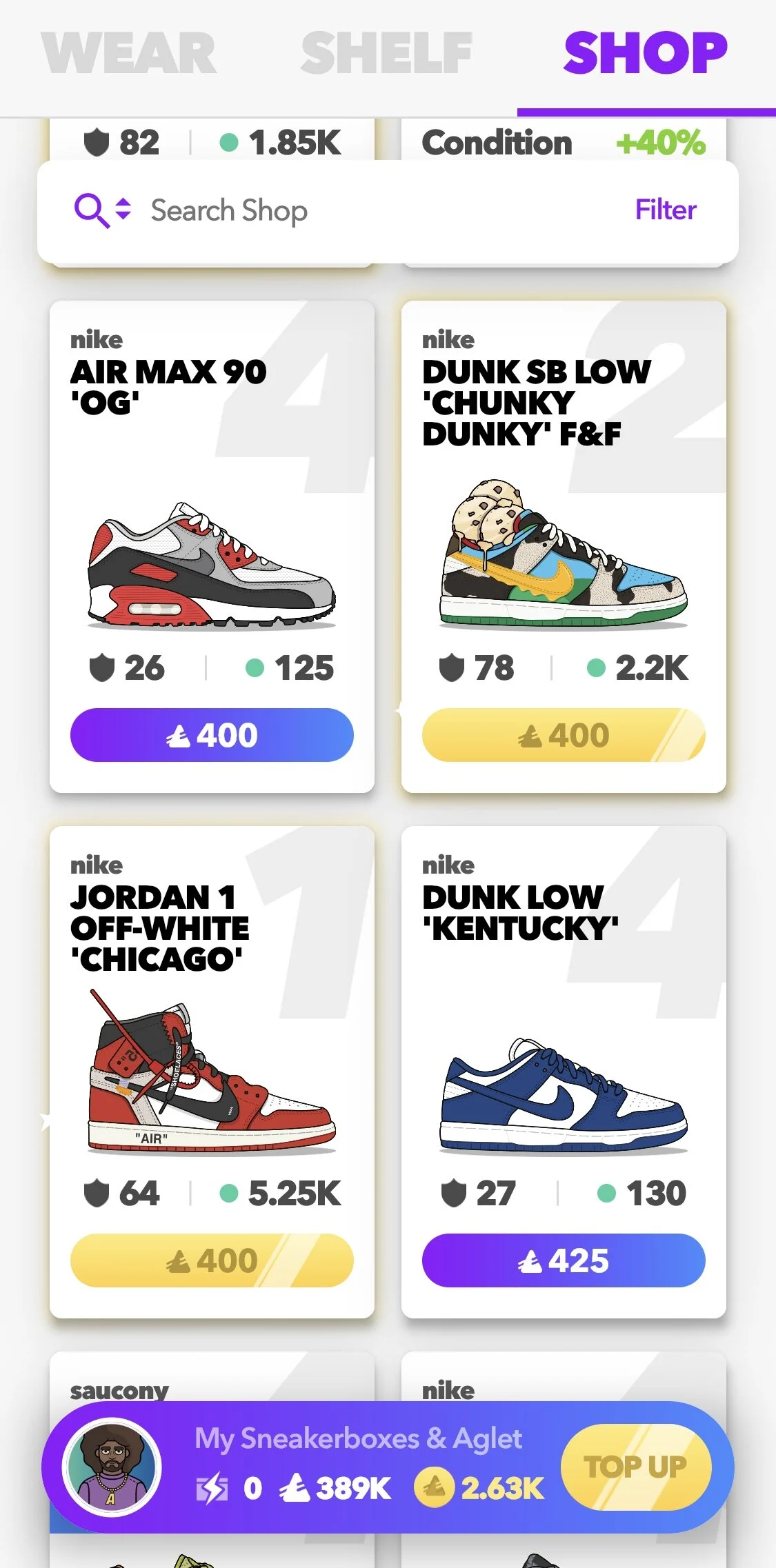
A virtual sneaker could therefore do several jobs at once. It could be a collectible, a game item and an early expression of demand. The appeal of this idea depends on what players actually do with a design over time. A passing glance and a shoe that someone repeatedly chooses to wear in a game tell rather different stories about attention.
Mullins also wanted space for new creators. His early vision included people designing their own footwear and establishing virtual brands. That ambition connected Aglet to his earlier storytelling work: a platform could let people make things as well as consume them. A collector’s game could become a place where a designer first found an audience.
A game with streets attached
Aglet acquired both financial backing and industry recognition. A $4.5 million funding round was announced in December 2020. In March 2022, Onlife reported $24 million raised in total, with Galaxy Interactive and Amazon’s Alexa Fund leading its newly announced round. Those figures describe the company’s financing at those dates; they are milestones in the history of the experiment.
Monthly active Aglet players reported by Mullins in July 2022.
Onlife’s current description: over 4 million players globally. These are different measures.The specific award is worth getting right. In 2021, Aglet won the Media & Brand Awareness category at the LVMH Innovation Awards. For a sneaker game, recognition in a category concerned with brands and attention was a useful expression of the commercial argument. Playing could become a way of encountering a product.
The location mechanics also proved adaptable beyond a footwear collection. Manchester City and PUMA worked with Aglet on a treasure hunt for the club’s 2023 tour of Japan and Korea. Visiting designated places in Tokyo and Seoul unlocked virtual merchandise. Fans elsewhere could participate through a global step challenge, with physical prizes also available.
That collaboration made the original premise easy to see. A digital reward could give a physical place an extra reason to be visited. A club, a brand and a game could share the same route. The phone supplied another layer to an activity already taking place in the city.
The distance between appointments
Onlife’s current product approaches the map with a more everyday task. Calendars are excellent at putting events beside each other. The world is less obliging. Two tidy rectangles on a screen may require a journey, a departure time and a revised plan. A day takes place somewhere, even when its organizing software treats it mainly as a sequence of hours.
Collect a reward.
Understand context.
Account for travel.
The Smart Map brings together calendars, reminders, travel information and an AI assistant. Onlife describes the Spatial Behavior Engine as the technology underneath it, and places that engine within its BrightLight architecture. The company traces the foundations to data-processing lessons from Aglet. The game supplied practical experience with activity attached to location.
The ambition is broader than a calendar display. Onlife wants software that responds to the changing shape of a person’s day. Its mission statement talks about understanding the relationship between individuals, businesses and their environments. The useful everyday version of that proposition is concrete: knowing where an obligation sits and what it takes to reach it.
For Mullins, this keeps the digital and physical relationship close to the original idea. A virtual sneaker gave the walk a purpose inside a game. A map organized around plans gives the walk, drive or journey a purpose inside the day. The reward has changed. Geography continues to insist on its part in the arrangement.
The philosophy books stay open
Mullins maintains a public writing practice alongside the company. His essays bring technology into conversation with philosophy, theology and aesthetics. His stated interests include human dignity in an age of artificial intelligence and the possibility of wonder in a world increasingly mediated by algorithms. Heidegger and Stephen Wolfram belong to the same reading landscape.
The titles show how persistent the questions are. In September 2025, he published How AI Gets Truly Useful: A Tiny Personal World Model. In February 2026, his LinkedIn writing returned to philosophy with The Most Undervalued Skill in AI; or, How Things Hang Together. These subjects sit close to the company’s interest in software that understands context.
His official Aglet biography also identifies JustinTV and Twitch as influences on his thinking about the relationship between digital media and physical life. A 2022 conference biography records another continuing ambition: directing movies. The interest in stories has survived the change in products. The reader, player and map user each inhabit an experience someone has arranged.
There is a pleasing consistency to this career. Mullins keeps finding a digital experience with a physical life attached: a book read on a phone, a shoe collected on a walk, an appointment that requires crossing town. The next test is whether Onlife can make those daily journeys easier to organize. A collector knows that getting hold of an object is only the beginning. Eventually, you have to live with it.
Follow the route
Explore Onlife’s Smart Map, read Mullins’s essays, or find him on LinkedIn, X and Instagram.
Conversations & further reading
- Inside Moves #8: interview announcement and YouTube link
- Onlife Podcast with Ryan David Mullins and Aaren Cristini
- GamesBeat: Aglet’s July 2022 player milestone
- VML interview: virtual goods and physical commerce
- MVFP Akademie: the readfy years
- Aglet’s origin story
- Manchester City: the Aglet tour treasure hunt
- The Lifestyle NYC: the collector behind the game
- Fashion Tech News: Aglet’s 2021 award and commerce vision
- Börsenblatt: mobile storytelling at oolipo