Ryan Caldwell had access to financial advice he did not particularly need. His single mother, who was struggling with money, could have used more help. The imbalance stayed with him. Here were two people connected by family, separated by the financial system’s ability to pay attention. A bank could record what happened to their money. Whether it helped them decide what to do next was another question.
That experience helped inspire MX, the financial technology company Caldwell founded in 2010. It also gives his career a more useful starting point than a funding announcement. His original problem was recognizably domestic: the person who needed guidance was having trouble getting it. The software, the institutional partnerships and the eventual boardroom arrived after that.
Today he is MX’s founder, chief executive and board chairman. His customers include the institutions that stand between financial information and the people who might benefit from it. He has spent much of his working life trying to close that distance. There is a certain comic difficulty in the assignment. Banking has become very good at remembering the price of lunch. Caldwell wants it to become better at understanding the person who bought it.
Before the bank statements
Caldwell’s route into this business began well outside a conventional banking career. He attended the United States Air Force Academy from 1994 to 1996. His own account of those years includes class leadership, boxing, wrestling, skydiving and soaring. It is an unusually airborne list for someone whose later work would involve the earthbound business of account information.
He subsequently transferred to Brigham Young University’s Marriott School to complete a business management degree with an information systems emphasis. The combination matters: his education put technology and the operation of an organization in the same frame. A financial interface may be software, but getting a bank to adopt it requires more than knowing how to write it.
There were businesses before MX. His entrepreneurial record includes MadKey, sold to AirWired in 2005, and EnticeLabs, sold to Neutron Interactive in 2010. He also worked at Zinch and held advisory roles with TopBlip and Grasswire. Those earlier ventures make MX a continuation of an entrepreneurial career rather than a sudden conversion to founding.
He had also consulted in Silicon Valley, Singapore and London, with work for companies including Visa and Microsoft. The eventual Utah founder had encountered organizations operating across very different markets. By the time he started MoneyDesktop, the business that became MX, he had experience both building companies and working around larger ones. His next company would need to do both at once.
The visitor who became a co-founder
In 2010, Caldwell was building MoneyDesktop while Brandon Dewitt was working on MyJibe, a personal finance application. Their companies approached a similar question from different starting points: how could people understand their finances well enough to manage them? Dewitt came to Utah to meet Caldwell. The visit turned into an extended collaboration, with months spent planning and writing code.
MoneyDesktop acquired MyJibe in November 2011. The company later took the MX name. That sequence is worth keeping straight. A founding partnership can emerge through an acquisition as readily as through two people sitting down on day one with a shared notebook. Caldwell and Dewitt brought existing work together, then built a common enterprise around it.
Dewitt’s account of the decision adds a revealing detail. He considered the relationship with Caldwell important enough to forgo immediate cash and see how the partnership developed. Later, as MX brought in substantial investors, Dewitt described a similarly methodical approach. He, Caldwell and finance chief James Dotter called references and asked difficult questions. Even money had to submit to an interview.
Caldwell’s early experience also gave him a less comfortable lesson about colleagues. Looking back on MoneyDesktop’s first year, he described a company held back by having the wrong people in important roles. He credited changes to the team, including Dewitt and Dave Jaynes, with helping it move forward. “We have a culture of candor,” he said. It is a short sentence with a fairly demanding job description.
“We have a culture of candor.”
Ryan Caldwell, 2015
A better answer than a string of numbers
The work itself is often hidden from the people using it. MX connects financial information, improves its usefulness and supplies tools through financial institutions and technology companies. One practical example Caldwell has discussed is cleaning up transaction descriptions. A baffling string of letters and numbers becomes a recognizable merchant. The customer can identify a purchase without briefly becoming a detective.
He has also compared the possibilities for banking with the personalization people encounter in services such as Spotify. A music service learns from what someone plays or skips. A financial institution has its own record of behavior, yet turning that record into useful guidance takes work. His argument concerns what an institution should do with knowledge it already holds.
By January 2021, the argument had attracted substantial backing. MX announced a $300 million Series C led by TPG Growth at a $1.9 billion valuation. CapitalG and other investors participated. Those were company financing figures, a dated measure of what investors were prepared to support. They put real resources behind Caldwell’s effort to make financial data useful at a larger scale.
Scale also changes the kind of problem a founder faces. A young company can persuade a customer through the force of a demonstration. An established provider has to sustain the relationship after the meeting ends. Caldwell’s task increasingly involved the people and processes that make a promise repeatable. The bank’s customer would never see most of that work. They would notice whether the result helped.
A return, and a preference for conversation
Caldwell moved into the executive chair role in early 2022 and returned as chief executive on June 18, 2024. The chairmanship had kept him involved in MX’s direction; the return put him back in charge of its daily leadership. In announcing the move, he emphasized the opportunity for financial institutions and fintechs to use permissioned data to improve products and customer outcomes.
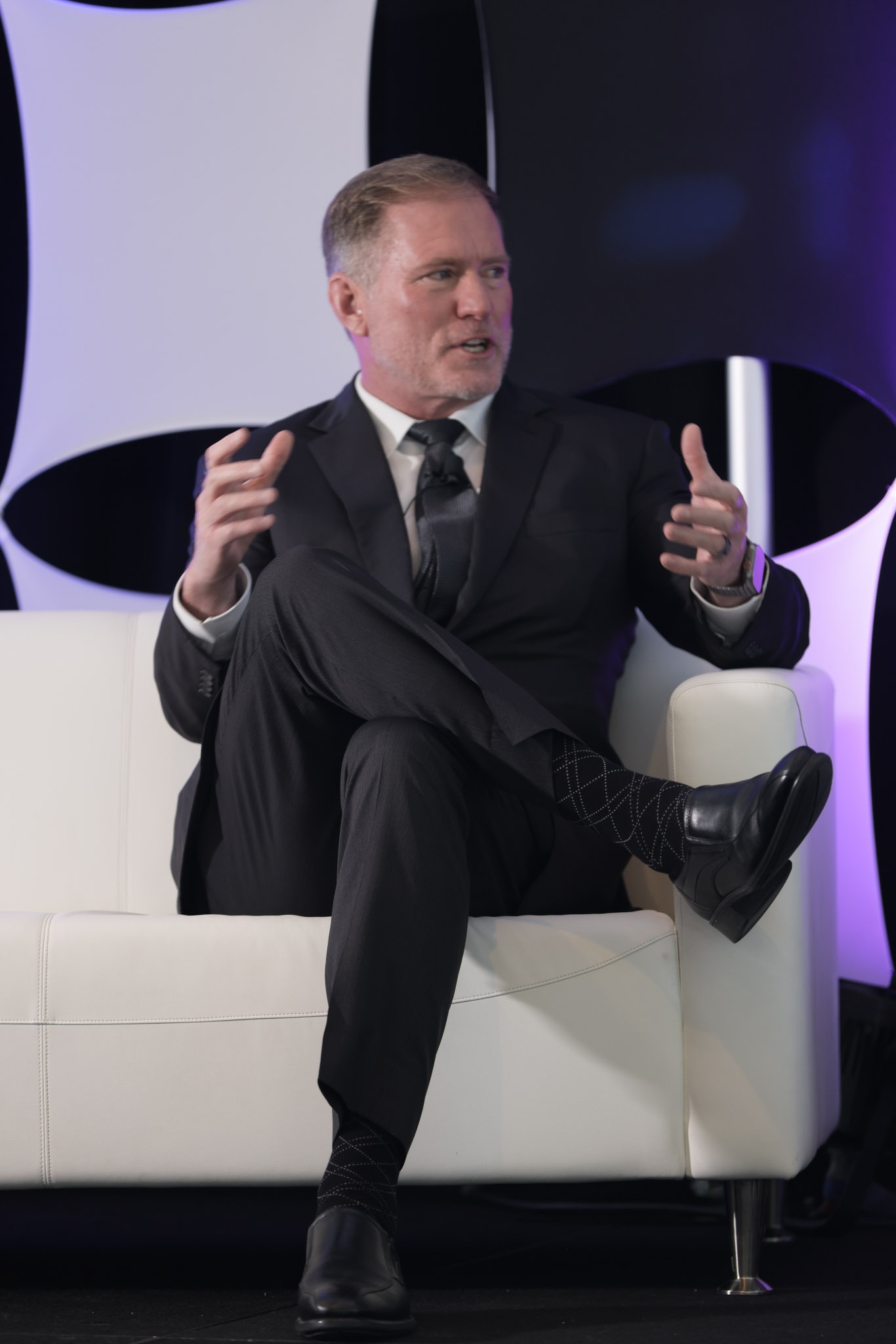
Later that year, at the Money Experience Summit, he appeared in conversation with MX’s Crystal Anderson. The setting supplied an accidental visual joke: smoke outside a gathering devoted to clearer financial experiences. Caldwell joked about the atmospheric staging. Then he explained his preference for unscripted exchanges: “I like just candid conversation.” The delivery suited an executive whose earlier account of building a team had emphasized frankness.
His definition of partnership was equally pointed. A useful partner listens, looks ahead and sometimes says no. For a software company, that last part carries consequences. A customer can request a feature that satisfies an immediate concern while leaving the larger problem untouched. Caldwell’s account allows room for disagreement inside a commercial relationship. It asks the provider to exercise judgment, and the customer to tolerate hearing it.
This is where his consumer ambition meets the bank’s business. He argues that institutions must help people make better financial decisions if they want to keep their relationships. A customer has alternatives. In that view, usefulness becomes a reason to stay. The logic is practical enough to survive a conference stage: a bank that wants loyalty needs to earn it in the ordinary moments when someone asks for help.
The next question arrives in plain English
In March 2026, Caldwell took that argument to the FDX Global Summit in a session with Dominic Venturo, U.S. Bank’s chief digital officer. His emphasis had moved beyond establishing a connection between systems. Institutions needed information they could interpret and use. Shared standards and permissioned access remained part of the foundation, because a useful experience still depends on the information reaching it reliably.
A few months later, on June 30, MX announced a conversational financial AI assistant. The proposed experience would sit inside a financial institution’s own digital banking channel and answer questions using enriched, permissioned customer data. The announcement described a product being developed for an upcoming launch. Its ambitions were specific; its eventual results would have to be judged in use.
The planned division of responsibility is revealing. Conversation would provide information and decision support, while actions such as moving money would go through the institution’s existing transaction processes. MX also described controls over data use and visibility for administrators. A friendly answer on a screen would be only the visible end of a more complicated institutional arrangement.
For Caldwell, this extends the same old question into a new interface. If a person can ask about money in ordinary language, the institution should be able to offer a useful response grounded in that person’s circumstances. The test is easy to state and harder to pass. Fluency may make software pleasant company. Financial usefulness requires the answer to have something solid underneath it.
- 01Connect
Bring together permissioned financial data.
- 02Understand
Clean and interpret the information.
- 03Help
Make it useful in the customer’s next decision.
The company he keeps
Caldwell’s public work in 2026 also shows the less theatrical side of running a company. In September, MX appointed Rebecca Moulton general counsel. She had joined in 2011 as its first in-house attorney. Caldwell praised her earned trust and execution. The appointment placed someone with a long memory of the business in a role central to its next decisions.
MX’s Founders Day offers another glimpse of what the company chooses to preserve. It recognizes Caldwell and Dewitt’s shared foundation and asks employees to take ownership of problems. In a business built around data, that is a notably personal instruction. An organization still needs someone to decide that a customer’s difficulty belongs on their own desk.
Caldwell remains occupied with the distance between a financial institution’s knowledge and a person’s need. It is the distance he noticed in his family before MX existed. The tools have changed, and the company around them has grown. The unresolved question is still small enough to fit into a household conversation: you know where my money went. Can you help me work out what happens next?