Ryan Ahern had someone to call. Shortly after Truveta was founded in 2020, he contacted Michael Jaff, a former supervisor who had moved to Boston Scientific. Ahern had a new company to explain. Jaff had a reason to listen. Their conversation helped lay the foundation for a collaboration between the two businesses. Before the partnership had its institutional shape, it had the rather more manageable shape of two people who already knew each other.
It is a small beginning for a company story, which is one reason to keep it. Funding announcements tend to arrive with their own brass band. A call to a former colleague goes about its business more quietly. Yet the latter can help explain how the former becomes possible: someone understands an idea, recognizes another person’s interest in it, and makes an introduction worth following.
By September 2026, Ahern would be named interim co-CEO of Truveta alongside fellow co-founder Jay Nanduri. Between the early outreach and the shared title lies a career concerned with getting organizations to work together. Its telling details include a supervisor’s number, an office used as a meeting venue and a birthday that nearly slipped past in a busy calendar.
An invitation with a useful address
Ahern’s approach to Jaff gives the story a specific point of contact. The two had worked together at Massachusetts General Hospital. By the time Ahern reached out, Jaff had joined Boston Scientific. An older professional connection now crossed the boundary between two companies.
That crossing is easy to summarize and harder to manufacture. Knowing someone does not settle the terms of a partnership. It does, however, give a new idea somewhere to land. A conversation can begin with shared history rather than a lengthy explanation of who is speaking and why the other person should remain on the line.
The episode offers a useful way to read Ahern’s business career. Partnerships require a view of both sides of the table. Someone has to understand what a company hopes to build and what a prospective collaborator has reason to want. Ahern’s early outreach put those two perspectives in contact. The subsequent work belonged to organizations, but the opening was personal.
The business titles came early
Before Truveta, Ahern worked as an engagement manager at McKinsey & Company. At Clarify Health Solutions, he led corporate development and data strategy, with responsibilities including mergers, acquisitions and strategic partnerships. These were jobs in which an attractive plan eventually had to meet another institution’s priorities.
The vocabulary changed between consulting and corporate development. The practical questions overlapped. What is worth doing? Who needs to agree? What would make the arrangement useful enough to survive the enthusiasm of the first presentation? A résumé lists the employers. Those questions help explain the kind of work moving between them.
Early coverage of Truveta in October 2020 identified Ahern as its chief business officer. The title is a helpful detail for anyone encountering him through his later position as Chief Medical Officer. Commercial responsibility was visible near the beginning of his Truveta story. His involvement in building relationships was already part of the company’s public identity.
His advisory work extends beyond Truveta. He also serves on Kitotech Medical’s business advisory board, another position that keeps his professional life connected to the decisions being made inside a company.
Truveta brought him together with founders whose experience included large technology organizations. Myerson had spent years at Microsoft; Nanduri was a former Microsoft technical fellow. Ahern’s own route through consulting and corporate development added another set of working habits. The founding group contained several ways of looking at the same enterprise.
Different organizations. Repeated work on strategy, partnerships and execution.
Forty chairs, fifty people
In 2023, Ahern and Lisa Gurry proposed a customer symposium. The first version would take place inside Truveta’s office. There would be room for a deliberately small gathering: 40 participants, divided evenly between two groups of partner organizations. Fifty ultimately attended, with academic customers joining too.
The arithmetic has a pleasingly human scale. You can picture forty chairs. You can also picture the mild logistical revision required by fifty people. This was a young company making space for people who had reasons to know one another, then discovering that the invitation had travelled a little further than the initial plan.
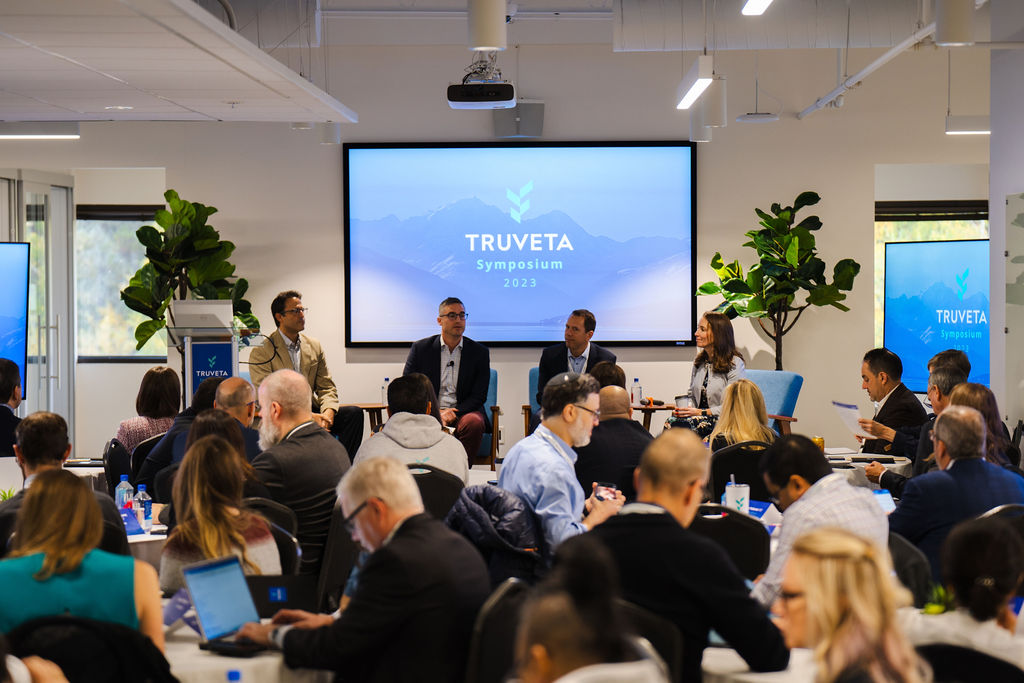
Myerson had worried that nobody would turn up. The event instead produced connections between people who did not ordinarily meet elsewhere. It also brought requests for more discussion of the company’s future plans. Customers had come to exchange ideas; they wanted the company to keep talking, too.
Ahern and Gurry’s proposal made room for that exchange. An office meeting may sound unremarkable beside a product launch. But a useful gathering gives participants something a presentation alone cannot guarantee: the chance to ask each other questions. It lets the company hear the conversation developing around its work.
A birthday between meetings
There is another small scene in Ahern’s public record, this time without a room to arrange. Reflecting on Truveta’s fifth anniversary, he wrote that the preceding weeks had been so busy he had barely paused to consider the birthday. September had supplied the milestone. The calendar had evidently supplied everything else.
His reflection thanked the team, member organizations and partners. It looked forward to the next five years. The emphasis was collective, consistent with his fourth-anniversary message, which had also singled out the people participating in the company’s work.
Anniversary posts are a familiar corporate genre, somewhere between the thank-you note and the office cake. This one adds a recognizable detail: building the thing can interfere with remembering to celebrate the thing. There is an ordinary working life tucked inside the founder narrative, complete with a crowded schedule.
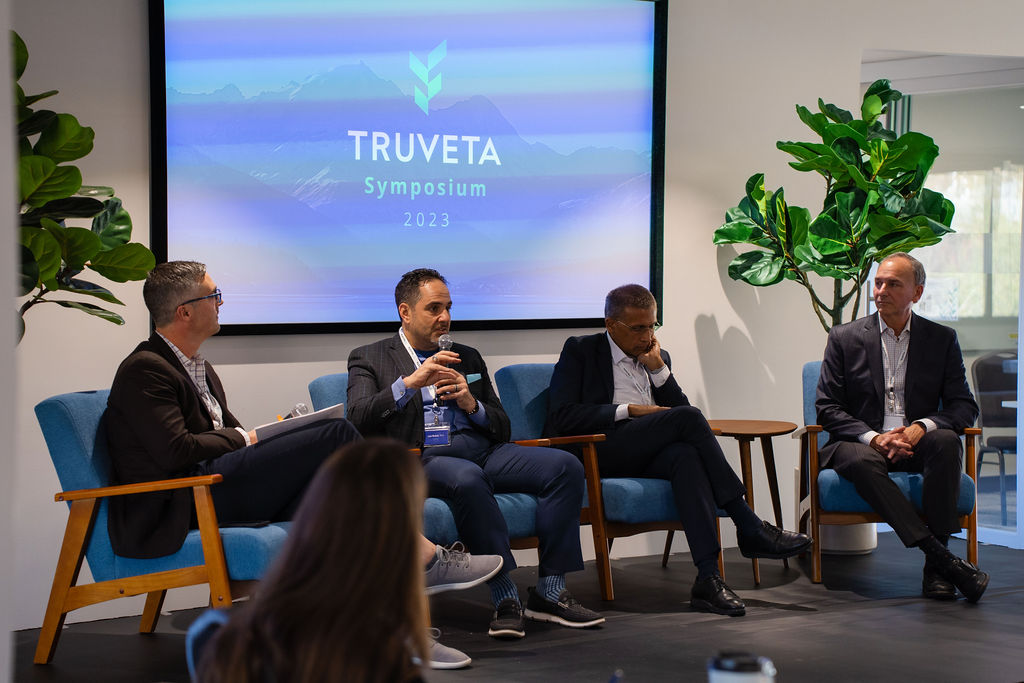
At a later symposium, Ahern again emphasized being together in person after work conducted across teams and time zones. He mentioned sharing a panel with Michael Jaff and Jennifer Webster. Jaff’s name reappears years after that early outreach, giving the story a continuity that a sequence of job titles would miss.
Two names on the door
On September 15, 2026, Truveta announced Myerson’s retirement and the appointment of Ahern and Nanduri as interim co-CEOs. The board would search for the next CEO. The appointment placed the company in the hands of two people who had helped establish it six years earlier.
The word “interim” matters. It describes the arrangement accurately without predicting the result of the search. Ahern’s new responsibility was real; the permanent leadership decision remained with the board. A founder can know a company from its earliest days and still face a new assignment inside it.
“Ryan takes care of demand.”
Jay Nanduri, on their division of responsibilities
The division of work was practical. Nanduri would continue to oversee engineering, product and underlying data systems. Ahern would run sales, marketing, customer delivery and the evidence services team. One shared title sat above distinct responsibilities. Their customers would still need someone to answer the next question, deliver the next piece of work and keep the relationship functioning.
For Ahern, this widened duties already familiar from partner development. At Truveta he had led the Life Science Partner team, responsible for developing relationships and helping partners succeed in their research. Shared leadership brought that customer-facing experience into the company’s top office.
A founding role becomes a shared responsibility for a larger organization.
The people who answer
Myerson’s departure also changed the scale of the handover. He described a business that had begun without employees, customers, technology or data and had grown to 500 people. Ahern and Nanduri were taking responsibility for an organization populated by the people its founders had once needed to persuade to join.
That is a different task from explaining a new idea to one sympathetic contact. It brings more colleagues, more commitments and more opportunities for one person’s decision to affect another person’s working day. The relationships that helped create a company become part of what its leaders must look after.
Ahern called helping build Truveta the most meaningful experience of his career. His transition statement credited Myerson’s leadership and expressed enthusiasm for the work ahead. The statement placed gratitude beside responsibility, an appropriate pairing for someone inheriting a larger role in a company he already knew.
The useful image to carry forward is still the room. Ahern helped propose a gathering, watched partners come together and later returned to the value of meeting in person. A business can become much larger than those moments. It continues to depend on people agreeing that the next conversation is worth having.
His connection to Myerson had itself begun with an introduction. Jerry Grinstein, a Madrona co-founder and former Delta Air Lines CEO, was Ahern’s uncle by marriage and connected the two. The detail puts another person in the founding story, someone outside the eventual executive pairing. Before Ahern could help bring partners to Truveta, a relationship had helped bring him to a future co-founder.
His education crossed institutions too: Boston College for a bachelor’s degree, the University of Washington for an MD, and Harvard for an MPH. The credentials sit alongside the consulting and corporate development roles. Together they describe a career assembled across several organizations, rather than a single employer’s ladder.
For Ryan Ahern, the next conversation now comes with a co-CEO’s responsibilities. There are colleagues to lead and customers to serve. The old skill remains relevant: know whom to call, give them a reason to listen, and make the meeting worth their time.
Keep the conversation going
Explore Ahern’s public work and the moments behind this profile.