A movie location begins as an address and ends as an argument. The argument says this street can be Boston, this storefront can be 1970s Los Angeles, this ordinary room can hold an extraordinary confession. Between address and argument lies the work: scouting, permissions, neighbors, generators, trucks, weather, time, and the delicate civic mystery known as parking. Russell Hadaya has spent much of his career in that in-between territory, making invented worlds physically possible without letting the machinery crowd the frame.
His first major-film lesson came in a city that is suspicious of anyone who claims to know it too quickly. On Gone Baby Gone, Ben Affleck's 2007 Boston crime drama, Hadaya was credited as a location intern and location assistant. It was an entry-level title attached to a film in which place did more than decorate the plot. Dorchester was atmosphere, memory, class, and moral pressure. To work there was to learn that a neighborhood cannot be ordered from a catalogue. It has to be understood, and then asked.
Hadaya had been studying at Ithaca College from 2004 to 2008. His campus life reads like an early draft of a production call sheet: football, club lacrosse, radio DJ shifts, promotions work, cinema classes, and student films. Sport teaches choreography under pressure. Radio teaches timing. Promotions teaches the ancient craft of persuading people to show up. Student films teach that someone will forget a cable. A location department eventually requires all four educations, often before breakfast.
A city is a cast member with a calendar
The credits accumulated by increments. Hadaya worked as a location assistant on Edge of Darkness, scouted for Medeas, assisted on Breaking the Girls, and served as a key assistant location manager on episodes of Amazon's Betas. The titles differ in scale and mood, but the underlying bargain remains the same: a production wants the world to bend briefly around a story, while the world would prefer to collect its mail and get to work.
That makes location work a branch of diplomacy with better walkie-talkies. A beautiful building that cannot accommodate a crew is not a location. A perfect street that collapses the schedule is not perfect. The craft lives in a compound question: does it look right, can it work, and will the people who live there still speak to you after wrap?
The answer is rarely contained in a photograph. A scout must imagine the direction of the sun hours later, the sound of an idling bus, the distance to a holding area, and the route a truck can take without clipping a branch. Then comes the human map: the shopkeeper opening at six, the resident with a sleeping baby, the city desk that needs another form. Cinema can make a location feel inevitable because the location department has spent days confronting everything contingent about it. The romance is assembled from curb measurements and returned phone calls.
A credit-by-credit apprenticeship
By 2019, Hadaya was supervising key assistant location manager on Dolemite Is My Name, the Eddie Murphy film about Rudy Ray Moore's magnificently improbable journey from record-store clerk to blaxploitation folk hero. The production needed present-day Los Angeles to perform its own past. The result has color, grime, heat, and the slightly dangerous optimism of people making a movie with more conviction than money.
For that work, location manager David B. Lyons and Hadaya were named on the film's 2020 Location Managers Guild International nomination for Outstanding Locations in a Period Film. Hadaya was also in the 2019 California on Location Awards field for assistant location manager of the year in feature film. Neither recognition turns logistical work into glamour, thank heavens. It simply lets the hidden architecture show for a moment.
The best location work produces a peculiar illusion: the audience believes the place was waiting for the story all along.
The producer enters the picture
Hadaya's résumé does not stay within one department. He co-produced the 2016 short Mother's Day, directed by Nico Raineau, and took an executive producer credit on the 2017 feature All About the Money. In 2016, he formed Chip City Entertainment in California, where public business filings list him as manager and describe the company as working in entertainment investment and production.
The name requires one useful clarification. This Chip City is not the cookie retailer founded in Queens. Hadaya's company is a Los Angeles entertainment business, established before the bakery's documented 2017 debut. Search engines may enjoy the collision. Biography should not.
Producing and location management are closer cousins than they first appear. Both ask a person to hold the finished thing in mind while dealing cheerfully with everything trying to prevent it. Budgets do not care about tone. Permits are unmoved by character development. A producer makes the improbable fundable; a location professional makes it parkable.
That movement between departments also makes Hadaya's filmography more revealing than a tidy ladder would be. His work includes features, television, short films, a music video, and the APEX Legends PRO AM esports special. One year may require protecting a period illusion; another may involve the compressed energy of a live event. The common asset is not a genre specialty. It is an ability to translate between creative ambition and the material world, which is forever asking where the cables go.
The project that kept going after wrap
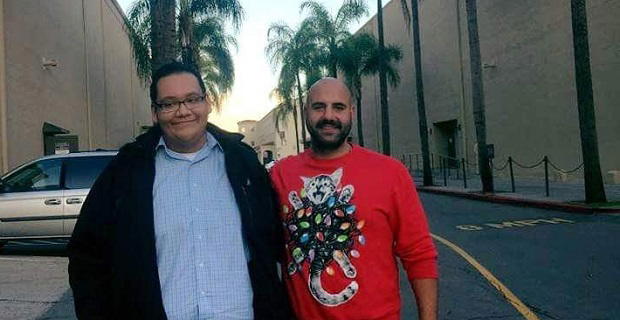
In November 2015, Hadaya volunteered at an event called “Only in Hollywood” at LA Film School. The nonprofit Create Now had brought young people from group homes and shelters to make a short video and try arts projects. There he met Ricardo Ortega, a teenager living in foster care. Hadaya helped him begin a screenplay.
A workshop can easily become a benevolent afternoon, photographed and forgotten. This one did not. Hadaya and Ortega stayed in touch. Their connection grew into years of mentoring and friendship, with movies, meals, and expeditions through Los Angeles. Ortega went on to study at Cal State Dominguez Hills and advocate for foster youth, with ambitions in public office.
“I really appreciate Create Now for connecting kids through the arts. There's much more that can come from that, and we are a case in point.”Russell Hadaya
There is an elegant continuity here. Hadaya's commercial work finds places for stories. His volunteer work helped someone find a story of his own. The technique is surprisingly similar: listen closely, notice what could exist, and handle enough practical details that imagination gets a fair chance.
His service record extends beyond one relationship. He coached club lacrosse at Occidental College from 2011 to 2013, volunteered as a teacher, fundraiser, and mentor with Create Now, and served as a board member and clerk with the Local Development Catalyst Network. These are not celebrity gestures arranged around a premiere. They are recurring appointments, the sort that require calendars.
The virtue of being just off camera
Film culture encourages us to imagine authorship as a single chair with a name on it. A set knows better. It is a temporary city populated by specialists, favors, contingencies, and people who can solve a problem without turning the solution into a speech. Hadaya's career belongs to this collective version of authorship.
The progression matters. Intern. Assistant. Scout. Key assistant. Location manager. Producer. Founder. Each title enlarges the circle of consequences. On the 2019 APEX Legends PRO AM television special, he held the location manager credit. On Dolemite Is My Name, he supervised within a large department. On an independent feature, he sat among the executive producers. The work changes, but the appetite for coordination remains.
His public self-description uses two gloriously unfashionable words: motivated and reliable. Neither will be embroidered on a director's chair. Both are invaluable when a company move is late, the light is leaving, or a young person needs an adult to keep the next meeting. Reliability is not charisma's dull cousin. In production, it is the floor beneath everyone else's daring.
Hadaya's story is therefore not about escaping the background. It is about discovering how much can be done from there. A period street can carry the ghost of another decade. A modest company can give independent work a legal and financial home. A single afternoon with a screenplay can open into years of friendship. None of these things arrives by spectacle alone.
A location scout learns to look at an ordinary place twice: first for what it is, then for what it might permit. That may be the most useful way to read Hadaya's career. The street is a street, but also a set. The volunteer shift is an afternoon, but also the start of a durable bond. The entry-level credit is a line near the end of a crawl, but also a door. He has made a profession of seeing the second possibility, then doing the work required to keep it open.