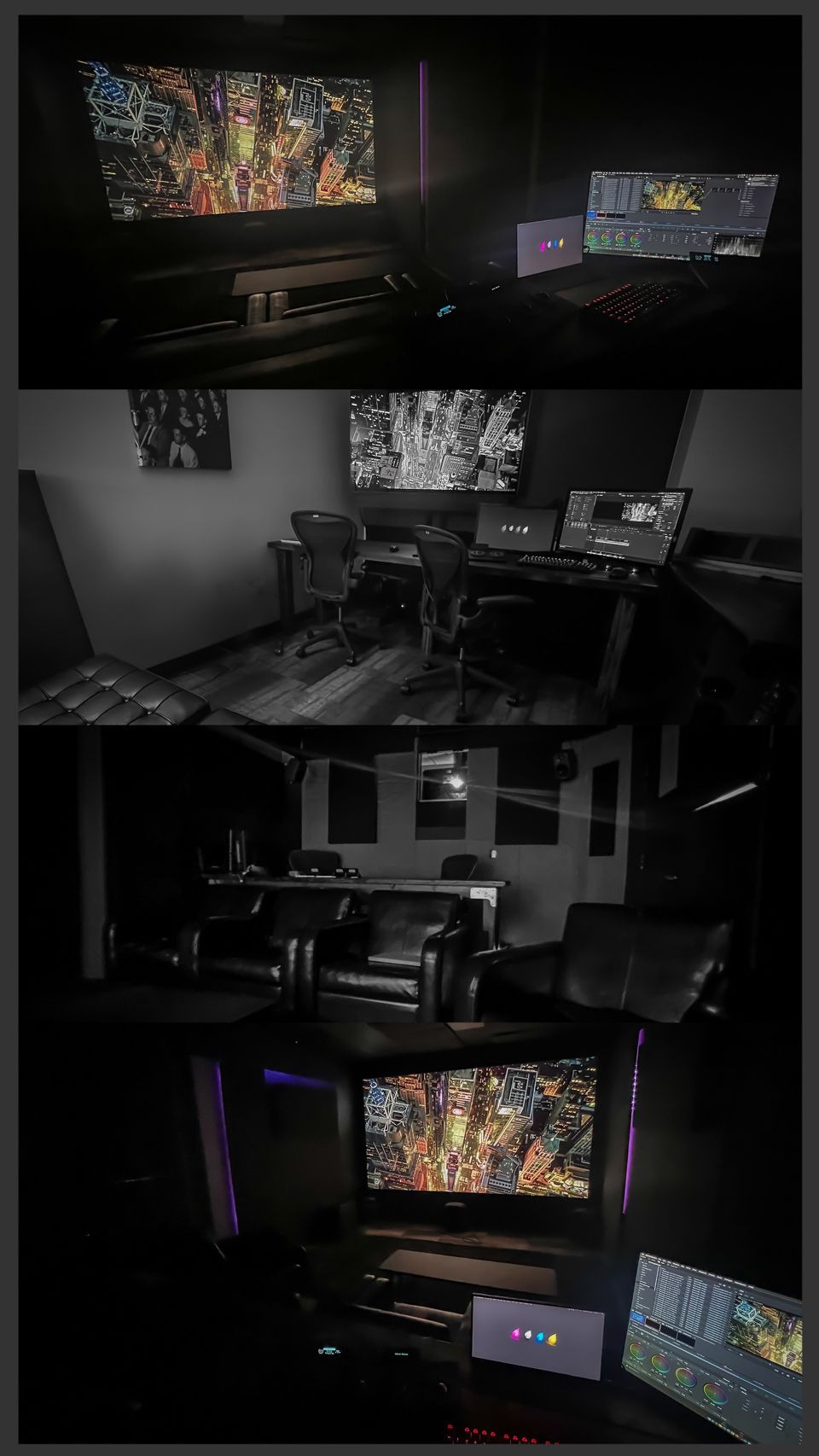
Aaron Peak works at the point where a film has already survived the expensive weather of production. The actors have gone home. The editor has moved the story around until it holds. The director and cinematographer have watched the same cut so many times that temporary choices begin to look ordained. Then the picture reaches a dark room in Los Angeles, and Peak looks at it as if it has just arrived.
The job is color, although that small word carries an indecent amount of responsibility. A colorist balances one shot against the next, protects skin tones, places darkness, guides attention and helps a collection of images speak in one voice. The good work can be difficult to point at afterward. Viewers remember a winter afternoon, a feverish club, a lonely kitchen. They rarely remember the person who helped those places feel that way.
Peak seems suited to this kind of partial invisibility. His public biography is thin. His screen credits are plentiful. His LinkedIn portrait is a face emerging from black, while his Instagram avatar is a dog in the surf. It is a charmingly unhelpful arrangement for anyone seeking the standard founder tableau of crossed arms, exposed brick and a strategically blurred office plant.
Fresh eyes are Peak's stated advantage. Before grading, he talks with the director and director of photography about narrative, mood and intention. He does not want months of looking at the offline edit to become a substitute for judgment. The colorist arrives late enough to see what familiarity has concealed, but early enough to change it.
The dark roomA career written in the last pass
Peak studied at the Art Institute of Pittsburgh from 2003 to 2005. By 2006 his name appeared in the credits of Made in L.A., the PBS documentary about garment workers organizing for labor protections. He handled color and graphics and also worked as an online editor through Solvent Dreams. The credit is an early clue to the shape of his career: one person, several adjacent jobs, all gathered around the finish.
The following years put him inside a fast-changing post-production business. He worked as a digital effects producer on Smiley Face and as a digital-intermediate colorist on four Command & Conquer games. At Hollywood DI, he joined colorists moving entirely to DaVinci Resolve just as graphics processors and desktop systems were making sophisticated finishing more attainable. In 2011 he colored Bobcat Goldthwait's God Bless America, which screened at the Toronto International Film Festival. The machinery was becoming less ceremonial. The eye remained the scarce component.
His credits widened with the tools. Imperial Dreams, Me + Her, Call Me Lucky, Little Pink House, Sword of Trust and Endings, Beginnings place Peak in dramas, comedy, documentary and a cardboard puppet romance. He has been named as colorist, online editor, post-production supervisor, digital artist and visual-effects supervisor. These are separate titles, but modern finishing makes close neighbors of them.
Me + Her is especially tidy evidence. The 2014 short built a Los Angeles love story from cardboard, a material that gives the smallest change in light an outsized emotional effect. Peak is credited not only as colorist but also as online editor and post-production supervisor. On a production made from handmade streets, puppets and carefully scaled photography, the finish was not decorative polish. It was part of the illusion's engineering.
Other collaborations began before the final session. Cinematographer John Guleserian worked with Peak in advance to build the look for Drake Doremus's Breathe In, then returned for the final grade. The film was conceived as a darker cousin to Like Crazy, with restrained camera movement, minimal lighting and an image shaped by many small decisions rather than one fashionable wash. Peak's part began in preparation and ended in the theater, a reminder that fresh eyes do not require a stranger's eyes.
On Call Me Lucky, cinematographer Bradley Stonesifer described a very fast turnaround. The work was exact and unshowy: balance the image from shot to shot, add a touch of saturation, decide where black and white belonged. Stonesifer had worked with Peak for years. His compliment was direct.
Restraint appears again in the short film Papa. Cinematographer Logan Schneider created a controlled visual arc in camera, beginning with darker, higher-contrast images and opening the picture as its relationship developed. Peak, working at Neon Diesel Finishing, kept the grade minimal and honored what had been photographed. A colorist owns a formidable set of knobs. Taste is knowing which ones should remain lonely.
The room begins to travelOne click, no geography lesson
A grading suite is intimate by design. The display is calibrated, the walls and ambient light behave, and the collaborators sit close enough to discuss whether a shadow feels too cool without raising their voices. That arrangement works beautifully until the director is across town, the producer is across an ocean or nobody is allowed in the same room.
Peak's answer grew from the working problem. With director Nenad Cicin-Sain and producer Paul Geffre, he co-founded Samara Systems, a remote collaboration platform built by filmmakers. It began as a way to conduct color sessions at a distance, then expanded toward production. A Samara encoder could take a feed from a camera, DIT system, video assist or post-production workstation, encrypt the signal and make it viewable through a connected device. The platform included live video and text chat because pictures travel poorly when the conversation does not travel with them.
Its diagrams read like a map of Peak's working life. Visual effects, editorial, color and sound enter on one side through SDI or HDMI. Authorized collaborators watch on a calibrated display, laptop, tablet or phone on the other. Samara did not transfer the underlying files; it streamed encrypted video and could sit behind a facility's existing firewall. A decoder supported environments where a calibrated monitor still mattered. The point was not to pretend every screen was equal. It was to let the right person see the right version without booking an airline seat.
The timing was severe and useful. Samara launched publicly in 2020, when production teams were discovering that a video conference was not the same thing as a trustworthy motion-picture feed. By that October, the company said its system had been used on more than ten films and five commercials. The technology supported 1080 HD, UHD, HDR and multichannel sound, with the promise of collaboration across production, editorial, visual effects, color and audio.
There is a founder's philosophy hiding inside that joke. Peak had spent years in rooms full of complicated equipment. He did not confuse complexity under the hood with difficulty at the wheel. Samara's public instruction was essentially plug in and click once. The expertise belonged inside the system, where it could quietly serve the expert using it.
to 2025
From color and graphics on Made in L.A. to visual-effects supervision on Ella McCay, Peak's documented credits trace nearly two decades of converging post-production roles.
What remains humanThe operator behind the automation
Peak's recent credits continue that convergence. On Endings, Beginnings, Neon Diesel handled both visual effects and color finishing, with Peak credited as visual-effects supervisor and DI supervisor. Episodes of the 2024 documentary series Investigation Alien list him as a digital artist and supervising colorist. In 2025, he received a visual-effects supervisor credit on James L. Brooks's Ella McCay.
None of this makes the colorist more visible to a general audience. It does make the role more connected. Color now touches data management, visual effects, online editing, remote review and the practical politics of getting several creative people to agree that a face looks right. Peak's career is less a ladder than a control surface: a row of disciplines adjusted in relation to one another.
The connections matter. Stonesifer returned across projects. Schneider trusted him to preserve a carefully photographed arc. Peak founded Samara with a director and a producer rather than with three people who all saw the same side of a set. His LinkedIn posts are sparse, but one offered encouragement to entertainment workers facing a punishing year. Another announced new rooms with the economy of a tradesperson unlocking the door: back to the office, new rooms ready.
That economy also distinguishes his public language about craft. Peak speaks about story, intended feeling and the danger of becoming attached to temporary color. He does not present grading as rescue work performed after everyone else has failed. The cinematographer brings an exposure, the production designer brings a palette, the editor brings duration, and the colorist brings a newly attentive pair of eyes. Authorship here is cumulative. The last hand on the image still has to remember all the hands that came before.
Perhaps that is the useful portrait. A dark suite. A finished image on the wall. Chairs waiting for collaborators. Peak's work begins with the humility to listen and the confidence to alter what everyone has grown used to seeing. His product work follows the same rule: make the difficult system simple enough that the conversation can become difficult instead.
When the lights come up, audiences leave with the story, not the grade. Peak has arranged his career around that disappearance. The colorist changes the picture and then steps out of it. For a founder in the image business, it is an unusually coherent trick.