The first night of The Bush began with a wardrobe error. Justine LaViolette and Jenille Nikke Alleyne had dressed like owners who expected to celebrate: cute outfits, platform shoes, a table, perhaps a drink while they waited to see whether anybody came. They had hired four bartenders. They had not hired barbacks. This looked, from the safe side of the locked door, like an acceptable plan.
Then they reached Troutman Street. The line had already escaped the building and gone wandering down the block. The women who had spent six years trying to persuade landlords, lenders and assorted skeptics that people would come were suddenly confronted by several hundred pieces of evidence. There would be no table. There would be no ceremonial drink. LaViolette and Alleyne spent opening night hauling supplies and helping behind the bar in their party clothes.
A producer may dream in images, but survives by solving the problem directly in front of her. LaViolette was already practiced. Her day job was film production; her company, Perfect Day NY, assembled the crews and logistics that let ideas become something visible. On that April night in 2023, the set happened to have a liquor license and an audience that had arrived before the show.
The consolation prize was a business partner
The origin story begins roughly a decade earlier with a date so unsuccessful that it became useful. After dinner, LaViolette’s date took her to Misster, the lesbian night at The Woods. There, through mutual friends, she met Alleyne. The romance fizzled; the friendship stayed. In LaViolette’s tidy accounting, it was the worst date and the best date of her life.
The two became the sort of friends who could identify a missing institution while sitting together on a couch. They wanted a place with cocktails worth ordering, a seat when conversation mattered, a dance floor when it did not, and a calendar that could hold events. They wanted the ease of queer shorthand, without the labor of explaining the room to a straight audience. After several years of friendship, the question arrived: “Wouldn’t it be cool if this thing existed?”
“Wouldn’t it be cool if this thing existed?”Justine LaViolette, remembering the first idea
Most versions of that conversation evaporate by morning. This one accumulated folders. LaViolette and Alleyne began researching, saving money and learning the exquisite vocabulary of New York hospitality: lease, build-out, community board, liquor authority, insurance. They had no bar experience, which meant commercial landlords could ask the circular question familiar to every first-time founder. Who had already trusted them with the thing they were trying to do for the first time?
At one prospective Bushwick location, they put thousands of dollars into the project and then discovered the landlord showing the space to a church group. It was brutal, and in retrospect useful. Their broker found another room on Troutman Street, close to Maria Hernandez Park, in a stretch of Bushwick with coffee, vintage clothing and queer-friendly neighbors. The address that survived rejection proved better than the one they lost.
From a night out to a night of their own
Two forms of production
LaViolette describes herself as a writer, director and producer. Her public film credits are compact but coherent. She produced Til the Crying Fades, a 2017 music video for Julia Weldon, and Mami, Alessandra Lacorazza’s 2019 short about a young immigrant woman caught between her future and the mother who depends on her. The film traveled to Palm Springs ShortFest, Durban, Nitehawk, the NALIP Summit and the New York Latino Film Festival.
With Lacorazza, she also developed The Boat, a road comedy transferred to water: two queer sisters take a sailing trip while one is reeling from divorce, and the itinerary goes wrong. The project received a pre-production grant from The Future of Film is Female and support from the NYC Women’s Fund for Media, Music and Theatre. Across the work, a pattern is visible. Women and LGBTQIA+ characters are placed at the center, where they can be difficult, funny, lonely and responsible for moving the story.
Perfect Day NY made that focus a business. LaViolette founded the full-service production company in 2019 after years as a freelance producer and photographer and a period as an executive producer at Fresh Content. Perfect Day is certified as woman-owned and LGBTQ-owned. Its name is occasionally mistaken for a California food-technology company. A camera crew arriving in Brooklyn is one way to settle the matter.

Film production and bar ownership share a suspicious number of verbs: scout, cast, schedule, light, open, strike. Both require somebody to imagine what strangers will feel inside a carefully arranged environment. Both also punish anyone who confuses taste with execution. A perfect mood board cannot unclog a sink. A beautiful shot does not feed a crew. LaViolette’s double career joins the aesthetic decision to the unphotogenic follow-through.
A room that can change its mind
The Bush calls itself a dyke bar for queers. The phrase is both specific and roomy. LaViolette and Alleyne wanted to recover the frankness and camp of historic lesbian bars while using the broader language their generation had gained around gender and belonging. Women, trans and nonbinary people are centered; the welcome is wider. The founders did not want to build a museum piece. They wanted somewhere alive enough to flirt in.
The physical room expresses the argument. It can carry conversation after work and turn toward dancing as the evening gathers speed. The early menu carried jokes in its names and considered the non-drinker as seriously as the cocktail devotee. Programming has included comedy, speed dating, craft nights, karaoke, mixers and DJs. The result is less a single identity than a useful range: neighborhood bar at one hour, party at another.
Its polish did not arrive from a hospitality kit. Friends and community members helped with the build. The benches were handmade; the bar top glittered. Even the name came from a fondness for the silly, suggestive names of older gay bars, with an additional wink at Bushwick. That mixture of labor and joke is important. The Bush was designed seriously without becoming solemn. The founders were making infrastructure, certainly, but infrastructure with disco balls and a cocktail called the Pillow Prince.
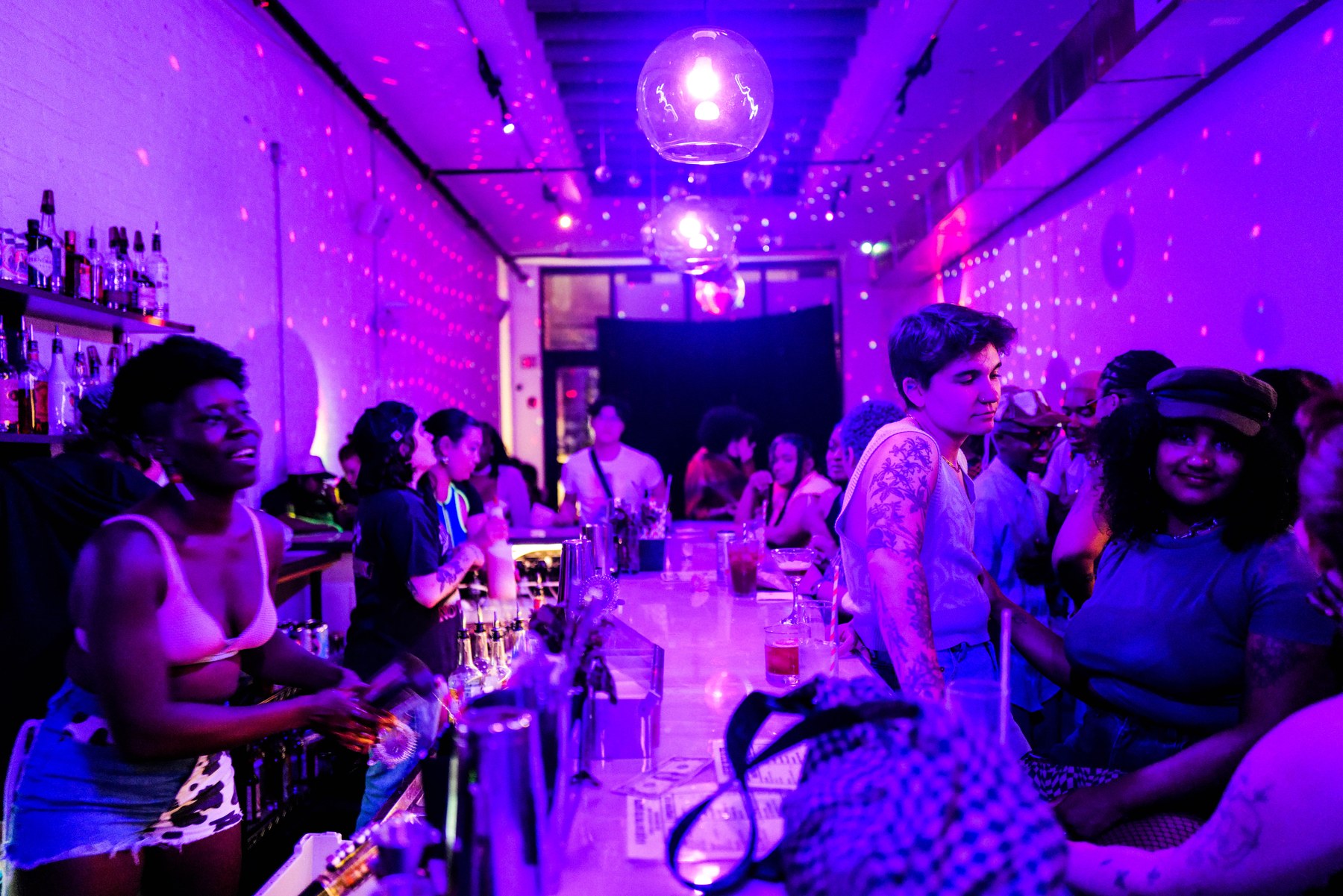
That flexibility contains an economic truth. Opening weekend proved appetite, but nightlife cannot live on opening weekends. Nearly two years later, the founders were candid about the difficult middle of the week. Friday and Saturday crowds look good in photographs. Tuesday through Thursday pay the same rent. The next act was to make The Bush comfortable enough for a quiet drink and durable enough to outlast novelty.
LaViolette’s own schedule made the mathematics personal. Both founders kept day jobs and divided responsibility at the bar, with LaViolette covering weekdays and Alleyne taking weekends in the first months. The arrangement put the glamorous idea of ownership on a practical timetable. A person could move from a production problem in the afternoon to a staffing problem at night, then return the next morning to whichever problem had been more patient.
This is where the tale becomes less like a launch story and more like stewardship. A permanent queer address changes the geometry of a city in small ways. A first date no longer requires waiting for a monthly party. A visitor does not need to know the right promoter. A regular can arrive without an occasion. The room exists on the calendar before anybody makes plans.
The next scene is an ordinary Tuesday
LaViolette and Alleyne have spoken about a larger space and more bars. Their ambition has a pleasing lack of territorial anxiety. They want other people to open sapphic venues too. More rooms do not dilute the community; they give it choice. LaViolette’s joke about the future is also a business thesis: she would like to cruise at a bar where she does not work.
There is something exact about that wish. The project succeeds when its founder becomes unnecessary for an evening, when the staff knows the rhythm, the lights are right, the ice is stocked and somebody else can simply walk in. Producers arrange the conditions for a scene, then stand outside the frame. Bar owners do roughly the same, though they may be summoned back into it by a broken glass or a surprise crowd.
The queue on opening night remains the cinematic image: platforms, panic, a line vanishing toward the corner. Yet the stronger measure is quieter. The Bush is still there after the first photograph, available on an unremarkable weeknight. LaViolette helped make a place where people can meet after their own bad dates and, with luck, leave having found the beginning of something better.