Russell Banzon keeps two kinds of score. One lives in annual recurring revenue, conversion rates and pipeline. The other arrives in eight-counts, clean transitions and the unspoken agreement of a dance crew moving together. His career has unfolded between them: a finance-trained marketer who can discuss attribution models, then explain why a miniature gong or a unicorn piñata may be the more sensible way into a Fortune 500 account.
He is now the chief marketing officer at Cresta, the enterprise AI company focused on contact centers. The remit is broad even by CMO standards. Banzon leads demand generation, corporate communications, product marketing, brand and sales development. His work is to translate a technically dense system of AI agents, real-time assistance and conversation intelligence into something a business can trust, buy and use.
This would be difficult enough if artificial intelligence were merely software. It is also a referendum, a budget fight and a source of extravagant promises. Banzon’s answer is characteristically double-sided: make the idea vivid, then make the evidence difficult to dismiss.
Act IThe spreadsheet learns to sell
Banzon graduated from the University of San Francisco in 2014 with an economics degree and a financial concentration. He completed the program in three years, magna cum laude, and finished as one of three Lehmann Award finalists recognized among the department’s undergraduate students. His early professional stop was Morgan Stanley. The numbers were not a metaphor yet; they were the trade.
He moved through inside sales before shifting into B2B marketing. That sequence mattered. Selling one person across a table taught him the mechanics of objection and attention. Marketing asked him to apply the lesson to a whole market. Roles at Conga and Inkling led toward demand generation. At Talkdesk, he worked globally in the contact-center category, the same operating terrain he would return to years later at Cresta.
In 2019, he joined Gong. Over five years he rose from director of demand generation to vice president of marketing. The company grew from seven-figure to nine-figure annual recurring revenue while creating the revenue-intelligence category, expanding internationally and adding products. Banzon led revenue-marketing functions across events, content, operations, digital and account-based programs.
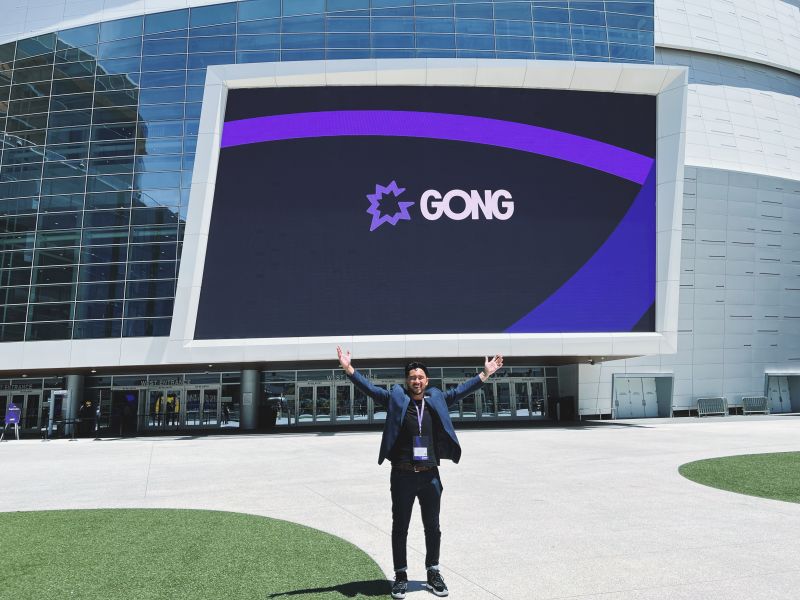
The goodbye he wrote in 2024 named the people before the metrics. He thanked founders Amit Bendov and Eilon Reshef, marketing leader Udi Ledergor, a circle of mentors and the team he had served. A line from his first Gong interview had stayed with him: join, and in two years he might wake up to a different life and career. Five years later, he said the prediction had proved right.
Act IIBring a prop. Keep the receipt.
Banzon’s best campaigns behave like good stage business: the object is memorable, but it earns its place by advancing the scene. At Gong, his team mailed miniature gongs in custom boxes to senior prospects. Sales representatives received a delivery alert, then followed up with a question: who had the recipient given the gong to? The package carried the company’s brand into the prospect’s office and supplied a natural reason for the next conversation.
The program influenced more than 400 opportunities and tens of millions of dollars in pipeline. Another small intervention addressed meeting no-shows. Representatives sent a five-dollar coffee card one hour before a scheduled conversation. Show rates rose by 50 percent. Elsewhere, a shorter, data-enriched demo form produced a 70 percent lift in conversion. None of these ideas required a manifesto. Each removed friction or added delight at a precise moment.
His advice to marketers is less polite. Do not “play Switzerland” with messaging, he has said. A point of view should land firmly enough that somebody might object. On measurement, he is almost severe in the other direction. Attribution systems are useful inputs, not oracles. Ask customers how they found you. Put the answer into the decision. A dashboard is a witness, not the judge.
The campaign scorecard
At Cresta, the experiments have become more literal. In 2025, Banzon helped his team make a commercial with AI-generated video and voices. The total bill was $855.07. He published the exact breakdown: $430.07 for Veo 3, $350 for licensed music, $33 for ElevenLabs, $50 for Kling and $15 for Runway. The latter two helped with exploration but did not appear in the final cut.
The team met for thirty minutes a week across five weeks. They tested, failed, regenerated and edited. Banzon’s own preparation included a sailor clip so bizarre that its roughness became evidence the tools were ready for a more ambitious trial. The finished commercial mattered, but so did the disclosure. In a market fond of hazy productivity claims, a receipt has unusual charisma.
Act IIIA contact center is an ensemble
Banzon joined Cresta in April 2024 because he saw a team, a receptive market and the chance to take part in a consequential build. Contact centers offered structured conversations and repetitive workflows where AI could produce visible business results. The technology could listen across interactions, understand customer-specific language, coach employees in real time and automate suitable work.
His current argument is not about replacing the cast. It is about assigning the scene correctly. In 2026, he said 76 percent of contact-center interactions were already handled by humans and AI working together. High-volume, low-variance conversations may suit automation. High-stakes moments belong with people. His crisp example is a customer considering a $20,000 cruise package: that customer probably wants a human being at the close.
The interesting work sits in the handoff. A system needs to know when the back end is ready, where an interaction might break and which context should follow the customer. Banzon has described a traveler who once mentioned that a son needs an exit-row seat. If that detail returns a year later, the technology has done more than retrieve data. It has made continuity possible.
He is also talking about synthetic customers: personas constructed from real interaction patterns that can test an AI agent before the agent reaches the public. The same simulations can train human staff for difficult calls or help marketers test messages against distinct groups before spending. The goal is rehearsal at scale. Here, the dancer’s instinct and the operator’s caution meet neatly. Practice the dangerous transition before opening night.
The other stageNever settle, always forward
The counterpoint to all this enterprise machinery is The Company, a Daly City hip-hop collective founded in 2005. Banzon has spent years as a semi-professional dancer and director and helps lead the group. Its motto, “Never Settle, Always Forward,” would look suspiciously convenient in a corporate profile if it had not been lived well beyond one.
The collective performs, teaches workshops and hosts an annual showcase called Good Times. Its community work has traveled farther. In 2017, Banzon joined a collaboration that connected dancers with Project PEARLS and workshops for children in Manila. Dance, in that setting, was not extracurricular decoration. It was a means of expression, connection and purpose.
Colleagues have described Banzon as curious, energetic, generous and unusually attentive to the careers of sales-development representatives. He describes his own mission more simply: to learn, grow and succeed while helping others do the same. His leadership advice follows the same line. Culture is not constructed in a virtual happy hour. It appears in ordinary exchanges, especially what happens after an employee answers “I’m good.” Ask again. Mean it.
There are lighter tells. He is devoted to the Warriors and Raiders. He has competed in a local bowling league. A former colleague remembered his charisma, his Jordan 1 sneakers and his willingness to help. The shoes are perhaps the cleanest emblem available: part performance, part Bay Area loyalty, and designed for motion.
The modern CMO is often asked to be an analyst, storyteller, systems designer, recruiter and public optimist. Banzon’s version adds choreographer. He wants hard numbers, but he also watches the transitions: from ad to conversation, from promise to experience, from machine to person. The work succeeds when the audience remembers the moment and the business can account for it afterward.
That is the useful tension in his career. Finance gave him a respect for proof. Dance taught him that timing and feeling are also forms of information. Enterprise AI now demands both. The machines can generate a scene, score a conversation and fill a dashboard. Someone still has to decide what should happen next.