Seven hundred and fifty dollars will buy a modest beginning. In 1999, Roy Sosa and his younger brother Bertrand used that sum to start Netspend from a one-bedroom apartment in Austin. Twenty-four years later, they returned to its consumer business through an acquisition valued at $1 billion. The price of coming home had risen somewhat.
Between those two numbers sits a career concerned with a less glamorous figure: the money an ordinary person has available to spend. Sosa built companies around people whose economic lives were poorly accommodated by conventional banking. They earned money. They bought things. Increasingly, the things they wanted required a card. Cash could pay the rent and still find itself unwelcome at the internet’s door.
Sosa’s answer began with prepaid debit. It grew into investment funds, international payment technology and, in 2023, a new parent brand called Ouro. Through the changes, his brother remained a business partner. Their story has the financial machinery expected of a founder biography, accompanied by an unusually persistent family resemblance.
An apartment, a brother, a way in
Roy was born in Mexico City. He and Bertrand spent their early years in Mexico before moving to the United States in 1986. Roy was 15; Bertrand was 11. Austin became the place where they would spend most of their lives. Roy attended the University of Texas at Austin and served in the U.S. Marine Corps.
The brothers had grown up around cash. In America, they saw how much depended on access to cards and banking relationships. As internet shopping expanded in the late 1990s, the problem acquired a fresh urgency. Having money was one matter; possessing the right instrument for spending it was another. The checkout could be a remarkably particular host.
Prepaid phone cards supplied a useful model. Customers could pay in advance for a service without first obtaining conventional credit. Netspend applied that approach to payments, offering reloadable cards to consumers who lacked established credit or banking relationships. The proposition connected a familiar behavior, paying ahead, with the ability to transact on card networks.
The apartment and the $750 make a memorable opening. The more consequential detail is the customer. The Sosas were looking at people whose needs created a market, even when their financial circumstances made them less attractive to traditional providers. Netspend went public in October 2010. In 2013, TSYS acquired it for approximately $1.4 billion.
Different measures: startup capital and two acquisition values. These figures do not represent Roy Sosa’s personal wealth.
He kept declining the beach
Long before the return, Sosa had already supplied a rather good explanation for remaining at work. Speaking at a Federal Reserve event in 2010, he asked: “So why are we still in this business when we could have just moved to Tahiti or South of France?” A financial-services presentation briefly acquired the atmosphere of a travel brochure.
His answer concerned the continuing purpose of financial inclusion, alongside its commercial possibilities. He talked about the need to fit products to customers, the opportunities in mobile payments and the practical importance of places where money could enter and leave the system. His original example was refreshingly ordinary: obtaining a debit card or opening an account at a convenience store.
That attention to ordinary settings helps explain the next companies. The brothers established MPOWER Ventures and MPOWER Labs, investing in and developing businesses for underserved markets. They co-founded Rêv Worldwide in 2009, taking their payments work into international markets. The ambition extended beyond a single American prepaid product.
Sosa also brought that work into institutional conversations. He became a World Economic Forum Young Global Leader and served as co-chair of its Global Agenda Council on Financial Empowerment. His career includes engagement with the Federal Reserve, the World Bank and the United Nations. The subject traveled from the retail counter to rooms with rather more microphones.
“Entrepreneurship is a team endeavor.”
Roy Sosa · advice to first-time founders, 2020
The billion-dollar return ticket
On May 1, 2023, Rêv Worldwide and funds advised by Searchlight Capital Partners completed the purchase of Netspend’s consumer business from Global Payments. The all-cash transaction was valued at $1 billion. Roy returned as chairman and CEO; Bertrand was president of Rêv. Their newer enterprise had become the vehicle for recovering their earlier one.
The transaction had a precise boundary. Global Payments retained its pay-card business, with Netspend continuing as a partner supporting it. Buying a consumer operation is a different undertaking from buying every business that has ever carried the same name. Corporate family trees require a pencil with a reliable eraser.
There was practical substance behind the reunion. At the time of the acquisition, Netspend described a retail partner network of 100,000 locations where people could purchase or load prepaid and debit products. Rêv brought international payment capabilities. A distribution network and a technology platform gave the brothers something concrete to combine.
In November, the combined strategic assets received a parent name: Ouro. Netspend remained its flagship prepaid brand. Rêv’s X World Wallet added a product aimed at travel and cross-border commerce. Sosa was Ouro’s co-founder, chairman and CEO at launch. A company identity had been built around a return that was already under way.
- 1999Netspend begins
- 2009Rêv takes shape
- MAY 2023Founders return
- NOV 2023Ouro launches
The name drew on the ouroboros, the ancient image of a creature consuming its own tail. It suggested renewal and the meeting of beginnings and endings. For founders who had just bought back their original consumer business, it was a metaphor with unusually cooperative supporting evidence.
New rooms, familiar company
By April 2024, the work was acquiring European partners and a football setting. Ouro named Spanish fintech Bnext as its strategic issuer for European expansion. The companies had already worked together on a Correos prepaid Mastercard distributed through 2,389 Spanish post offices. The local counter had changed countries and acquired postage stamps.
The partnership paired Ouro’s multilingual, multicurrency processing technology with Bnext’s issuing capabilities. Prepaid cards, debit products and digital wallets were among the planned areas of work. Here was the recurring method in another setting: combine a product with institutions and locations that can actually put it in someone’s hands.
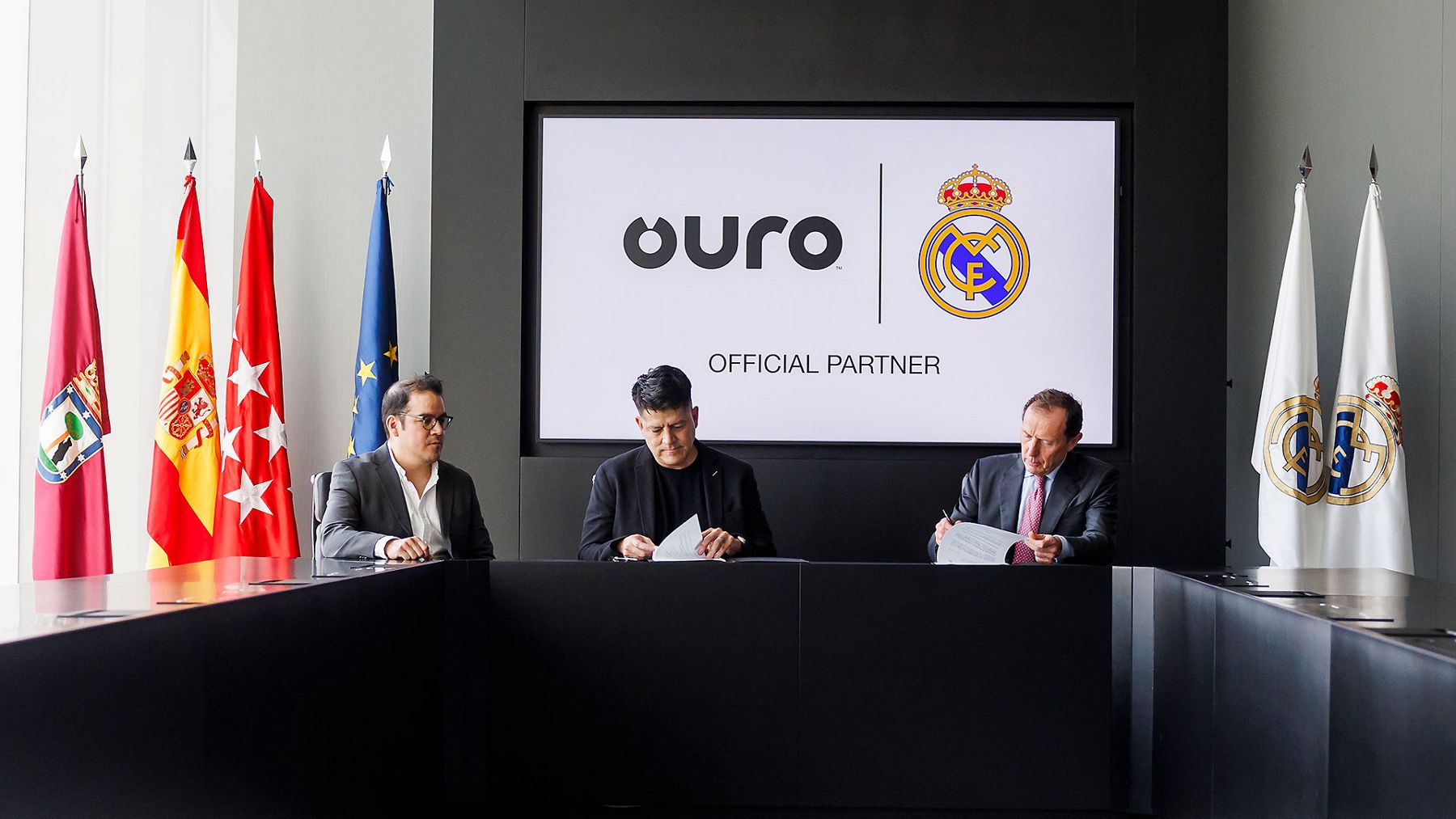
The following day’s announced partnership with Real Madrid put Roy and Bertrand at a signing table with Emilio Butragueño, the club’s director of institutional relations. Ouro became a regional partner in six countries: the United States, Mexico, Brazil, Portugal, France and the United Arab Emirates. The arrangement covered the men’s and women’s first football teams in the prepaid, credit and debit card sector.
The photograph catches the ceremonial part of entrepreneurship: documents, flags, carefully arranged seats. The less photogenic work is delivering the product after the signing. For Sosa, whose advice to founders emphasizes investors, executives, suppliers and customers as partners, a room full of signatures belongs to a much longer process of cooperation.
A teacher enters the balance sheet
Later that month, Sosa appeared before another group with a claim on the future. At the National Teachers of the Year event on April 30, 2024, he presented Ouro’s $275,000 gift honoring 55 State Teachers of the Year. Each was to receive $5,000. The company described it as the beginning of a commitment spanning several years.
Sosa used the occasion to recall a teacher who had helped him at a pivotal moment, while he was adjusting to his new life in the United States. The recollection puts a person into a biography otherwise crowded with companies. Before the founder could make his case to customers and investors, someone had helped the newcomer see more possibility in himself.
$275,000 in total
He spoke about teachers’ influence continuing through the communities their students enter and the people they will eventually meet. It is an expansive way of thinking about a classroom. It also gives his own account of progress a welcome complication: the entrepreneur, so often presented alone at the beginning, had assistance before there was anything resembling a company.
The name comes around again
The business continued to change. By October 2026, Ouro was retiring its name and moving forward under the Netspend brand. Michael Weissman is now Netspend’s CEO. Sosa led Ouro as chairman and CEO at its 2023 launch; today, he is Rêv Worldwide’s co-founder, chairman and CEO. The titles have changed around a business he helped create.
He is also offering advisory conversations to founders through Intro, with subjects including building fintech companies, raising capital, emerging markets and partnerships with financial institutions. The invitation is consistent with the advice he gave years earlier: cultivate strong partnerships throughout the business. His own career supplies several versions of the lesson.
There is the brother who helped start it. The investors who made a return possible. The institutions needed to move money. The teacher remembered long after the classroom. Sosa’s biography is crowded, in the useful sense. Even the celebrated apartment beginning had two occupants working on the idea.
The original $750 gets the reader’s attention. The return explains why the story keeps going. After the public offering, the sale, the international ventures and the new names, Roy Sosa came back to a familiar problem: helping people make use of the money they have. It has proved a durable reason to postpone Tahiti.