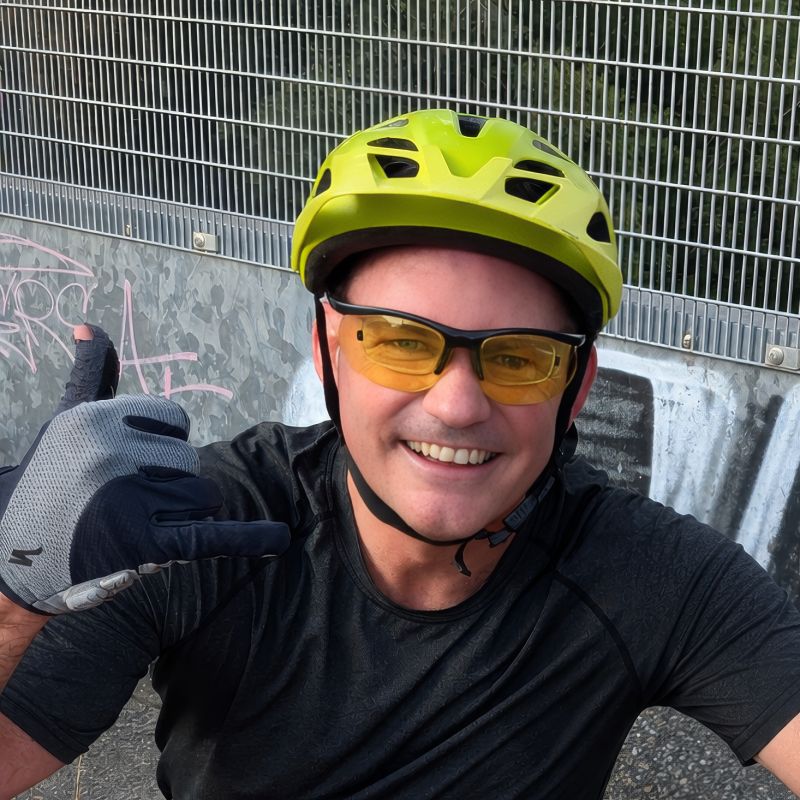
The job offer came on a mountain-bike trail in Wales. Oliver Bradley was riding with Ronald Tweedie, up climbs and into rocky single track, when the founder of Neem suggested they make their working relationship official. Bradley remembers accepting before they reached the car park. Recruitment departments have spent considerable sums arranging less memorable afternoons.
In Bradley’s telling, there was no presentation and no interview panel. There was a red trail, two bikes and a conversation between people who knew one another. He joined Neem as chief digital officer in 2026, after a long career at Unilever. His preferred expansion of CDO was “Chief Dirt Officer”. The appointment had acquired its own explanation before anybody needed to write an announcement.
The anecdote is a good way into Tweedie’s career because it puts a relationship before an organisation chart. Again and again, his working life seems to turn on an introduction: to a client, to a friend with a technical problem, to somebody whose experience could become part of a business. The technology matters. So does knowing who understands the difficulty on the other side of the screen.
The arithmetic of one Ronald
Tweedie came to Britain from South Africa with £500. It is the opening Neem gives its own history, and it has the compactness of a good opening scene: a journey, a small sum and an uncertain next chapter. Johannesburg was where he came from. The Greater Cheshire West and Chester area is where his public professional profile now places him.
Early work brought an introduction to a team at Unilever. Tweedie helped with technology projects aimed at saving money and improving efficiency; further demand followed. Eventually the available work exceeded the available Ronald. Building a team gave the business a way to accept more than one person could deliver. Neem Consulting Limited entered the company register in January 2009, with Tweedie as a director.
There is a practical change of occupation hidden inside that sequence. A developer can answer for the work on their own desk. A founder has to think about who will do tomorrow’s work, how it will be handed over and whether a customer will recognise the same care in somebody else’s delivery. Hiring adds capacity. It also adds the obligation to make individual know-how usable by other people.
Demand grew beyond the founder’s available time. A team became the answer.
Neem now describes a team of more than 200 people across 14 countries. Those are the company’s own figures, and the word “team” matters: this is a claim about the organisation built around delivery. The £500 makes an arresting beginning. The less photogenic business of coordinating people is what allows the story to continue.
The hotel operators had a complaint
Another part of Tweedie’s career began with a familiar irritation: software that cost too much and made a working day harder. Richard Drummond and Jon Erasmus ran hotels. They understood reservations, arrivals and the complications of keeping a hospitality business moving. Erasmus knew Tweedie from his IT days. When the hoteliers wanted a different system, they had somebody to call.
The partnership became Hop. Drummond and Erasmus supplied the operational experience; Tweedie supplied software-development expertise. Drummond later described a development period of two years and beta testing at McKays Hotel in Pitlochry before the system moved into their other hotels. That arrangement gave the product an unusually direct route back to its users. The founders could encounter the consequences of a design decision at their own reception desks.
Launch-era coverage in November 2017 described £500,000 invested by the three directors and software already operating at McKays, The Boat Hotel and the Glen Mhor. Commercial rollout followed, with later accounts identifying 2018 as the year Hop began signing clients. Tweedie joined the board of Hop Software Limited in June 2017. By 2023, coverage identified him as co-founder and chief technology officer.
The distinction between the partners’ skills is more interesting than the usual picture of a lone inventor. Knowing that an operation is awkward does not automatically tell you how to redesign its software. Knowing how to build software does not automatically tell you which awkward operation deserves attention first. Their collaboration brought those two kinds of knowledge into the same conversation.
When the booking leaves Scotland
Hotel software has an advantage over a hotel building: it can travel without a removal van. In March 2023, Hop announced work with five hotels in Duncan Bannatyne’s leisure portfolio, alongside business in Florida and Nigeria and a deal in Barbados. The product combined functions such as bookings, payments, orders and check-ins. Its pitch addressed the expense and complication that had annoyed the founders in the first place.
That summer, the business passed its 200th UK property. It also signed an integration agreement with Australian events-software company iVvy. Weddings and conferences brought another set of tasks into the picture. A hotel’s reservation system sits inside a larger working environment, and partnerships offered Hop a way to connect with more of it.
By September 2023, a contract with Kings Beach Village in Barbados extended the story further. The agreement covered a villa complex, with software supporting guest check-in, payments and room-service ordering. The setting had changed considerably from a Scottish hotel reception. The underlying ambition remained recognisable: bring several pieces of the working day into one place.
- 2017Launch-era reports describe Hop operating in its founders’ hotels.
- 2023Hop passes 200 UK properties and announces overseas contracts.
- 2025A Cape Town office gives Hop a permanent local operation.
In July 2025, Hop opened an office in Cape Town and recruited local business-development and onboarding staff. For Tweedie, the South African connection was personal as well as commercial. The country he had left was now part of a business’s expansion. That does not turn every overseas contract into a homecoming, but it gives this chapter a particular geographical echo.
A company with more than one kind of problem
Hop makes Tweedie’s technical contribution easy to picture: a hotel, a booking and the system behind it. Neem has a broader working vocabulary. Its portfolio spans software platforms, consulting, digital commerce, data and AI, creative work and specialist resourcing. These are different disciplines with different daily demands. Running a consultancy that accommodates them requires more than repeating the founder’s original job description.
The leadership team reflects that range. Oliver MacPherson is chief operating officer, Glyn Roberts chief technology officer and Bradley chief digital officer. Jon Dickson leads creative work, while Setti Douzan is executive vice-president for the Americas. Tweedie remains founder and CEO. The organisation around him makes the shift from individual practitioner to company builder visible in a list of actual responsibilities.
One example of Neem’s product work is Rhino, which tests whether product imagery can be read at a glance. The problem lives at the small end of a screen: an image may contain the right information yet communicate it poorly when somebody is browsing. Neem describes a system for testing imagery in bulk, combining text detection with contrast and clarity measures. It is a different task from running hotel reservations, but still a concrete piece of friction to investigate.
It would be easy to assign every project to the founder and call that a profile. The more revealing point is that these projects belong to a team. Tweedie’s company has become a place where other people’s specialisms can meet a client’s particular problem. That is the longer answer to the early shortage of Ronald’s time.
Work, luck and the next climb
Tweedie has also written publicly about the relationship between effort and luck. Responding to a chapter in Robin Sharma’s The Greatness Guide, he questioned whether hard work necessarily precedes luck, while arguing firmly for the importance of effort. It is a modest but useful glimpse of his voice: he is willing to consider a motivational proposition, then argue with part of it.
“I'm not sure that is strictly true”
Ronald Tweedie, questioning whether hard work necessarily precedes luck
That distinction suits a career in which effort and introductions appear together. An introduction can open a conversation. Somebody still has to deliver the work. A hotelier can explain a frustrating process. Somebody still has to build and test an alternative. A colleague can join a business with decades of experience. The relationship still needs a task worth sharing.
The Welsh bike ride compresses all of that into an afternoon. There is familiarity, a proposal and an answer given while moving. It would be a mistake to turn one ride into a complete theory of management. It is enough that Bradley remembers the offer so clearly. A business appointment has become a story two people can tell.
Tweedie’s career has moved from doing the work himself to assembling the people who can carry more of it. Neem and Hop show different versions of that progression: one built around a range of client problems, the other around the recurring needs of hotels. Both required other people’s knowledge. Both began with something specific to do. And on at least one occasion, the next person joined before the bikes were back in the car park.