A beach is an excellent place to forget the office. Romesh Wadhwani found another use for it. On one holiday, he put a towel over his head so he could see his laptop screen in the glare and carry on working. His longtime colleague Nigel Pratt remembered the scene years later. The towel had become an improvised office. The sea, one imagines, had to manage without his full attention.
It is a small, wonderfully inconvenient detail in a career usually described with very large numbers. In March 2000, i2 Technologies announced a stock deal for Wadhwani’s Aspect Development valued at $9.3 billion. A sensible biography might arrange its furniture around that event and settle down. Wadhwani kept rearranging the room. He built Symphony Technology Group, started SymphonyAI, and put his wealth behind entrepreneurship and employment through the Wadhwani Foundation.
Today, as founder, chairman, and CEO of SAIGroup, he is still occupied with what businesses might become. His story has several beginnings, an unusually long apprenticeship, and a persistent interest in giving other people a chance to begin. Retirement would have made for a tidier ending. He seems to prefer an unfinished sentence.
Before the billions, 124 closed doors
Wadhwani was born in Karachi in 1947. His family moved to India after Partition and rebuilt their lives there. Education became his route outward: electrical engineering at the Indian Institute of Technology Bombay, followed by a move to Pittsburgh in 1969. He arrived with barely $2.50. Carnegie Mellon supplied the next part of his education, a master’s degree in 1970 and a doctorate in 1972.
During his doctoral years, he decided to start a company. He had technical training, but no previous experience running a business. In 1972 he founded Compuguard, developing software for energy management and security in commercial buildings. Before he could build much of anything, he needed someone willing to finance it.
He approached 125 venture capital firms seeking $100,000. The first 124 declined. Urban National Corporation in Boston finally agreed. That sequence makes a pleasing anecdote when told from the far side of success. Living through it would have involved a rather less pleasing amount of travel, explanation, and waiting. The cheque arrived after an extended lesson in how often conviction must introduce itself.
For a first-time founder seeking $100,000, one yes finally followed 124 refusals.
Compuguard became a $10 million business over roughly a decade before he sold it. His next undertaking, American Robot, brought him into industrial robotics and manufacturing software. These were substantial stretches of working life, not a brief montage before the interesting part. Wadhwani later judged his first two companies with a candour that most anniversary brochures would quietly edit out.
“My first two companies were mediocre.”Romesh Wadhwani, reflecting on his early ventures, 2022
The self-assessment matters. Success had not satisfied his own expectations. He had spent about twenty years building businesses and still felt that something larger was happening elsewhere. In Silicon Valley, entrepreneurs were working on computers, storage, and semiconductors. He wanted to put himself closer to that activity, even if it meant surrendering the comfort of a familiar city.
A third company, a different scale
He moved from Pittsburgh to California with his wife and young daughter. The decision meant leaving friends and starting again without an established local network. In 1991, he founded Aspect Development. The name would eventually become attached to the sort of transaction that makes newspaper editors reach for the biggest available type.
Aspect addressed an everyday industrial nuisance: finding and choosing the components needed to make a product. Its software and information helped manufacturers search for parts and understand alternatives. There is little glamour in a component catalogue until an engineer cannot find the right component. Then the catalogue acquires a certain social standing.
When i2 announced its acquisition in March 2000, Aspect brought a database of 17 million parts. Its information complemented i2’s supply-chain software. The announced $9.3 billion valuation was in stock; it was the value placed on the company in that transaction, rather than a personal cash payment to Wadhwani. The distinction belongs beside the number, however much it inconveniences a good headline.
The deal established a new scale for his career. Yet the business beneath the valuation was recognisably practical. Manufacturers needed usable information about the things they bought. Aspect had organised that information into something customers could act on. Years later, Wadhwani would return to much the same commercial question with more advanced technology: where does better information improve an actual decision?
Compuguard
A first company in Pittsburgh.
Aspect Development
A fresh start in Silicon Valley.
Symphony Technology Group
From one business to a portfolio.
SymphonyAI
Another beginning, in enterprise AI.
Finding people who can carry the baton
In 2002, Wadhwani founded Symphony Technology Group, investing in software and technology-enabled services. The work expanded from running an individual company to helping build a collection of them. That changes the founder’s job. Choosing executives and deciding where capital can do useful work become central activities; personal effort alone cannot substitute for an organisation.
His relationships offer a glimpse of how he thinks about that work. In a public LinkedIn post, he described Adobe’s Shantanu Narayen as a friend, noted their shared interest in recruiting strong leaders, and mentioned their love of books. The image is rather different from the solitary founder guarding a brilliant idea. It suggests a career sustained partly through conversation, counsel, and attention to other people’s judgement.
That willingness to share authority became explicit in January 2022. Wadhwani appointed Sanjay Dhawan CEO of SymphonyAI and remained chairman. Dhawan had previously led Symphony Teleca within the STG portfolio. The appointment reunited two executives with experience of working together.
“In my opinion, Sanjay is a better CEO than I am.”Romesh Wadhwani, on appointing Sanjay Dhawan, 2022
Founders are not always celebrated for making that sort of sentence easy to say. Wadhwani said it plainly. His SAIGroup leadership and SymphonyAI chairmanship are distinct roles, and the distinction helps explain this phase of his career: he continues to build while placing operating responsibility in other hands.
AI, with a job to do
SymphonyAI began in 2017. Wadhwani committed $1 billion of his own capital to building it. The ambition was to apply AI to the work of enterprises, including retailers, manufacturers, and financial institutions. A commitment of capital is a statement of intent; the products still have to earn their place inside a customer’s business.
The applications make that test concrete. Retailers need to understand demand and what is on their shelves. Manufacturers need to use equipment effectively. Financial institutions need help detecting money laundering. Each problem has its own data, working practices, and consequences. An impressive demonstration must eventually survive a working Tuesday.
Wadhwani’s interest in AI predates the current rush. At Carnegie Mellon he encountered the work of Herbert Simon and Allen Newell, early figures in the field. His later work at American Robot explored machine vision for industrial assembly. That history gives his recent enthusiasm a longer frame: he has watched the technology change while continuing to ask where it can be used.
In November 2025, he described a change in his own routine. Reviews of disruptive technology that once happened every few months had become weekly, then daily. He argued that India should concentrate on practical AI applications, including smaller reasoning models suited to particular tasks and local data. The proposal reflects the commercial habit visible throughout his career: begin with a problem someone needs solved.
An award scroll, and a longer obligation
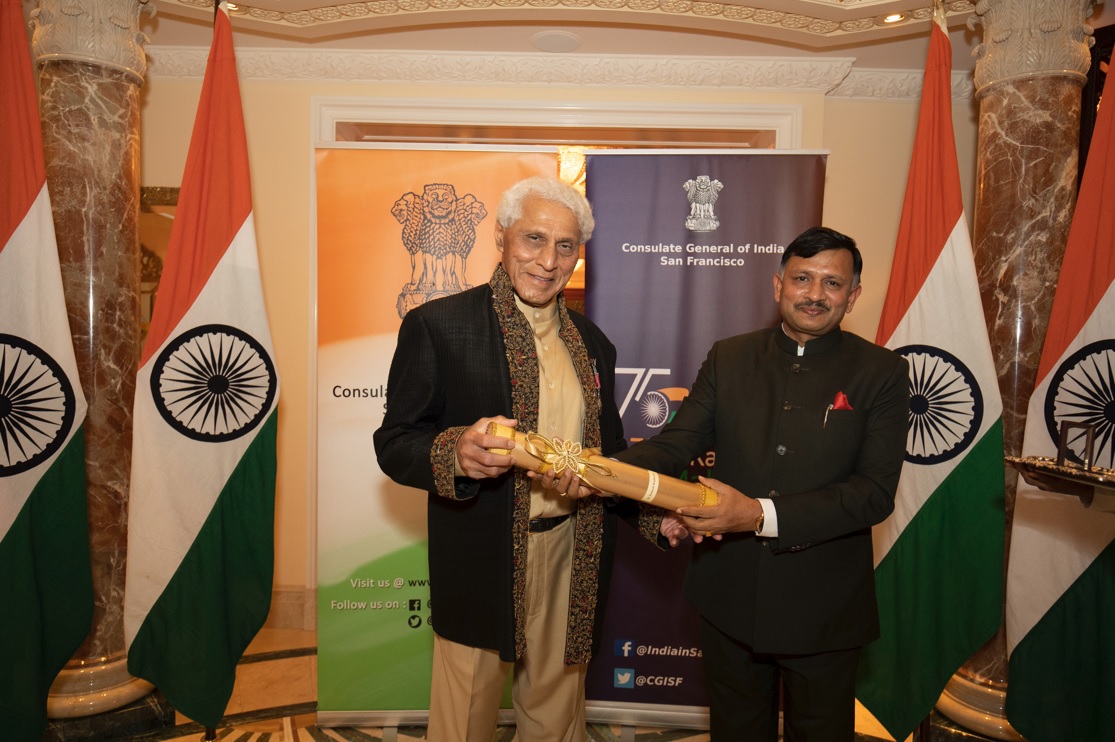
India awarded Wadhwani the Padma Shri in 2020. The presentation took place through its San Francisco consulate, whose account described his work on economic development and job creation. Shantanu Narayen attended the ceremony. In this photograph, an entrepreneurial life briefly assumes the formal shape of an award scroll, flags, and a handshake.
His philanthropic commitment had already become public in another form. In 2012, Romesh and Kathleen Wadhwani joined the Giving Pledge, promising a majority of their wealth to charitable causes. The couple’s names appear together. A biography dominated by one founder’s decisions should leave room for that shared commitment.
The Wadhwani Foundation, established in 2001, focuses on economic opportunity through entrepreneurship, workforce skills, innovation, and AI. Its current structure supports independent local nonprofit organisations across Asia, Africa, and Latin America. Local organisations carry responsibility for their own programmes and outcomes. The ambition travels; delivery has to belong somewhere.
The next beginning belongs to someone else
There is a practical logic connecting the foundation’s interests. Entrepreneurs need support to start and grow companies. Those companies need people with relevant skills. Workers need a route from training into paid employment. Treating these as connected problems puts the employer and the prospective employee in the same picture. A training certificate alone cannot supply the missing job.
In 2018, Wadhwani and his brother Sunil also launched Wadhwani AI, applying artificial intelligence to challenges facing underserved communities. Its work includes education and agriculture. The brothers were recognised together in TIME’s inaugural TIME100 AI list in 2023. Here, again, the family connection becomes an institution with work to do.
His public agenda continues to evolve. On January 30, 2026, he delivered a CSIS keynote ahead of India’s AI Impact Summit, discussing AI agents, adoption, policy, and workforce preparation. The setting was Washington; the questions crossed borders. Who will be able to use these systems? How will institutions adapt? What preparation will people need?
For Wadhwani, the first business required someone else’s willingness to say yes. Decades later, his wealth gives him room to finance companies, institutions, and opportunities for other people. There is a satisfying symmetry in that, though symmetry is unlikely to keep him occupied for long. There will be another decision to make, another executive to recruit, another piece of technology to examine. Somewhere, perhaps, a perfectly good beach will once again have to wait.
Keep company with the ideas
Explore his work and conversations.
- SAIGroup · SymphonyAI leadership
- Romesh Wadhwani on LinkedIn
- Wadhwani Foundation · Wadhwani AI
- Watch: AI, jobs, and India’s tech future on CNBC-TV18
- CSIS talks and profile
- The March 2000 Aspect deal
- The SymphonyAI leadership handover
- A longer conversation about building and giving
- His 2025 argument for applied AI in India
- Romesh and Kathleen Wadhwani’s Giving Pledge