YesPress Profile / The Operator
Sanjay
Sanjay
Dhawan
"The guy you call when the spinout has to ship, the integration has to close, and the next product still has to surprise the customer."
File / 2026
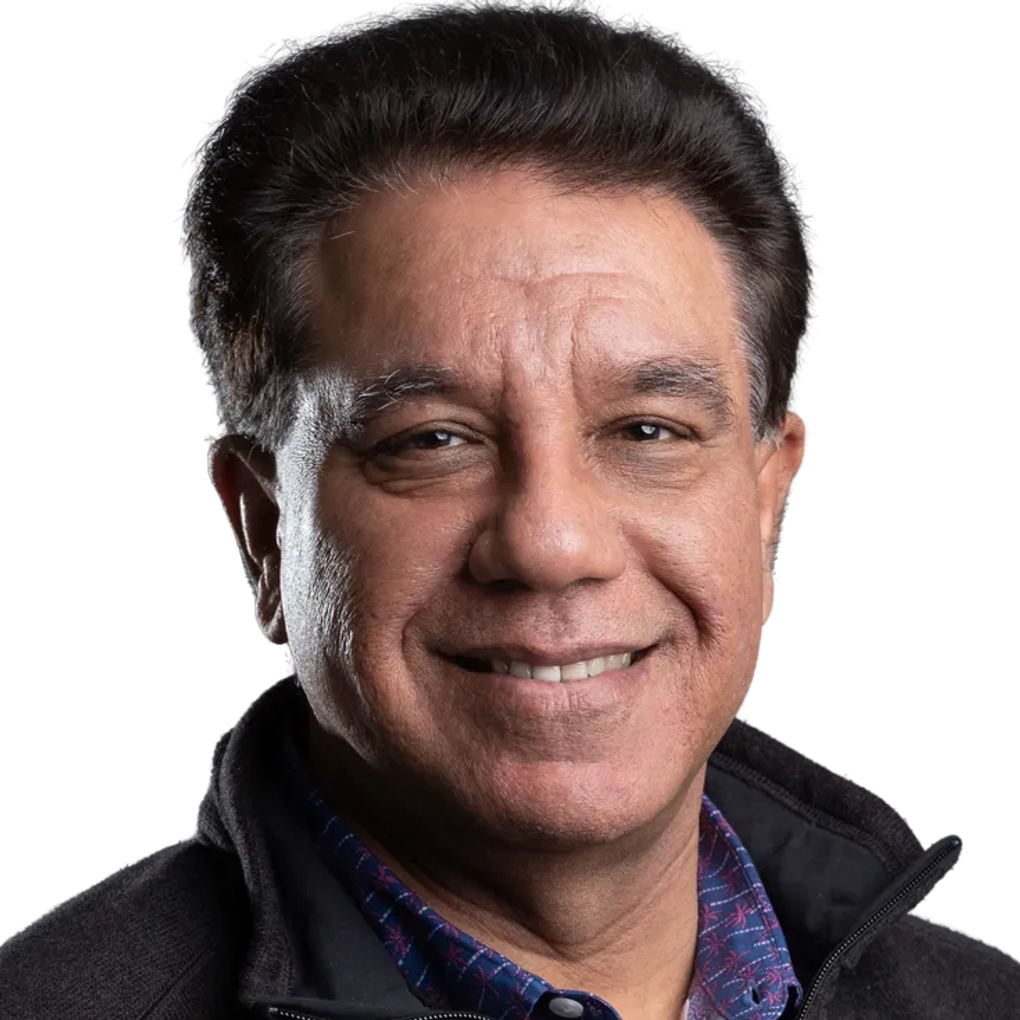
"The guy you call when the spinout has to ship, the integration has to close, and the next product still has to surprise the customer."
Walk into the Hillview Avenue offices in Palo Alto and you find a company that built itself by acquisition - Concertiv, Ayasdi, NetReveal, ConcertAI, Wadhwani group bets - and one man trying to make seven verticals sound like a single chord. Sanjay Dhawan is the conductor. He has done this kind of work before.
SymphonyAI was assembled, not founded. The Indian-American entrepreneur Romesh Wadhwani spent the back half of the 2010s buying up enterprise software companies aimed at specific industries - retail, financial crime, manufacturing, media, IT operations - and stapling them together under one brand. By 2022, the project needed an operator who had spun a company out, hit the public markets, and absorbed an acquirer the size of Samsung without losing the engineering team. Dhawan had the resume.
He took the CEO job in January 2022. The pitch from the outside is simple enough: most of the AI buyer's day is not spent talking to a chatbot, it is spent inside a fraud-detection workflow, a retail demand-forecast, an MRI throughput dashboard, an ITSM ticket queue. SymphonyAI sells into those workflows. The Eureka platform underneath is the connective tissue. Predictive models. Now generative ones. Now agentic ones. The label keeps changing. The customer keeps wanting industry depth.
Dhawan grew up in the previous wave. He earned a B.Sc. at REC Kurukshetra in India - now NIT Kurukshetra, an engineering school that has shipped a fair number of Silicon Valley CEOs into the diaspora - and a master's in electrical engineering at Brunel University on the western edge of London. He went into networking, the way ambitious engineers did in the 1990s. AMD. StarNet. Netopia. The names matter less than the pattern: he was building boxes that talked to other boxes, and he was the one chairing the IEEE standards committee that decided how the talking would happen.
Then he started a company. Inkra Networks, which Dhawan co-founded and ran as Chairman and CEO, is credited with defining the virtual networking segment - the idea that you could slice a physical network into many logical ones and treat them like software. It was an early echo of what would later become cloud infrastructure. Inkra did not become a household name. The technical instincts did.
By the mid-2000s he was at Aricent, an India-anchored engineering services firm, as President and COO. From Aricent he stepped into the role that gave him his stage name: President and CEO of Symphony Teleca Corporation in 2010. Symphony Teleca was one of Romesh Wadhwani's earlier outfits - thousands of engineers, mobile platforms, embedded software, the kind of services business that gets you in the door of every consumer electronics company on earth. He ran it for five years. In January 2015 Harman International bought it.
At Harman he became President of the Connected Services Division and Chief Technology Officer. Two years later, in 2017, Samsung Electronics bought Harman for roughly $8 billion - the largest automotive-tech deal of its time. Dhawan was inside the management team that closed it. He stayed through 2019.
In 2019 he did the unusual thing twice. He took Cerence - the in-car voice assistant business inside Nuance - and spun it out as a standalone public company. He became President and CEO. Cerence's technology was, by then, already running inside more than 350 million vehicles. Under his leadership the market cap moved from around $500 million at spin-out to a peak above $5 billion in 2021. Then, in January 2022, he left to take the SymphonyAI job.
The pattern is hard to miss. He has been on multiple sides of the same table. Inside Symphony Teleca when Harman bought it. Inside Harman when Samsung bought Harman. Inside Nuance when Nuance carved out Cerence. Most CEOs get one big transaction in a career. Dhawan has been in the room for four.
Two months after taking the SymphonyAI seat, he picked up another title - this one in Tokyo. In 2022 Pioneer Corporation, the storied Japanese consumer-electronics and car-audio company that had been taken private by Baring Private Equity Asia, named him Chairperson of the Board. The announcement was a single-page press release from Pioneer's global newsroom. It was easy to miss. He has been doing both jobs since.
Around all of that, he advises. EQT, the Swedish private equity firm with a deep technology practice, lists him as a Senior Advisor in the United States. He shows up in the Wadhwani orbit. He turns up at TiEcon, the Indian-American technology entrepreneurs' conference that once filmed him in a Media Lounge interview a decade ago - the video is still on YouTube.
What he does not do, judging by the public record, is talk much. He is not a Twitter pundit. His LinkedIn is a steady drip of reposts, not soliloquies. He turns up in earnings calls when his companies have them, in keynote panels at industry events, and in carefully worded press releases. The reticence is part of the style. So is the durability.
The interesting question is not what he has done. The interesting question is what he is doing now, and whether the bet works. SymphonyAI is private. Its revenue is reported in the hundreds of millions. Its competition - in retail, in financial crime detection, in industrial AI - is some combination of the hyperscalers shipping horizontal platforms, well-funded category startups, and the entrenched enterprise software incumbents. Dhawan's bet, as far as it can be read from the company's positioning, is that the customer eventually buys depth. Not the cleverest model, not the chattiest interface, but the one that knows what a Suspicious Activity Report looks like, or how a CPG retailer reasons about an out-of-stock event during a holiday weekend.
It is an old bet for a new technology. He has made it before.
SymphonyAI's business is split into business units that sound like industries: Sensa-NetReveal for financial-crime prevention, Retail for grocery and CPG, Industrial for manufacturing optimization, Media for content monetization, IT for service management, and a Health unit. Under Dhawan's tenure the company has leaned into agentic and generative AI across all of them, with the Eureka platform pitched as the shared brain.
Before any of it, Dhawan published networking papers, chaired IEEE standards committees, and worked on the kind of low-level protocol design that does not get press releases. That history shows up in how the companies he runs are organized: by what is technically true, not by what sounds good in a deck. Inkra was a virtual-networking startup years before the word "virtualization" carried any weight in enterprise sales. He bet early. He bet right. He has been betting since.
Walk through his career and you find the same names recur. Romesh Wadhwani appears at Symphony Teleca and again at SymphonyAI. Harman comes back through automotive AI. Nuance and Cerence sit on the conversational-AI side. EQT and Baring sit on the private-equity side. The map is small. The relationships are old. It is how Silicon Valley actually works, even when the press copy makes it sound like a meritocracy of strangers.
Reported by SymphonyAI and Cerence press releases. The peak was brief; the slope on the way up tells you the story.
Three decades, rendered as the rooms he was in when the paperwork closed.
The unit that watches for money-laundering, sanctions hits, and the kind of fraud that fills regulatory inboxes. AML is the part of banking AI nobody fights about - everybody just needs less of it.
Demand forecasting, assortment planning, on-shelf availability. Grocery and CPG buyers reasoning about a holiday weekend's out-of-stocks. Real-time decisions, not retro dashboards.
Plant optimization and predictive maintenance. The least-photographed AI category. Also one of the few where the model has to be right or something stops moving.
Content licensing, monetization, distribution analytics. The Ayasdi acquisition repurposed for the streaming era.
Ticket triage, agentic remediation, automated service request fulfillment - shipped into the queues IT runs today.
The connective tissue underneath. Predictive AI, generative AI, increasingly agentic. The bet is that vertical depth wins where horizontal LLMs run out of context.
Runs an AI company in Palo Alto. Chairs a Japanese consumer-electronics company in Tokyo. Advises a Swedish private-equity firm. The calendar is its own performance art.
The name "Symphony" follows him around. Symphony Teleca. SymphonyAI. Both belong to the Wadhwani family of companies. A career arc that keeps wandering back through the same door, with a slightly different sign on it.
Most Indian engineers of his generation went to American grad schools. Dhawan went to Brunel University in West London - a campus better known for engineering rigor than executive talent. He took the rigor.
Before the AI thing and the auto thing and the M&A thing, he was writing networking protocol standards. The instinct for what makes a system durable predates the title slide.
Inside Symphony Teleca when Harman bought it. Inside Harman when Samsung bought Harman. Inside Nuance when it spun out Cerence. Now inside SymphonyAI, the long roll-up.
When he left Cerence, its software was running inside more than 350 million vehicles on the road. Few CEOs ship anything to that many endpoints. Fewer still leave at the peak.