Two weeks before Russia's full-scale invasion of Ukraine, Roman Nykulyshyn was debating with his boss whether war would really come. He believed it would, and that it would be large, bloody and difficult. Even so, his calendar still contained the ordinary audacity of a growing technology company: he was preparing to fly to Boston, where he expected to help develop Creatio and take part in important projects. On February 24, 2022, the future stopped behaving like a forecast.
Nykulyshyn woke in Lviv to calls saying Kyiv was under attack. He began ringing friends and talking about the enlistment office. First, he reasoned, he needed equipment. At a military shop he encountered veterans who were serious, brisk and reassuring. He gave the clerk the least polished pitch of his career: he did not understand what a person needed for war and wanted advice. The veteran walked him through it. Nykulyshyn bought the gear, visited his parents and carried his bag to the enlistment office.
It is a scene that refuses decoration. A sales-development leader, trained to make complicated propositions legible, confronted a subject on which he was a beginner and said so plainly. Expertise began with an honest inventory of ignorance. His parents were shocked. He had no certainty about where he would be sent. He volunteered anyway.
“When people from professional civilian fields come into the military, they bring a lot of new things, above all unconventional thinking in solving tasks.”Roman Nykulyshyn, December 2022
A career built from prototypes, not prophecies
Years before that morning, Nykulyshyn had been constructing an education in useful decisions. He began working in 2008 as an assistant accountant at Market Universal. In 2012, he and a friend created a service that checked student papers for correct English. A year later, as part of a UCU Business School hackathon team, he helped develop Wise Heat. The idea was to scan buildings for heat loss, send owners a simple diagnosis, assemble a directory of local insulation specialists and let neighbors combine their demand into cheaper group orders.
The concept is revealing. It joins measurement, communication and aggregation. Find a leak. Explain it clearly. Build a market around fixing it. Those verbs would keep reappearing.
At UCU Business School, where he completed an MSc in Innovations and Entrepreneurship in 2015, ideas were not treated as charming pets. They were expected to survive contact with costs, customers and time. Nykulyshyn also studied project management at Lviv Polytechnic and spent two years in Britain studying risk management in banking at the London School of Business and Finance. Finance gave him the grammar of constraint. Entrepreneurship gave him reasons to use it.
In 2015, he and a team began making leather accessories in a small workshop at Lviv's Biblios factory. They traveled through Italy, Poland and Slovakia to learn about materials. They made the first pieces with their own hands. The business grew from simple laptop sleeves into more complex products, and the team learned photography, content, customer communication and digital sales because the goods demanded it.
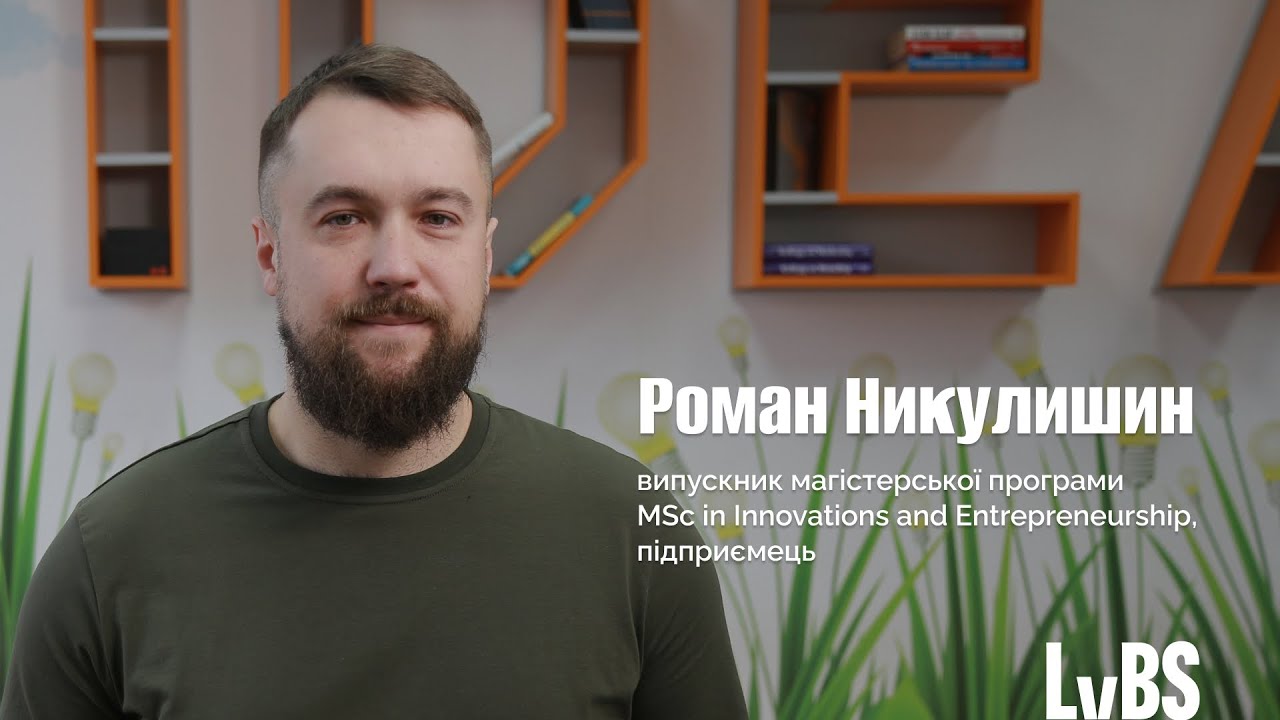
By 2016 there was IMAGINE, the leather-accessories brand he co-founded. In 2017 came WOOWOO case, a textile-accessories venture. Solving the products' marketing problems produced another business. In 2018 he founded AdVerto, an agency that promised practical internet-marketing knowledge to Ukrainian entrepreneurs. The product company had generated its own service company. Business plans are often less like architecture than compost: one attempt becomes material for the next.
The expensive romance of the perfect product
When Nykulyshyn returned to UCU as a guest teacher in 2019, he did not bring a victory lap. He brought the rake marks. His team had loved its products so much that enthusiasm distorted judgment. Inventory accumulated. The ideal version took too long. The market, impolitely, maintained its own tastes.
His response was a presale system with a two-week waiting list. Instead of buying materials for a full run and hoping affection proved contagious, the company could test demand first. Make a prototype. Let customers answer. Spend in proportion to the evidence. The advice was deliberately unromantic: do not begin at the premium end before understanding acquisition costs; do not raise money without something to show; do not make a business only for money or only for pleasure.
“Money is a tool for implementing ideas, not an end in itself.”Advice to founders at UCU Business School, 2019
His repeatable operating loop
- Observe the real problem, including the inconvenient parts.
- Build the smallest credible response.
- Measure what users do, not what the plan promised.
- Adapt the system and take responsibility for the result.
The sharpest rule was also the shortest: do not wait for a sign. Try the idea intelligently and without a reckless initial bet. Nykulyshyn had already learned the complementary lesson in his own portfolio. Commenting years later on the distraction of too many simultaneous ideas, he wrote that he had abandoned an unprofitable business and concentrated on the one that earned money. Focus arrived by subtraction.
From the customer journey to the harder map
In 2021, Nykulyshyn's writing for Forbes Ukraine made his method explicit. One guide argued that e-commerce businesses could lose money while guessing at the cause. His cure began with macro and micro conversions, moved through analytics and session observation, and ended with reports that managers could act on. In his illustrative furniture store, 80 percent of traffic came from phones, yet mobile visitors stayed for only 20 seconds compared with four minutes on computers. A broken cart and a poor mobile experience were not matters of taste. They were visible in behavior.
That year he joined Creatio, first as an enterprise account executive and then, in December, as Head of Global Sales Development. Creatio sells tools for automating workflows and customer relationships. His route there made sense: physical products had taught him the customer could reject a founder's ideal; marketing had taught him to watch behavior; enterprise sales asked him to translate complex systems into business outcomes.
The Boston plan belonged to this chapter. It promised proximity to Creatio's American center of gravity and a larger field for the work. Then the invasion made ordinary ambition look almost antique.
What survives when the roadmap does not
In the armed forces, Nykulyshyn found other people whose previous titles seemed to have been packed away with civilian clothes: entrepreneurs, international-company employees, an operations director. He noticed that their varied experience mattered. Military service was its own profession, with skills no boardroom could confer, but civilians could contribute habits of analysis, coordination and improvisation.
His English opened an early role. His appetite for learning helped with unfamiliar systems. Later, he moved toward training and preparation, work that again required turning complex tools into actions people could repeat. The resemblance to enterprise implementation is only structural, never moral. Selling software and defending a country are not comparable stakes. Yet a person's way of attending to problems can cross the border between lives.
Nykulyshyn also spoke about the force of community support. Equipment funded by people outside the unit could decide outcomes inside it. The observation completes a circle that began with Wise Heat. A scattered group sees a shared need, combines resources and creates purchasing power. In one life, the result is warmer buildings. In another, the need is infinitely more urgent.
By 2025, he was preserving a fuller account for UCU's oral-history project, Little Stories of a Big War. The interview was recorded in February and published in June. It placed his prewar résumé beside the decision that interrupted it: the accountant who became an entrepreneur; the maker who became a marketer; the sales leader who was bound for Boston; the Ukrainian who volunteered.
Clear sight, followed by action
There is an unfashionable consistency in Nykulyshyn's public voice. He distrusts the comfort of the imagined version. The perfect product can conceal weak demand. A dashboard can conceal a broken checkout unless somebody follows the customer. A lively city can conceal the proximity of war if people prefer the lighted shopfront to the evidence beyond it.
This realism does not make him a pessimist. It gives aspiration a job. In 2019, the job was to make an idea useful, current and financially viable. In 2022, he said he wanted peace and a quiet life, but rejected the illusion that either could arrive without victory. He wanted to do as much as possible to return to what he called an adequate world.
A conventional profile would finish by asking what comes next. His story warns against the question's vanity. The next thing may ignore the plan. Better questions are smaller and tougher: What is true now? What can be learned quickly? Which resources can be assembled? Who needs to understand the system? What decision can responsibly be made today?
Nykulyshyn's path offers no tidy doctrine, only a durable sequence. Look without romance. Prototype without cowardice. Count what matters. Ask for instruction when you are new. Teach what you have learned. When the conditions change, do not worship the old itinerary. Boston was a plan. Responsibility became the destination.