A person can travel to Comic-Con for work and still have no idea what everyone is talking about. There are panels to attend, unfamiliar characters looming over the street and promotions attached to films whose names seem to require homework. Mac McLean and his colleagues noticed the problem early in the life of Click. Their response was to make a guide. A convention devoted to extraordinary worlds had produced a wonderfully ordinary need: somebody ought to explain the place.
That small act of explanation is a useful introduction to McLean, the Burbank-based co-founder, CEO and president of Team Click. Publicity is often imagined as the business of getting somebody to look. His guide suggests an additional job: giving people enough understanding to enjoy what they are looking at. At a convention, attention is already abundant. Comprehension can be in shorter supply.
A guide for the gloriously bewildered
By July 2019, the annual Comic-Con publication ran to 64 pages. McLean’s introduction traced it to the agency’s first year, when colleagues making the trip to San Diego were overwhelmed by the entertainment properties competing around them. The guide gathered information on coming films and television, added commentary and playful features, and included artwork from people in the team’s orbit.
The choice of format tells its own story. A guide assumes that the reader has a destination and could use some assistance getting there. It offers a place for both the committed enthusiast and the colleague trying to catch up. There is generosity in that arrangement. Knowing the reference becomes more valuable when you can let somebody else in on it.
Movies, television, toys and the pleasure of having a little context.
As a piece of publicity thinking, it also avoids a common trap. The expert can forget the moment before expertise, when the names were unfamiliar and the excitement belonged to other people. A reader-friendly explanation preserves that moment. It lets curiosity arrive without an entrance examination. There is no professional advantage in making a colleague feel foolish for asking what a billboard means.
The publication continues in a quarterly format. The agency’s guide page lists a July 2026 Guide to Geek Entertainment and an October 2025 horror edition. Its stated audience includes entertainment professionals, newcomers to comics and established fans. That is quite a range of assumed knowledge. Making room for it requires the sort of attention that begins with the reader’s question.
Two McLeans, then a wider circle
Mac and Dinah McLean founded Click in 2007 with a premise rooted in their own interests as fans and consumers. The agency’s history describes building relationships and strategies from that position. It is a practical starting point for an entertainment business: before deciding how to promote something, understand why anyone might want it in their life.
For a founder, that creates a particular responsibility. Personal enthusiasm can supply an opening thought, but a business has to make the thought useful to other people. The guide is one example. A campaign is another. Both ask the enthusiast to translate an interest into a form that someone with less time, or different interests, can enter.
A substantial expansion came in March 2017, when Click Communications acquired Carl Samrock Public Relations to form Team Click. The firms had already collaborated for more than six years. Their combined experience brought traditional publicity and digital marketing into the same agency. McLean and Dinah, his wife and business partner, would lead the company alongside its digital leadership team.
“This is an exciting new chapter in Click’s ongoing evolution.”Mac McLean / March 2017
The history matters because the acquisition followed a working relationship. The participants had experience of one another beyond a presentation about potential cooperation. The announcement named studio projects involving Warner Bros., Disney, Sony, Universal, Lionsgate and DreamWorks Animation. It described a combination intended to connect marketing and publicity more closely.
Digital marketing+Carl Samrock PR
Traditional publicity
Team Click
Two years later, the enlarged business encountered a less glamorous challenge. People still carried around an older impression of Click. Its website relaunch post described outsiders who thought the agency was very small, or worked only in digital. The post also recalled a publicity client surprised to learn that Click handled social media.
It is an amusing predicament for people paid to explain things. It is also easy to recognise. A business changes a little with each assignment; the picture in a client’s head can remain quite still. The episode gives McLean’s company a human scale. Even an agency surrounded by entertainment campaigns needed to put down the client work long enough to explain its own.
Freddy gets a group photograph
Then there is the photograph with the enormous glove. In April 2019, McLean published an enthusiastic account of Team Click’s work with Ultra Productions on publicity and social campaigns for the I Like Scary Movies Experience. The interactive art installation gave the agency’s horror enthusiasts a project they were plainly pleased to discuss.
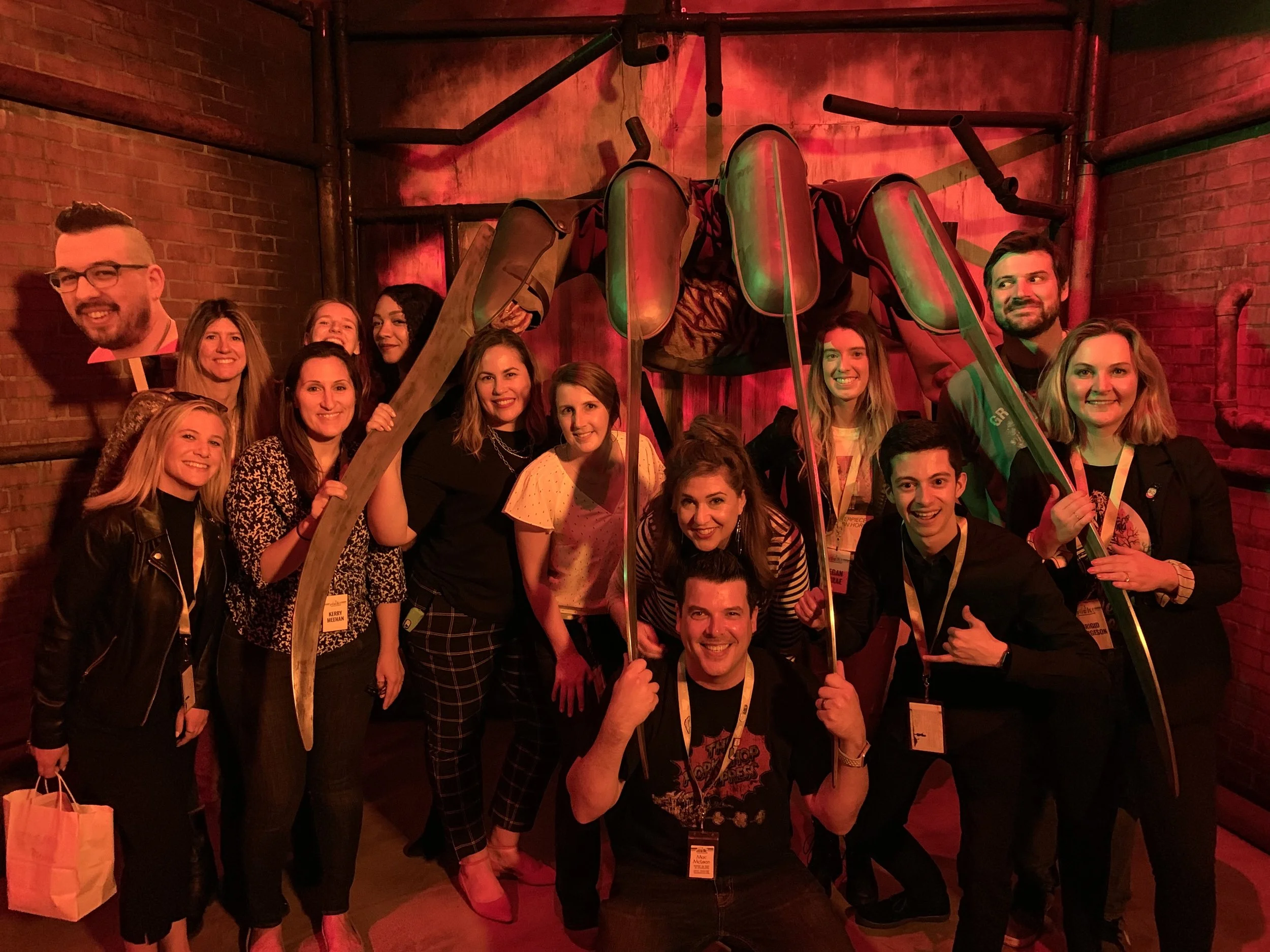
The group picture has the pleasing absurdity of office life interrupted by a fictional menace. A team outing becomes a souvenir from inside the entertainment itself. It is also a neat visual explanation of the agency’s founding premise. Here are the people doing the promotional work, apparently enjoying the thing they are helping other people discover.
McLean’s account reported social followers rising from 10,000 to 20,000 in less than 24 hours. Those are the agency’s reported audience numbers. The photograph offers a different kind of evidence: a physical setting where people can enter the joke together. A horror reference turns into an activity, and the activity leaves them with an image.
That is an appealing piece of campaign logic. The familiar object gives fans something to recognise; its scale gives them something to do. Nobody in the photograph needs to stand beside a paragraph explaining that the occasion is entertaining. A very large glove has already made a persuasive opening argument.
The part that needs a spreadsheet
The business around those moments contains a good deal of practical coordination. Team Click’s production offering includes budgeting, scheduling, invitations and the handling of talent. It also describes promotional objects designed for a life on a shelf, desk or in a wardrobe. A souvenir has to survive the journey from an idea to an actual thing somebody can take home.
That journey places limits on imagination. An object needs a maker. An event needs a time. A clever reference needs to reach someone who will appreciate it. These are ordinary observations, but they explain why an agency built around interests still needs people who can follow a project through. The memorable part of a campaign can depend on an unmemorable piece of organisation.
Family marketing gives the same business a different set of practical questions. The agency offers craft activities, cooking demonstrations, themed recipes and downloadable materials. For parents and family creators, usefulness has its own requirements. A workable activity has to fit into the recipient’s day. The connection to a film or character should give the activity a reason to exist.
The creative asset work is quieter still: selecting clips, editing, localisation, clearances and distributing trailers. A campaign file has to arrive in a usable form. The recipient may never see how much coordination made that possible. Looking at this part of McLean’s company helps explain how a business devoted to fan enthusiasm can serve departments with quite different responsibilities.
The publicity offering also makes room for people beyond the most recognisable faces: filmmakers, voice performers, stunt professionals, designers and artists. Each can give an audience a different route into a project. That is a useful extension of the guide’s logic. People become interested through particular details, and the person who knows those details may be somewhere behind the camera.
A business with room for another interest
McLean has described being influenced by an earlier boss’s willingness to take on varied work, then building an agency open to that attitude. In 2026, he also described helping develop a partnership between Ice Nine Kills and Dead by Daylight with colleague Spencer Hubbard. The details of the work change; the need to find the right knowledge and collaborators persists.
There is a distinction between enjoying everything yourself and recognising who knows a particular subject well. An agency can make space for the second. That gives a colleague’s enthusiasm a practical place in the work, and gives the founder a reason to listen before settling on the idea.
His family has also entered the convention story. McLean shared that his parents were attending Comic-Con for the first time and that his mother, Valerie, would appear on a panel about raising nerds. There is a nice reversal in that arrangement. The professional enthusiast gets to bring a parent into the world that became his work, and she gets a place in the programme. The guide, meanwhile, is something a newcomer can carry into that world. Family, colleagues and the wider audience meet around the same practical question: what would help someone feel at home here?
For McLean, the guide remains a particularly clear expression of that approach. It begins with people who are interested enough to gather the details, and ends with people who can use them. Somewhere between those two groups, a bewildering convention becomes easier to enjoy. There may still be a queue. At least the person standing in it has something good to read.