Roger Masse started on the third shift, doing basic production work. By 2022, he had spent 47 years at the business that became AvCarb Material Solutions, moving through its ranks to the chief executive’s job. Asked whether his younger self could have imagined that destination, his answer was compact: “I would have laughed.” The career retrospective, evidently, would have had a difficult first audience.
It is an unusually useful starting point for understanding a manufacturing executive. A factory has an organizational chart, but it also has a second map: the people who know how its work gets done. Masse’s story invites us to read the two together. His route to leadership began with the product, long before the title.
At AvCarb, the product can look deceptively ordinary. Paper. Felt. Fabric. These are familiar words for materials asked to perform unfamiliar jobs, from helping gases move through fuel cells to controlling friction. The plainness of the nouns is part of the charm. Advanced manufacturing sometimes arrives dressed as something you might find in a sewing cupboard.
At the business by the 2022 plant visit. From third-shift production to CEO.
An education that stayed in Lowell
The Lowell operation’s technical ancestry reaches back to the Apollo era. Under earlier corporate identities, it helped develop and apply the heat-shield materials used for spacecraft reentry. That work preceded Masse’s reported tenure. He inherited an industrial tradition already accustomed to difficult specifications, where a material’s behavior mattered more than its appearance.
The distinction is helpful. A company can possess a famous past and still have to earn its next order. Apollo heritage provides a memorable introduction; a customer designing an electrochemical system needs to know what the material will do in that system. Manufacturing carries history forward through processes, equipment and people, then submits it to another set of requirements.
AvCarb’s range makes that inheritance visible. Its carbon materials serve thermal, friction and electrochemical applications. Heat needs to be managed. Motion needs to be controlled. Gases and liquids need to pass through a material in useful ways. These are different engineering problems, even when the starting vocabulary remains carbon, fibers and coatings.
For a person whose working life developed inside the business, those differences give the career its setting. Masse’s experience crossed the distance between doing production work and speaking for the company. The significance of that journey lies in how closely the executive story remains attached to the manufacturing one. The factory never disappears from the picture.
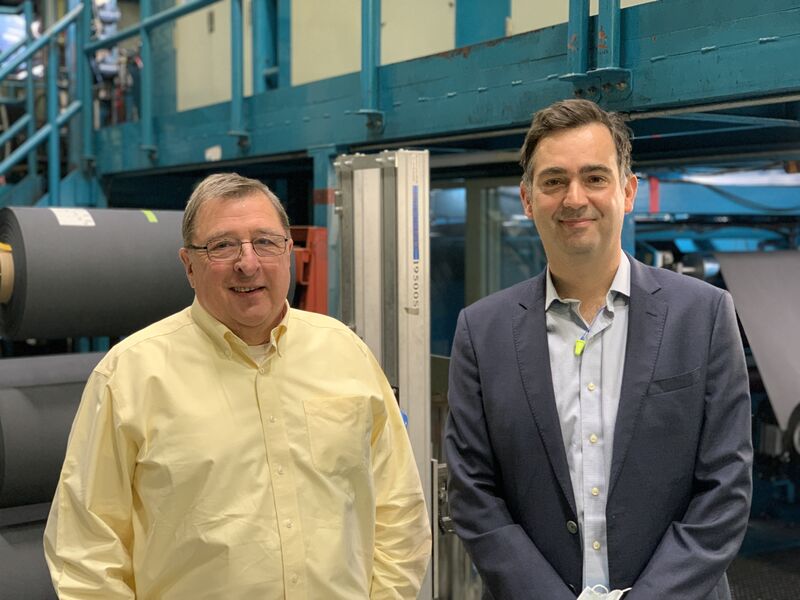
There is a practical pleasure in the photograph: two executives beside industrial equipment, with the machinery taking up much of the frame. It is an appropriate composition for this career. The human story and the production setting share the space, and neither needs much help from a motivational slogan.
The day the division became a company
On January 31, 2013, Ballard Power Systems announced the sale of its Material Products division in Lowell. The buyer was investment group ALY Holdings, working with the division’s senior management through a newly formed company, AvCarb LLC. Masse was identified as its president. A long association with the operation had reached a new corporate chapter.
The price was up to $12 million, with $10.5 million paid at closing and the balance tied to the division’s 2013 financial results. These were payments to Ballard for the transaction. They describe the deal’s structure, rather than anyone’s personal fortune. The distinction matters in a story about an operator: a company changing hands is a business event with many participants.
Ballard wanted to concentrate on its fuel-cell products. Much of the division’s sales came from other industrial sectors. Yet the relationship would continue: AvCarb agreed to supply gas diffusion layer material for Ballard’s fuel cells. Independence came with an ongoing customer connection, a sensible arrangement for a business whose expertise was already useful to its former parent.
Masse’s public emphasis was the opportunity for the company and its employees, alongside service to customers whose requirements were changing. Read together, the transaction and that emphasis reveal a specific leadership problem: how to give an established operation a new corporate footing while keeping its productive relationships working.
New ownership. An ongoing GDL supply relationship with Ballard.
For someone who had come up through production, this is a meaningful turn in the narrative. The work acquired a different legal home while retaining the need to make materials customers could use. Corporate independence still had to report for duty at the factory.
Why carbon paper earns its keep
To understand the business Masse led, begin with the gas diffusion layer. In a proton exchange membrane fuel cell, hydrogen and oxygen participate in a process that produces electricity and water. A porous carbon layer helps the gases reach the working surfaces, supports the adjacent layers, carries heat and electrons, and helps remove water.
That is a demanding assignment for a sheet of paper. The material must balance several properties at once. Opening paths for gas is useful; conductivity is useful; mechanical support is useful. The design has to accommodate them together. A component occupying little visual space can therefore carry considerable responsibility for the system around it.
A simplified view of the GDL’s jobs in a PEM fuel cell.
AvCarb makes its GDL papers using a multistep process involving carbon fiber and a proprietary saturation ink. Adjusting the ink’s composition and loading changes the internal structure and properties. The same broad manufacturing approach can accommodate different requirements. Such flexibility gives an established materials operation a way to serve customers whose designs vary.
Its custom-solutions work also draws a useful distinction between carbon composites selected for structural performance and materials tailored for electrochemical behavior, conductivity, permeability or pore structure. Carbon fiber’s public reputation often concerns lightness and strength. In this business, much of the interest lies in what can move through it, and how predictably.
These details help explain why the production beginning matters to Masse’s profile. His career unfolded in a company where making the material is central to delivering its value. The finished component embodies a sequence of manufacturing decisions. An executive’s promise to serve customers eventually has to survive that sequence.
Growth needed a partner, too
In November 2021, Arsenal Capital Partners announced its acquisition of AvCarb. Masse was now identified as CEO, with Guy Ebbrell serving as president. The transaction’s terms were undisclosed. Arsenal’s stated interest included the materials needed for hydrogen production, electricity generation from hydrogen and energy storage, along with AvCarb’s prospects for international growth.
The two executives emphasized complementary parts of the opportunity. Masse pointed to Arsenal’s industrial experience and record of growing businesses. Ebbrell described customers needing additional production capacity, development support and service as decarbonization technologies were deployed. The question was how to support demand with the resources required to manufacture.
It is a revealing pair of priorities. A material can be useful in a laboratory and still require substantial work to become a dependable commercial supply. Customers need support for their designs as well as access to production. Growth changes the volume of that obligation, and it can change its geography.
- President, AvCarb LLCManagement-backed purchase of Ballard’s Lowell assets.
- CEO, AvCarbArsenal acquisition announced; Guy Ebbrell serves as president.
- 47 years at the businessA plant visit records Masse’s rise from third-shift production.
Masse’s trajectory puts a human timescale alongside these transactions. Corporate announcements mark distinct dates. An operator’s familiarity with the work accumulates between them. The result is a career whose milestones include changes in ownership, but whose central setting remains a materials business in Lowell.
A fishing reel belongs in this story
AvCarb also makes carbon materials for fishing-reel drag washers. Its woven fabrics for this use grew from materials developed for military braking systems. A reel and a military vehicle make an unlikely pair in a product discussion, but both give friction a job to do. The customer changes; controlled material behavior remains valuable.
The washer catalogue offers fine or coarse weaves, resin or glass support, and thicknesses from 0.5 to 1.5 millimeters. Those details bring the industrial story down to an agreeable scale. After fuel cells and spacecraft, the business can be considered in a small piece of tackle. Carbon has a surprisingly varied social calendar.
By October 2025, AvCarb was announcing FLEX-GDL, a flexible graphitic material designed for fuel cells and electrolyzers, with Chris Holmes named president and CEO. The company described compatibility with roll-to-roll processing and commercial supply in wide, long rolls. That later chapter belongs to the business’s continuing development, under different leadership.
Masse’s own place in its history is already substantial: a production worker who rose to lead the operation, a president at its management-backed separation from Ballard, and a CEO when Arsenal invested. His story offers a way of thinking about ambition that leaves room for a destination to emerge through years of work.
“I would have laughed.”
Roger Masse, in 2022, on imagining the CEO role at the start of his career
The retrospective laughter is a good place to leave him. A younger worker could hardly be expected to predict every customer, corporate transaction or new use for carbon that lay ahead. What makes the journey interesting is its distance, measured from a basic production job to responsibility for the company. The third shift turned out to be an opening chapter.
Follow the material
Factory visits, company channels and the transactions behind the story.