Breaking Ted McKlveen's Verne unveils world's first cryo-compressed hydrogen Class 8 truck /// Amazon Climate Pledge Fund & United Airlines back Verne's $15.5M raise /// LLNL + Verne demonstrate hydrogen densification with 50% energy savings /// New Pennsylvania manufacturing facility to create 61 clean energy jobs /// Forbes 30 Under 30 Energy · Stanford GSB MBA · Harvard Chemistry summa cum laude /// Ted McKlveen's Verne unveils world's first cryo-compressed hydrogen Class 8 truck /// Amazon Climate Pledge Fund & United Airlines back Verne's $15.5M raise /// LLNL + Verne demonstrate hydrogen densification with 50% energy savings /// New Pennsylvania manufacturing facility to create 61 clean energy jobs /// Forbes 30 Under 30 Energy · Stanford GSB MBA · Harvard Chemistry summa cum laude ///
Founder Profile  ·  Clean Energy

TedMcKlveen

A Minnesota kid who read chemistry at Harvard, picked up a consulting toolkit at Bain, and then decided the trucking industry's real problem was thermodynamics - not software.

Co-Founder & CEO  at  Verne  ·  San Francisco, CA
$15.5M
Total Funding
87%
Denser than 700-bar H2
61
New PA Jobs
2020
Verne Founded
Forbes 30 Under 30 Breakthrough Energy Fellow Stanford GSB MBA '21
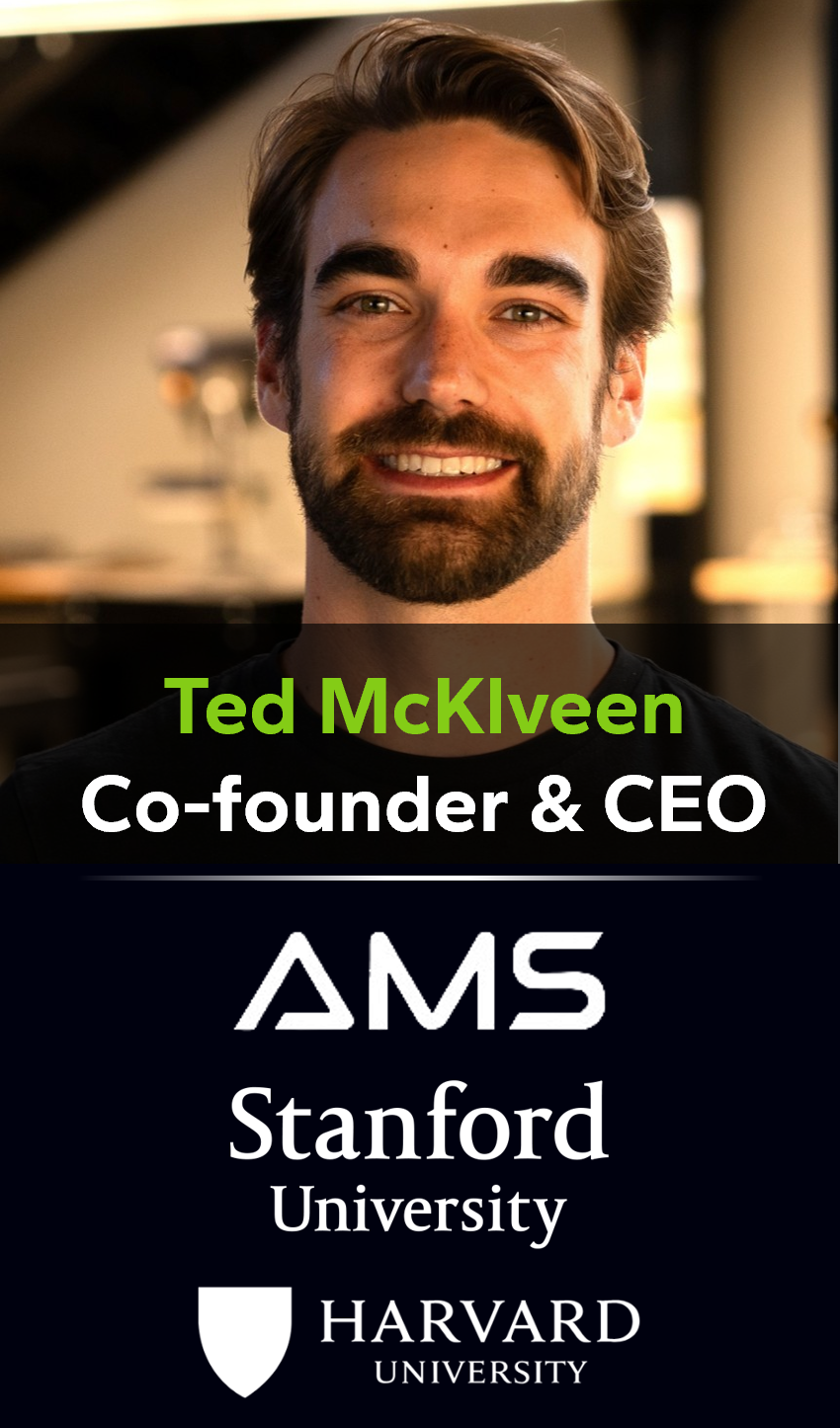
Ted McKlveen, Co-Founder and CEO of Verne

The chemist who found the missing middle of the hydrogen economy

By 2019, the hydrogen industry had a peculiar gap. Hundreds of companies were racing to produce clean hydrogen. A handful were building fuel cells to consume it. But the middle - getting dense, affordable hydrogen from point A to point B at commercial scale - was largely empty. Ted McKlveen walked into Stanford's Graduate School of Business, noticed the gap, and built a company in it.

Verne, co-founded with Bav Roy (now COO) and David Jaramillo (CTO), pursues a technology called cryo-compressed hydrogen (CcH2). The principle: cool hydrogen below its boiling point and compress it simultaneously, without forcing a full phase change. The result is hydrogen stored at up to 79 grams per liter - 33% denser than liquid hydrogen, 87% denser than the 700-bar compressed gas tanks that dominate today's market. For long-haul trucking, where payload and range are everything, those numbers rewrite the economics.

"About 40% of heavy duty trucks are either long range or payload limited. And that's really the market for hydrogen."
- Ted McKlveen, Down to Zero podcast

McKlveen grew up in Minnesota. His father's family owned a lumber company in rural Iowa - a background that gave him an early, ground-level understanding of physical industry, the kind that can't be optimized away with a software update. The environmental turn came later. In 2006, fourteen-year-old Ted watched Al Gore's An Inconvenient Truth and came away with a conviction that stuck. He steered toward chemistry at Harvard, graduated summa cum laude, and spent his early career working on grid-scale redox flow batteries and renewable energy at Advanced Microgrid Solutions before landing at Bain & Company.

At Stanford, while classmates were building SaaS dashboards and consumer apps, McKlveen dove into decades-old research from Lawrence Livermore National Laboratory and BMW's hydrogen work. He recruited the original inventor of cryo-compressed hydrogen storage technology as a technical advisor at Verne's earliest stage - before the company had more than a handful of employees. That move signaled something about how he operates: respect for the science, willingness to go back to primary sources, and zero interest in reinventing what doesn't need reinventing.

Verne's most visible proof point arrived in late 2024: the world's first cryo-compressed hydrogen Class 8 truck drove hundreds of miles in Southern California, completing multiple refueling events with Verne's own CcH2 filling equipment. It wasn't a closed-track demonstration. It was real-world testing that validated dormancy, density, and durability simultaneously. McKlveen called it confirmation that cryo-compressed hydrogen "can break the current trade-off between density and cost."

Then came the LLNL collaboration in March 2025: Verne and Lawrence Livermore demonstrated a hydrogen densification pathway that achieves cryo-compressed storage without requiring a full phase change - cutting energy consumption by 50% compared to small-scale liquefaction. The physics had cooperated. The cost curve bent.

McKlveen's Verne isn't just a trucking company anymore. As of early 2025, the company began offering zero-emission on-site power generation to customers at ports, EV charging stations, construction sites, and data centers - sectors facing grid capacity crunches. A Pennsylvania manufacturing facility announced in mid-2025 will produce hydrogen storage vessels for distribution and mobility at commercial scale, creating 61 new jobs in Lycoming County with backing from Governor Shapiro.

"This demonstration confirms that cryo-compressed hydrogen can break the current trade-off between density and cost. Providing a low-cost way to reach high densities will bring down the cost of delivering and using hydrogen, opening up a host of applications... from construction to ports to warehouses."
- Ted McKlveen, March 2025

On policy, McKlveen takes an unfashionable position for a clean-energy founder: he'd rather have a carbon tax than technology-specific subsidies. His reasoning is straightforward - subsidies pick winners; a carbon price lets the best solutions compete. He estimates hydrogen fuel could reach diesel price parity within six to seven years, but only if infrastructure and density challenges are solved at the same time. He's building the infrastructure. He's already solved the density.

What drives him isn't abstract climate policy. It's the roads. McKlveen has repeatedly pointed out that low-income communities near major freight corridors bear a disproportionate pollution burden from diesel trucks. That specificity - not "global emissions" in the abstract, but the air quality alongside I-10 - is what distinguishes his framing from the usual founder pitch.

Verne's investors include Amazon's Climate Pledge Fund, United Airlines Ventures Sustainable Flight Fund, Trucks Venture Capital, Collaborative Fund, and Newlab - a group that spans e-commerce logistics, aviation, and deep-tech infrastructure. The bet they're all making is the same one McKlveen made at Stanford: hydrogen's future isn't just about clean production. It's about getting that hydrogen to where it needs to be, as densely and cheaply as physics allows.

He named his company after Jules Verne, who wrote in 1874 about a future powered by hydrogen. The reference isn't sentimental. It's a wager - that the 150-year-old prediction is finally, precisely, about to come true.

Cryo-Compressed Hydrogen: The Physics of Dense Energy

Why storing hydrogen cold and compressed changes the entire economics of clean trucking

700-bar Compressed Gas (Standard)
42
g/L hydrogen density
Today's dominant H2 truck technology. Shorter range, heavier tanks.
Liquid Hydrogen (LH2)
59
g/L hydrogen density
Requires complex cryogenic handling. Higher infrastructure cost.

No Full Phase Change Required

Verne's process densifies hydrogen without forcing a complete liquid phase transition, cutting energy consumption by 50% versus small-scale liquefaction - the LLNL-validated breakthrough of March 2025.

Station-Agnostic Refueling

"If you have one of our storage tanks on your truck, you can stop at any station type, independent of how the hydrogen got there." CcH2's flexibility makes it compatible with existing hydrogen infrastructure.

Payload + Range, Both

Traditional hydrogen storage forces a trade-off: more range means heavier tanks, less payload. CcH2 delivers double the range of 700-bar systems while improving payload capacity for Class 8 trucks.

Designed for Hard-to-Decarbonize Sectors

Beyond trucks: Verne's CcH2 systems now power data centers, ports, EV charging stations, and construction sites - anywhere grid access is limited or intermittent power is unacceptable.

From Harvard Chemistry Lab to World-First Hydrogen Truck

2006
At 14, watches An Inconvenient Truth in Minnesota. Environmental conviction takes hold.
~2011
Graduates Harvard University summa cum laude with AB in Chemistry. Begins work on novel molecules for grid-scale redox flow batteries.
~2012-2017
Management Consultant at Bain & Company. Builds operational and strategic toolkit across industries.
~2017-2019
Joins Advanced Microgrid Solutions, applying renewable energy expertise at the grid's edge.
2019
Enrolls at Stanford Graduate School of Business. Identifies the missing middle of the hydrogen value chain.
April 2020
Co-founds Verne with Bav Roy and David Jaramillo. Recruits original LLNL inventor of cryo-compressed hydrogen as technical advisor.
2021
Graduates Stanford GSB as Arjay Miller Scholar and Social Innovation Fellow. Verne named one of Poets & Quants' Most Disruptive MBA Startups. Receives Breakthrough Energy Fellowship.
2022
Verne founders named Forbes 30 Under 30 Energy.
April 2024
Verne closes $15.5M fundraise led by Trucks VC. Amazon's Climate Pledge Fund and United Airlines Ventures Sustainable Flight Fund join as investors.
Late 2024
Verne demonstrates world's first cryo-compressed hydrogen Class 8 heavy-duty truck in Southern California. Hundreds of miles driven. Multiple refueling events completed.
March 2025
LLNL + Verne breakthrough: hydrogen densification pathway demonstrated with 50% energy savings versus small-scale liquefaction.
January 2025
Verne begins offering zero-emission on-site power generation to data centers, ports, EV charging, and construction sites.
July 2025
Verne announces Pennsylvania manufacturing facility in Muncy, creating 61 new jobs. Governor Shapiro attends announcement. $1.27M state support committed.
"About 40% of heavy duty trucks are either long range or payload limited. And that's really the market for hydrogen."
On market opportunity - Down to Zero
"A lot of analysis shows that the hydrogen fuel price at the pump has to be around $4-5 a kilogram to compete with diesel."
On price parity targets
"Across sectors, decarbonization efforts are being hindered by limited access to clean energy and zero-emission alternatives that meet operational standards."
On the off-grid power opportunity, January 2025
"If you have one of the storage tanks on your truck, you can stop at any station type, independent of how the hydrogen got to that station."
On CcH2 station compatibility
"This demonstration confirms that cryo-compressed hydrogen can break the current trade-off between density and cost. Providing a low-cost way to reach high densities will bring down the cost of delivering and using hydrogen, opening up a host of applications for hydrogen across some of the most demanding sectors of the economy from construction to ports to warehouses."
On the LLNL breakthrough, March 2025
🏆

Forbes 30 Under 30 Energy

Named alongside co-founders Bav Roy and David Jaramillo in the 2022 Forbes 30 Under 30 Energy category.

🎓

Stanford Arjay Miller Scholar

Top academic distinction at Stanford GSB, awarded to students in the top 10% of the MBA class.

Breakthrough Energy Fellow

Selected for Bill Gates' Breakthrough Energy Fellows program in fall 2021, supporting climate-critical innovations.

🚚

World's First CcH2 Truck

Led Verne to demonstrate the first-ever cryo-compressed hydrogen Class 8 truck in real-world Southern California operation (2024).

📈

$15.5M Total Funding

Raised from Amazon's Climate Pledge Fund, United Airlines Ventures, Trucks VC, Collaborative Fund, and Newlab.

🏭

PA Manufacturing Facility

Established Verne's Muncy, Pennsylvania plant - 61 new jobs, $4.5M facility, $1.27M state support from Governor Shapiro.

Why trucking, why hydrogen, why now

Heavy-duty transport - Class 8 trucks, long-haul shipping, construction fleets - accounts for roughly 10% of global CO2 emissions. Batteries can't reach the range and payload requirements of the most demanding routes. That's the opening McKlveen identified: a 150-million-vehicle market that runs on diesel not because no one cares about emissions, but because no alternative has matched the energy density of fossil fuels.

McKlveen's policy instinct is telling. He supports carbon taxation over technology-specific subsidies because a carbon price doesn't pick winners - it lets the physics decide. That's the same logic he applies to Verne's technology: rather than betting on a political mandate, he's betting that cryo-compressed hydrogen will be the right answer on the merits: cheapest, densest, most versatile.

He believes hydrogen could reach diesel price parity within six to seven years. That timeline requires cost reductions in production, distribution, and storage simultaneously. Verne is attacking the storage and distribution piece. The rest of the ecosystem is catching up.

The pivot to data center power in 2025 isn't a departure. It's an expansion of the same thesis: when the grid can't reach you, or can't reach you cleanly, hydrogen stored at high density and converted on-site is the answer. Construction sites. Ports. Airport ground support. Remote infrastructure. The same tank that goes on a truck goes in a generator.

Origin Story

Verne was born from a gap no one had filled. In 2019, McKlveen and Roy looked at the hydrogen value chain and noticed something strange: billions were going into production (electrolyzers, green hydrogen projects) and billions were going into consumption (fuel cells, vehicle integration). But the middle - storage and distribution - had almost no serious capital or engineering attention.

They dove into the research stack: decades of work at Lawrence Livermore National Lab, BMW's cryogenic hydrogen program, academic literature on hydrogen thermodynamics. Then they found the original inventor of cryo-compressed hydrogen storage - and hired him as an advisor before Verne had more than a whiteboard.

The name itself is a statement of intent. Jules Verne wrote in The Mysterious Island (1874): "Water will one day be employed as fuel, that hydrogen and oxygen which constitute it... will furnish an inexhaustible source of heat and light." McKlveen's bet is that the 150-year-old prediction is finally happening on his watch.

Things Worth Knowing About Ted McKlveen

14

His age when Al Gore's An Inconvenient Truth turned a Minnesota kid toward environmental science for good.

79 g/L

Verne's CcH2 hydrogen density - the highest achievable density for hydrogen storage, period.

1874

The year Jules Verne predicted a hydrogen-powered future. McKlveen named his company after him and is building it in real life.

Summa

How Ted graduated from Harvard in Chemistry. The same rigor he brings to hydrogen thermodynamics at Verne.

50%

Energy savings Verne's densification process achieves versus small-scale liquid hydrogen production, validated with LLNL in 2025.

3

Stanford GSB classmates who co-founded Verne: Ted McKlveen, Bav Roy, and David Jaramillo - all MBA '21.

Harvard University
AB in Chemistry
~2007 - 2011
Graduated summa cum laude

Worked in a chemistry lab developing novel molecules for grid-scale redox flow battery energy storage.

Stanford Graduate School of Business
MBA
2019 - 2021
Arjay Miller Scholar • Social Innovation Fellow

Co-founded Verne during his MBA. Named one of Poets & Quants' Most Disruptive MBA Startups in 2021.