A customer can want the chicken, choose the chicken, and still fail to buy the chicken. Somewhere between appetite and dinner sits a checkout form, a payment processor, perhaps a fraud rule with an overdeveloped sense of duty. Roberto Kafati has built his working life around that awkward interval. For a restaurant, the difference between a completed order and an abandoned screen is rather less philosophical than it sounds.
His interest began close to home. Kafati, the Honduran co-founder and CEO of DEUNA, came from a family in the fast-food business. In 2020, he recalls, its revenue fell by 80%. The remaining business flowed through delivery platforms and other intermediaries, with fees attached. His family asked him to help. He had been advising businesses on digital payments at McKinsey. Now the merchant needing a better way to sell was his own family.
That request became a company. Alongside José María Serrano, whose family was facing similar pressures, Kafati started DEUNA in 2020. The question they took on was straightforward: how could a merchant offer the convenience of a large marketplace through its own digital channel? Answering it would carry them from the visible checkout button into the less visible machinery underneath.
A payments education, before the company
Kafati was born and raised in Honduras. Studying in the United States gave him another vantage point on a problem he already recognized: moving money mattered enormously to the country he came from. Remittances helped draw his attention to cryptocurrency in 2015. The attraction was practical. A technology promising a different way to transfer value had obvious relevance to an economy deeply connected to money arriving from abroad.
He also recognized the limits of his preparation. An interest in crypto did not supply expertise in the rules and institutions surrounding payments. He chose to learn more at McKinsey, working with banks and large merchants in Latin America. There is something pleasantly unfashionable about that sequence. Before founding a payments business, he went to understand payments.
His academic route included Government and Economics at Dartmouth, where he graduated cum laude, followed by an MBA at Stanford. DEUNA developed alongside that second education. Stanford's degree record dates his MBA conferral to September 2022. The combination placed him between two worlds: studying how organizations work while helping build an organization whose customers needed something to work immediately.
The store should get to keep its customer
The appeal of a marketplace is easy to understand. The customer already has an account. An address and payment details may already be waiting. Buying feels familiar. A brand's own website can ask the same customer to start again, filling in fields and hoping the payment goes through. Convenience becomes a reason to shop through someone else's front door.
Kafati's objection has consistently been commercial. Merchants should be able to build direct relationships with buyers and retain more control over the transaction. DEUNA's early one-click checkout sought to make that possible without requiring each business to assemble the experience from scratch. Serrano brought a background in private equity at Carlyle; Kafati brought his payments consulting experience. Their different careers met at the same merchant problem.
By July 2022, DEUNA had announced a $30 million Series A, following a $7 million seed round. Activant Capital led the Series A, with investors including Valor Capital, Acrew Capital, Abstract Ventures and Upload Ventures. The distinction matters: the often-repeated $37 million figure combined the two rounds. It was financing for a business selling other businesses a better chance of completing the sale.
Two rounds, one frequently compressed headline.
The button had a basement
In his early explanations of DEUNA, Kafati liked the word “magic.” The customer would find their details ready and encounter fewer obstacles. The merchant, meanwhile, needed a single integration connecting payment methods, gateways and fraud tools. The simplicity on the screen required considerable cooperation behind it. Even magic, it turns out, has an integration schedule.
He described several reasons a payment might fail, including latency and unsuitable fraud rules. A merchant needed alternatives when one route did not work. A pleasant form could only accomplish so much if the underlying transaction was rejected. Improving checkout therefore meant reaching deeper into the payment process, where decisions about acceptance and risk were being made.
There was also a less glamorous constraint. In 2022, Kafati said DEUNA had a waiting list and limited resources to serve it. The challenge was to add capacity while delivering the promised value. That is a useful detail in a founder's story: demand can produce its own difficulties. Every additional customer brings another obligation to make the system behave.
- 01CheckoutMake buying easier
- 02OrchestrationConnect the payment machinery
- 03IntelligencePut transaction data to work
A product progression, rather than a scale drawing.
Chicken, repeat customers, and a smaller bill
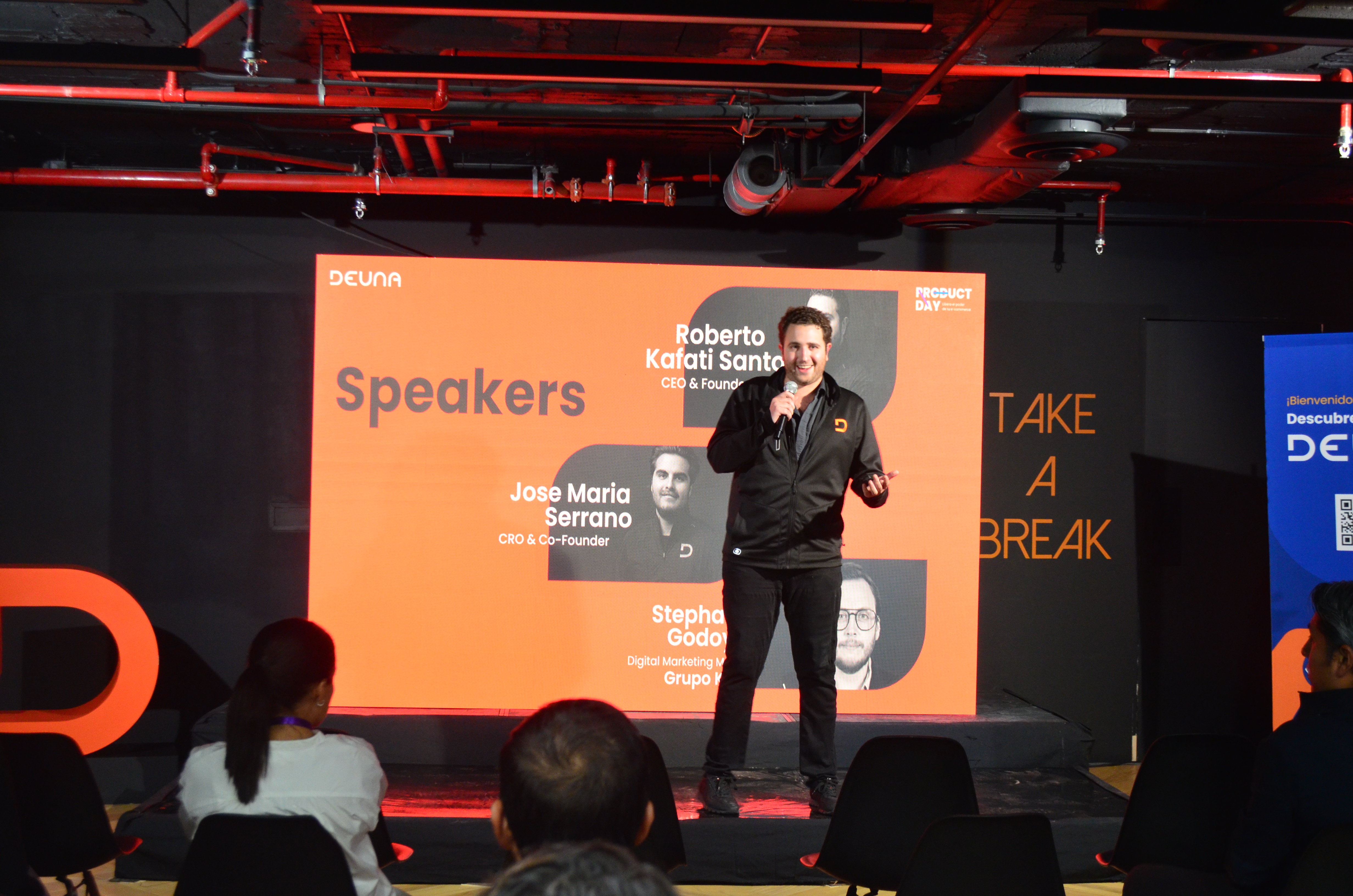
At DEUNA's Product Day in Mexico City in February 2023, the restaurant connection returned in a concrete form. KFC Ecuador's digital executive, Stephane Godoy, described a shift away from concentrating on acquisition toward bringing customers back. In the earlier approach, he said, new users represented 80% of the customer mix and returning users 20%.
The aim was to improve the experience and payment options enough to encourage repeat purchases. Godoy reported that, with DEUNA's one-click checkout, the user checkout cost fell from $3.07 to $1.36. That was a customer account of a particular implementation. It also gave Kafati's argument something tangible: a restaurant discussing the economics of its own channel.
Godoy's observation about loyalty was especially telling. After repeated purchases, he argued, people became loyal to the experience. A familiar logo could attract someone; a reliable purchase journey helped bring them back. Kafati's company was working in the space where that distinction becomes measurable. A checkout has very little personality, yet customers remember when it makes them do unnecessary work.
Learning the wrong name, in public
There is a smaller story that brings the CEO into focus. At an industry event, Kafati announced the winner of a giveaway and called out the wrong name. He had been preparing to meet someone else, and that person's name escaped into the announcement. The actual winner was a senior executive at an enterprise client DEUNA hoped to sign.
The client eventually signed. The embarrassment remained useful. Kafati connected it to the care required in relationships, where a name and a conversation can carry more weight than their place on an agenda suggests. A payments founder spends plenty of time discussing precision in software. Here was precision failing at the microphone.
“Build with long-term vision - and make it unique.”
Roberto Kafati
His advice about building a company tends toward patience and resilience. The giveaway story supplies an appealingly ordinary companion to those ambitions. Someone can be designing a more intelligent commerce system and still suffer the ancient human problem of saying the wrong thing in front of a room.
What a transaction can tell you
By September 2023, Kafati was already discussing AI as a way to understand customer behavior and payment-provider performance. At the time, DEUNA was also helping brands identify users for more personalized experiences. He named KFC and Wendy's among businesses using those capabilities in several countries. The later emphasis on intelligence had an observable earlier chapter.
In 2025, Athia became a prominent expression of that direction. Kafati presented it at the Payments Leaders' Summit as a way to turn raw payments and commerce data into actions informed by business context. A transaction contains information beyond the fact that somebody bought something. The ambition was to make that information useful to the teams operating the business.
He has described a future in which systems detect revenue leaks and help teams respond sooner. The current DEUNA offering extends across payment connectivity, orchestration, reconciliation and AI tools for investigating performance. Its premise follows the path of the company itself: once you help a merchant process a purchase, you have an opportunity to help explain what happened around it.
That ambition also raises the standard of the promise. A checkout can be judged by whether an order completes. An intelligence product must help someone make a useful decision. Kafati's move into AI takes him further into the merchant's daily work, where an impressive demonstration eventually has to answer an unromantic question: what should we do next?
The next chapter needs other people's experience
In a 2026 update, Kafati drew attention to the people joining DEUNA. He named Mark Walick, whose experience included payments infrastructure at Google and systems at iTunes, and Ferhan Elvanoglu, with experience at Lyft and Affirm. For a founder moving from checkout into broader enterprise infrastructure, those backgrounds speak to the work ahead.
His public profile now places him in New York, while Mexico City remains an important gathering place for the company. Recent team accounts describe a leadership offsite with product discussions, whiteboards, tacos and lucha libre. The wrestling is a welcome detail. Even a company occupied with frictionless transactions appears to have found an evening for professionally organized friction.
The thread through Kafati's career remains the merchant's ability to keep a direct relationship with the customer. It began with a family asking for help and expanded through checkout, payment operations and data. The product vocabulary has grown considerably. The original test is still easy to picture: someone has chosen dinner, reached for a card, and expects the restaurant to be able to take the order.