A shopper reaches the end of an online purchase. The product is chosen, the address entered, the card ready. For the merchant, this ought to be the easy part. Yet a sale can still disappear between intention and approval. DEUNA has built a company around that small, expensive interval. Its argument is appealingly awkward: before paying to attract another customer, examine what happened to the one who already wanted to buy.
- DEUNA connects payment and fraud providers, then helps merchants decide how to use them.
- Checkout conversion and payment approval are separate problems. It works on both.
- Athia adds AI analysis and workflows to the transaction data underneath.
Consider Sony Store Online Mexico. In a September 2025 case study, DEUNA reported a 9.38% uplift in approved transactions after Sony upgraded its payment infrastructure. It also reported recovering 14% of gross merchandise value during peak seasons and delivering up to fifteen dollars in return for each dollar invested in payment optimization. Those are company-published customer results, rather than a forecast for the next merchant. Still, they pose an interesting question. How much growth might be waiting inside an existing payment operation?
Reported uplift in approved transactions after the payment upgrade.
DEUNA customer case · September 2025 · uplift as publishedThe button was only the beginning
DEUNA began in 2020 with Roberto Kafati and José María Serrano. Its early proposition was one-click checkout for Latin American merchants: recognize eligible returning shoppers, spare them repeated form-filling, and help brands sell through their own channels. Kafati brought experience in digital payments at McKinsey; Serrano had worked in private equity at Carlyle. Their chosen problem lived where customer experience, payment acceptance and fraud prevention collided.
In July 2022, the company announced a $30 million Series A led by Activant Capital, following a $7 million seed round. The money was intended for expansion, hiring and product development. Bloomberg Línea’s reporting captured a less polished difficulty, too: Kafati said explaining the solution to merchants was a principal challenge. Building during the pandemic also made transmitting company culture across a remote team difficult. A clever checkout still needed a comprehensible sales pitch.

The brief widened. In a 2025 founder interview, Kafati described realizing that merchants needed payment systems capable of working across countries. Checkout led into infrastructure, orchestration and data. The change makes practical sense: removing a form field helps little if the resulting transaction reaches the wrong provider or disappears into an unexplained decline.
A traffic controller with a ledger
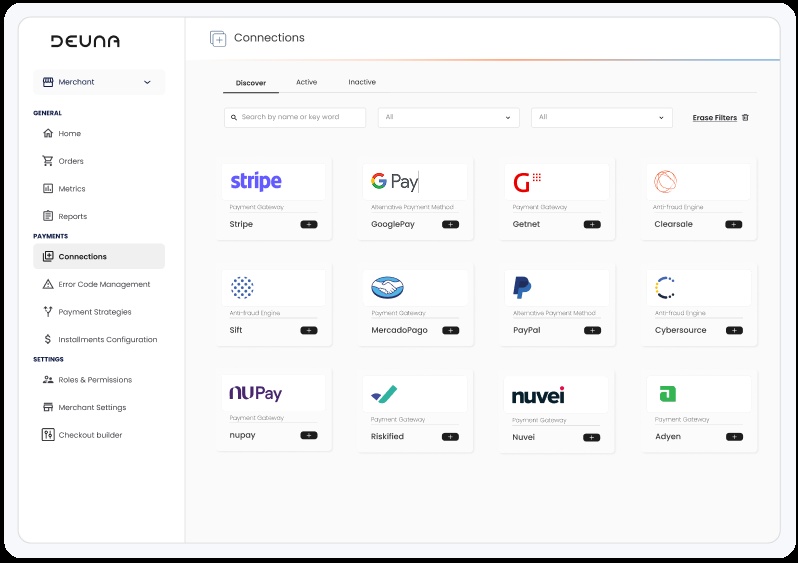
Today, DEUNA’s infrastructure offers a single integration to what it says are more than 400 payment providers, alternative methods, acquirers and antifraud tools. Merchants configure routing rules through a no-code interface, manage captures and refunds centrally, and inspect transaction histories. The orchestration layer coordinates existing providers. A merchant can direct transactions according to market, payment attributes, processing costs and risk, rather than accepting one fixed route for every purchase.
That places DEUNA in the payment orchestration market, alongside alternatives such as Yuno and Primer. Businesses can also maintain direct integrations themselves. DEUNA’s particular package combines the routing layer with a recognized-user checkout network, reconciliation, subscription billing and Athia. Its roots in Latin American commerce help explain the attention to local methods and installment options. The expertise lies in coordinating a complicated stack, including the commercial decisions around it.
The customers reflect that complexity: retailers, airlines and restaurant groups, including Sony, Volaris, Flybondi, KFC and Essity. This is a B2B SaaS business sold through enterprise conversations and demonstrations. The relevant budget is therefore broader than software alone: integration effort, processor charges, fraud losses and the operating time consumed by exceptions all belong in the calculation.
Coca-Cola had a different leak
En Tu Hogar by Coca-Cola illustrates why the distinction between conversion and approval matters. Its project involved a customized checkout, keeping shoppers within its digital ecosystem and connecting with bottler logistics. DEUNA reports a 37% decrease in cart abandonment after its checkout widget was implemented. Sony’s approval metric describes transactions getting through; Coca-Cola’s abandonment metric describes shoppers staying long enough to complete the journey. A merchant who confuses the two risks fixing the wrong leak.
Essity’s Mexico case adds another dimension. Its implementation combined one-click checkout, routing rules, promotions and fraud controls. DEUNA reports a 20% increase in acceptance and sales growth above 30%. The useful lesson is the combination of measures. More approvals have to be considered alongside fraud and customer experience. A low-friction purchase that later becomes a chargeback is an expensive kind of success.
“Their platform was highly effective in optimizing our payment process, which was fundamental to our success.”Santiago Dávalos · D2C Mexico, Essity
The AI needs your spreadsheet
Athia is DEUNA’s attempt to make the accumulated data operational. It organizes payment, commerce and identity records, accepts questions in ordinary language, surfaces opportunities through specialist agents and connects insights to workflows. DEUNA and KFC showcased the product at NRF 2025. The intended progression is from knowing that performance changed to understanding why, then doing something about it.
The revealing detail is in the documentation. Negotiated fee schedules enter Athia through CSV uploads because most providers do not expose those commercial terms through APIs. A rate card records what a merchant should pay; settlement records show what it actually paid. Both matter. When prices change, the file needs updating. The inference is straightforward: an AI recommendation about cost is only useful when the underlying agreement is current.
Count the orders, then count the cost
In August 2026, DEUNA announced an expanded global PayPal partnership covering eligible access to Wallet, Venmo and Pay Later through its API. The announcement’s geographic exclusions make a useful point: provider connectivity does not make every product available everywhere. Regional eligibility still matters.
What can another operator copy? Separate checkout abandonment from payment declines. Compare outcomes by provider and market. Keep fee schedules current. Measure recovered orders against processing costs and fraud losses. For a merchant with a simple, satisfactory payment setup, another coordination layer may offer less value; that is a business judgment, not a universal prescription. DEUNA’s wager is strongest where complexity is already costing money. The customer has done the charming part: wanting the product. Someone still has to finish the sale.