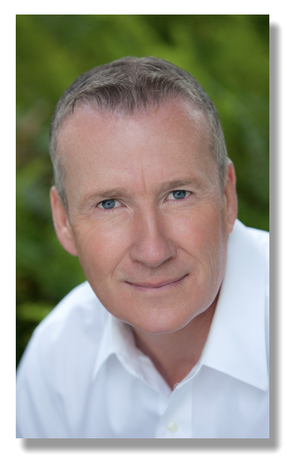
He keeps getting handed companies that have a great idea and no revenue. Then he hands them back with a clinical trial, an FDA clearance, and a sales run rate. Twenty-five years of the same useful trick, across four different specialties.
Robert K. Weigle runs NOW Diagnostics today, and the pitch is simple enough to fit on a single test strip: get a real answer from a drop of saliva or blood, fast, without a needle or a lab in the loop. It is the same idea he chased at Prime Genomics, where the goal was reading cancer signals out of spit instead of a scalpel. He talks about it the way a salesman talks about a product he actually believes in - as access, not just technology.
That instinct is the through-line. Weigle is not the scientist who invents the device and he is not the financier who only sees a cap table. He is the person in the room who has done this enough times to know the order of operations: prove it works, prove a regulator agrees, prove a patient and a payer will pay, and only then talk about scale. Founders hire him because he has walked that exact hallway before, in cardiology, in spine, and now in molecular diagnostics.
He came to medicine sideways. The degree from the University of California, Berkeley is in political science, not biology or engineering. The early jobs were in sales and marketing for the giants - Johnson & Johnson, Baxter, Camino, Aesculap - the kind of training that teaches you how a hospital actually buys things, which turns out to be more useful to a startup than another patent.
From 2009 to 2020, Weigle was CEO and a director of Benvenue Medical, a Silicon Valley spine company. He took it from pre-clinical research through clinical trials and into commercial launch - not in one market, but two at once: treating compression fractures in the spine and degenerative disc disease. The first full year of selling cleared a run rate north of one million dollars a month.
The harder achievement is the one that does not photograph well: more than $200 million raised over a decade, in a category where investors get tired and devices take years. Across his career the private-placement total runs past $130 million. Raising money is not a footnote on his resume. It is arguably the resume.
Read the timeline sideways and a pattern jumps out. Cardiac Pathways went to Boston Scientific. Neurocare went to Integra Life Sciences. Via Corporation went to Alliance Pharmaceuticals. Weigle has spent his career inside companies that other, larger companies eventually wanted to own - which is a polite way of saying he is good at building the thing that gets bought.
His specialty list reads like a tour of modern medicine: interventional cardiology, electrophysiology, radiology, pain management, neuroimplantables, spine, and now genomics. Most executives pick a lane. Weigle treats the lane as interchangeable and the playbook as the constant.
Lay the company list flat and you get a map of three decades of medical innovation. He held vice-president roles at TherOx, a company built around oxygen therapy for the heart. At Cardiac Pathways, an electrophysiology business later acquired by Boston Scientific. At Cardima, in cardiac mapping and ablation. At Via Corporation, which Alliance Pharmaceuticals acquired. At Neurocare, scooped up by Integra Life Sciences. Earlier still came the foundational sales-and-marketing years at Johnson & Johnson, Baxter, Camino, and Aesculap, the names that taught a young political-science graduate how a catheter actually reaches a patient.
Notice how many of those sentences end in the word "acquired." That is not luck repeated six times. Weigle's particular skill is taking a venture-backed company through the unglamorous middle - the clinical data, the FDA clearance, the reimbursement strategy, the first real revenue - to the point where a larger player decides it is cheaper to buy than to build. He has described his own expertise in exactly those terms: corporate strategy, investor relations, regulatory affairs, and the slow art of getting a payer to say yes.
Oxygen therapy and cardiac mapping - the heart years, early in the device career.
Both later acquired - by Boston Scientific and Integra Life Sciences respectively.
The Fortune 500 schooling in sales, marketing, and how hospitals buy.
A small California medical device company building an orthopedic surgical system for sacroiliac (SI) joint fusion - a single-implant approach to a joint most surgeons have historically ignored.
Weigle joined the board in 2022. He served on the Audit Committee and chaired the Nominating and Corporate Governance Committee, the unglamorous machinery that keeps a public medtech company honest.
It is not a random board seat. Spine was Benvenue's whole business. Tenon gets a director who has already taken a spine device from idea to operating room and back to the capital markets.
Stents, spinal cages, fixation hardware. Big trials, big capital, long roads to the operating room.
Saliva and blood tests that hand a result back fast, without a needle or a central lab in the path.
For most of his career, Weigle sold things that go inside the body. Interventional cardiology catheters. Electrophysiology systems. Pain-management implants. Spinal devices at Benvenue. Each one carried the same heavy economics: a long clinical trial, an expensive sales force, and a hospital purchasing committee that moves at the speed of a glacier. He got good at that economics. He also, clearly, started looking for a different one.
Diagnostics is that different bet. Move the value from the procedure to the answer. Make the test cheap enough and simple enough that it can run far from a hospital, and the whole calculus changes - who can get screened, how early, and at what cost. When Weigle took the CEO chair at Prime Genomics in 2020, the mission he signed up for was blunt: improve breast cancer detection for all women, using a sample as ordinary as spit. The phrase he keeps returning to is "noninvasive." It is not marketing. It is the entire point.
That move also explains the company he keeps. His years as Entrepreneur in Residence at DigitalDx Ventures put him next to early diagnostic companies looking for someone who has actually shipped a regulated medical product. His CEO run at NOW Diagnostics, which makes rapid point-of-care tests, is the same thesis turned into a day job. The common thread from Berkeley to now is not a single technology. It is a stubborn belief that the bottleneck in medicine is access, and that the way through it is making the test simpler, not the science flashier.
It helps that he learned the business from the inside of the giants before he ever ran a startup. The sales-and-marketing apprenticeship at Johnson & Johnson and Baxter, the regional management role, the executive coursework stacked on through Kellogg and Darden - all of it taught him the part founders usually learn the hard way: how money, regulators, and hospitals really behave. By the time he was raising rounds for spine devices, he was not guessing. He had seen the machine work from every seat.