A golf resort is an agreeable place to spend someone else’s money. Robert Rowling’s arrangement in Frisco was rather less relaxing. His family’s holding company helped guarantee roughly $525 million for a resort and golf courses on former ranchland. The PGA of America needed assurance that its new home would actually be built. The city needed assurance, too. Somewhere beneath the drawings of fairways, restaurants and a 500-room hotel sat a promise with the Rowling name attached.
The project opened in May 2023. By then, Bob Rowling had spent decades turning the proceeds of a Texas oil business into hotels where people could sleep, hold meetings, get married and occasionally lose a ball. Dallas knew him as the owner behind Omni. Frisco gave that ownership a particularly visible expression: land, buildings and an ambitious golf destination, with the family carrying the financial commitment.
A lawyer returns to the oil patch
Rowling grew up in Corpus Christi, the son of Reese Rowling, a geologist who built Tana Oil & Gas. Oil supplied the family’s opportunity and its education in uncertainty. A promising prospect might become an asset; a convincing argument might become an expensive hole. There was no avoiding the difference once the drilling began.
Robert graduated with honors from the University of Texas at Austin in 1976, earning a business administration degree. Three years later he graduated with honors from SMU’s law school. His father had encouraged the law degree. He went into tax law, then returned to the family business in the early 1980s. The young lawyer had acquired a useful way to read a transaction. He wanted to participate in the transaction as well.
Tana’s fortunes eventually changed. Texaco bought its oil and gas assets in 1989, giving the family the capital from which TRT Holdings emerged. The important change was the question Robert now had to answer. Finding oil had made the money. What should the money own next? A bank and pipelines entered the picture. Hotels offered another route, one that would occupy much more of his life.
It is tempting to give this transition the smooth inevitability of a business-school case. Rowling’s own account is untidier. His early hotel purchases came during a depressed market, when properties could be bought out of financial trouble. The hotel business arrived through a deal before it became the family’s defining enterprise. A career can have a direction without having started with a master plan.
Half a billion dollars buys a new set of worries
In 1996, TRT acquired Omni for about $500 million. The buyer had experience with capital and a growing interest in hospitality. He was taking on a brand whose fortunes would depend on thousands of ordinary encounters: a reservation honored, a meeting room ready, dinner arriving while it was still dinner. An oilfield could reward the right geological judgment. A hotel required the right judgment again tomorrow.
Owning the business also meant spending money after the purchase. The historic Parker House in Boston received more than $60 million in improvements. That is the less photogenic side of acquiring a famous address. The past may get guests through the door; keeping them comfortable requires present-day expenditure. A brass plate describing the building’s history cannot repair the building.
Rowling’s hotel model placed ownership and operation close together. Land, buildings, brand and service belonged within the same business. That gave the owner more say over the guest experience and a larger share of responsibility for it. The appeal of control is easy to understand. Its cost appears when the property needs work, the market turns or a new development takes longer than expected.
His portfolio also carried personal convictions into commercial decisions. In 2004, Rowling and Omni president Jim Caldwell discussed the company’s removal of adult pay-per-view films from its hotels in a recorded FamilyLife interview. Whatever a guest thought of that choice, it demonstrated something concrete about private ownership: an owner could decide that a source of revenue did not belong in his business.
“At most places golf is an amenity. It’s different here. It will make money.”
ROBERT ROWLING · ON GOLF AT FRISCO · 2024
The fairways become part of the business
Golf became increasingly important to Omni’s resort ambitions. Amelia Island joined the portfolio in 2010. A substantial resort acquisition followed in 2013, bringing properties such as Barton Creek, La Costa, Rancho Las Palmas, the Grove Park Inn and the Homestead into the group. These were places people traveled to deliberately, often for an experience that lasted longer than a night.
The attraction came with complications. Golf courses require land, upkeep and customers with time to play. A resort needs enough reasons for the rest of the traveling party to come along. Rowling was buying businesses where the room, restaurant and round could support one another. The economics depended on the whole property working, rather than a golfer admiring a particularly fine stretch of grass.
At the Homestead in Virginia, Omni completed a renovation costing more than $150 million in 2023. The work included 483 guest rooms and substantial meeting facilities. The resort had welcomed travelers since 1766. Historic ownership, in this instance, involved modern rooms and functioning event spaces as well as affection for an old name. Guests may appreciate continuity; they also appreciate a comfortable chair.
Frisco needs a signature
The Frisco proposal brought another set of people to the table. David Ovard, a local attorney, had wanted somewhere for young golfers to practice without an expensive club membership. Northern Texas PGA leader Mark Harrison was pursuing a home for his organization. Developers, city officials and the PGA of America eventually joined a project much larger than those early ideas.
Blake Rowling, Robert’s son and TRT’s president, became a central participant. An initial evening meeting with the family at Dallas Country Club ran far beyond the short appointment a developer had expected. The attraction included championship commitments and the possibility of a resort in North Texas. The difficulty was aligning organizations with different needs, then putting enough financial backing behind their agreement.
Robert had already worked with Jerry Jones on the Omni hotel at The Star, the Cowboys’ Frisco headquarters development. That experience made the newer proposal easier to contemplate. In 2019, he appeared at a project event alongside the PGA’s Seth Waugh, architects Gil Hanse and Beau Welling, and Lee Trevino. A usually reserved investor had a site plan worth discussing.
Approximate resort and golf-course commitment backed by the Rowling family and TRT.
Project figures reported at opening. Dollars refer to financial backing, not annual revenue.
When Omni PGA Frisco opened on May 2, 2023, its attractions extended beyond championship play. There were two full courses, a ten-hole short course and a two-acre putting green called the Dance Floor. The names lowered the temperature a little. A destination associated with major tournaments could also make room for somebody whose principal golfing achievement was having brought the children.
The hotel added meeting space, dining and ten ranch houses. The design included paintings by Terry Rowling in those houses and an ice-cream shop named for Blake’s daughter Margaret. Such details give a family enterprise a literal presence inside its property. They also supply a pleasantly modest counterweight to a development whose construction budget was anything but modest.
Two campuses, two kinds of return
The family’s buildings also reach beyond hospitality. In 2013, Robert, Terry and their family pledged $25 million toward a new graduate business building at UT Austin. Both Robert and Terry were business-school graduates of the class of 1976. Their son Blake also earned his undergraduate degree there. The gift brought several generations of the family back to an institution they knew personally.
The proposed building was meant to support teamwork, interviews, faculty meetings and graduate study. That makes the donation more specific than a name on a facade. The family helped finance the practical conditions in which other people would learn to do business. Robert’s stated aspiration was to encourage talented students to come to Austin for an MBA and participate in Texas’s economy.
At SMU, the Robert B. Rowling Center for Business Law and Leadership was established through combined gifts of $4 million. An anonymous lead donor requested the name. Its purpose joins the two disciplines Rowling studied and used: business and law. Naming a center for him was recognition by others, rather than a simple instance of an owner ordering new lettering.
Another campus building preserves his father’s name. The family contributed a $5 million Longhorn Legacy gift, and the east side of Texas’s football stadium was rededicated as Reese M. Rowling Hall. Robert’s career moved beyond the oil company. The family’s giving kept the earlier generation visible. A hotel purchase could start a new chapter without closing the family album.
A resort can still become a contested asset
The obligations of ownership were visible again in 2026, this time around the Greenbrier in West Virginia. TRT affiliate White Sulphur Springs Holdings acquired the resort’s first-lien debt from Carter Bank. Jim Justice and his family, the hotel’s owners, challenged the transaction in court. TRT rejected their allegations and said the central issue was unpaid debt. Competing claims became litigation, rather than an agreed partnership.
The episode ended differently from an Omni acquisition. In August, a financing and joint-venture deal with Kennedy Lewis Investment Management was completed, and the related state and federal lawsuits were dismissed. Kennedy Lewis took majority control, with the Justice family retaining a minority stake. The distinction matters: Rowling’s involvement as a creditor did not make the Greenbrier an Omni-owned resort.
That outcome belongs in a portrait of the investor alongside the openings and gifts. A hotel can be a gathering place, a local landmark and the collateral behind a financial argument, all at once. The owner or lender cannot choose just the agreeable part of that identity. The balance sheet keeps its own appointment.
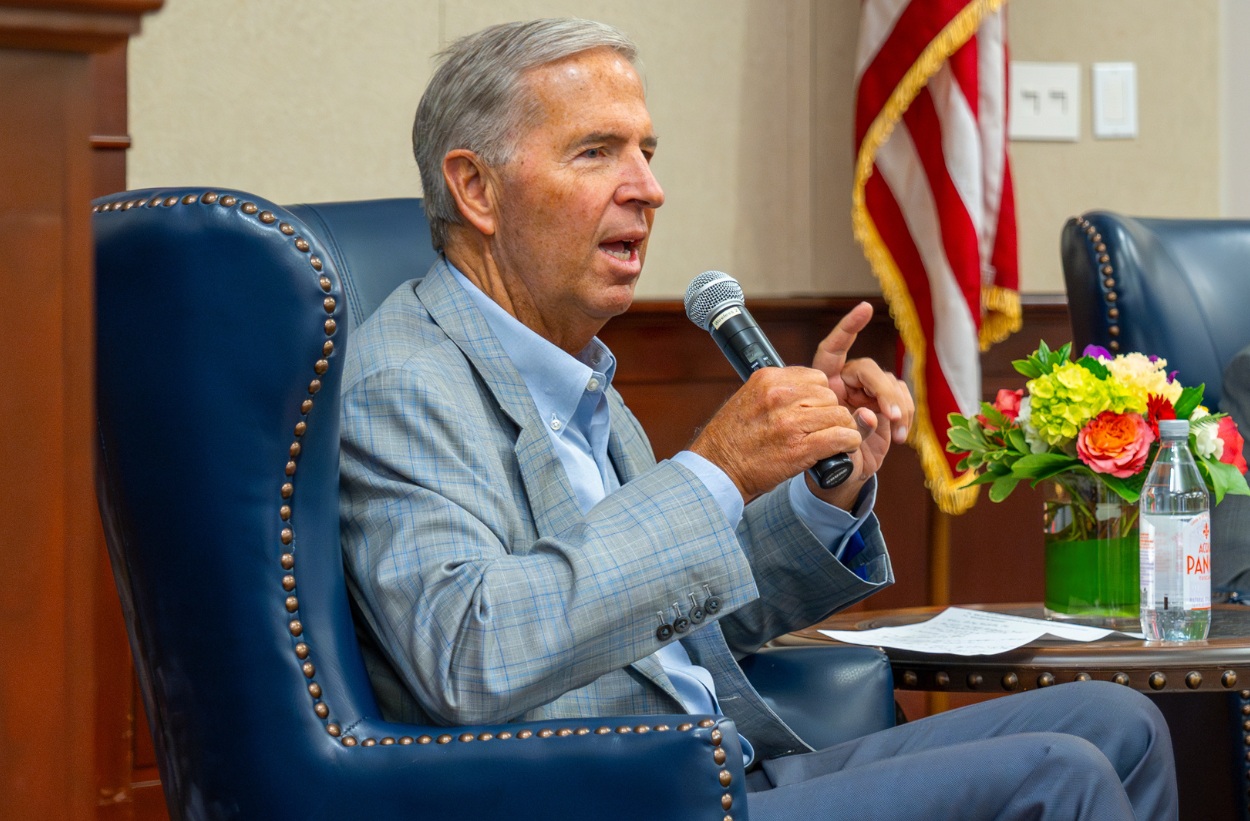
Rowling returned to SMU’s Trailblazer speaker series in 2024 to talk about the decisions behind his career. His useful closing observation was brief: “It’s never a straight line.” The Frisco guarantee makes the point without much ornament. A golfer sees a fairway and considers the next shot. Robert Rowling also has to consider the money that made the fairway possible, and how long that promise will last.
Keep reading
- TRT Holdings ↗Company website
- Bob Rowling on LinkedIn ↗Personal profile
- Rowling at SMU’s Trailblazer series ↗December 2024 · career conversation
- The people who brought PGA Frisco together ↗D CEO · May 2023
- How a Texas oil investor entered hotels ↗Forbes · April 2024
- A recorded conversation with Bob Rowling ↗FamilyLife · March 2004 · audio interview
- The Rowling family’s UT Austin gift ↗UT News · March 2013
- The Greenbrier settlement ↗MetroNews · August 2026