Matthew Marcial had already got the job. He was chief executive of the Public Relations Society of America, responsible for its programs, finances and operations. Then he put himself through the process his own organization asks other professionals to undertake: earning Accreditation in Public Relations. In December 2025, the association executive added APR to his credentials. The person running the organization had become a student of the profession it serves.
There is something pleasingly inconvenient about that decision. A new CEO has plenty of respectable reasons to postpone studying. Meetings multiply. Everyone has a priority. The calendar begins to resemble an airport departure board. Marcial chose to learn anyway. His route to the top had begun years earlier in hospitality, with a high school job at a resort. By the time he arrived at PRSA on March 3, 2025, he knew how associations worked. He wanted a closer understanding of the people inside this one.
A resort job with a long afterlife
At first, the resort work sounded like fun. Marcial was preparing for college, working with guests and discovering that he liked the human side of the business. He continued advancing in hospitality while studying for his bachelor's degree and then his master's. His education took him through Saint Leo University, where he studied business administration, and Florida International University, where he earned his MBA.
Hospitality gave him a practical habit: anticipate what someone will need. That is a useful education in any organization that depends on people choosing to return. A guest can leave. So can a member. Both have lives outside the institution, and neither is obliged to be impressed by its internal arrangements.
After his MBA, an opportunity arose to lead a national association's meetings and events team. Association work opened up a wider range of responsibilities. Education, membership, sales and partnerships became parts of the same professional world. He could develop a career while helping other people develop theirs. The setting changed; the interest in serving people remained.
His earlier hotel and resort roles included reservations, convention services and national sales. Those jobs put service and business in the same sentence. It is easy to admire the welcome at a hotel and overlook the planning that makes the welcome possible. Marcial's subsequent career repeatedly placed him near that machinery.
The meeting that people left early
He joined Meeting Professionals International's global team in 2014 and became its vice president of education and events in 2016. His responsibilities encompassed a global events portfolio and educational products. Here was a profession whose members knew exactly how much work a conference required. Serving meeting planners meant organizing meetings for people who could spot the seams.
One revealing example came from MPI's World Education Congress. Feedback from the 2017 sessions was positive, yet attendance tracking exposed a complication: many participants spent only 20 to 30 minutes in sessions scheduled for a full hour. Even highly rated sessions saw that pattern. A satisfied attendee, apparently, could also be an attendee heading for the door.
The 2018 agenda responded with sessions of different lengths, including 30, 60 and 90 minutes. Smaller learning areas helped attendees move between experiences. It is a wonderfully unromantic leadership lesson. People can approve of a program and still use it differently from the way its organizers imagined.
The agenda said 60 minutes.
The audience said 20-30.
Observed at WEC 2017; WEC 2018 offered a mix of session lengths. These bars describe reported session behavior, not an average across all attendees.
Another program took education outside the usual meeting room. At CES in January 2016, MPI's Experiential Event Series brought 19 participants behind the scenes to meet event leaders. The group learned about transportation logistics for more than 175,000 convention participants, alongside security and venue operations. The experience offered 20 hours of continuing education credit.
The attraction was access: seeing how another team solved problems at a scale most planners would rarely encounter. Marcial's work also included an education partnership with the Global Business Travel Association for its 2017 Frankfurt conference. The common thread was practical learning across professional boundaries. A useful idea need not carry the badge of your own industry.
Before PRSA, a campus-sized brief
By 2021, Marcial was vice president of conferences and sales at The Institute of Internal Auditors, then described as a global association with 200,000 members. Leading a substantial business unit helped prepare him for responsibility across an entire organization. On September 1 that year, he became CEO of the National Association of College Auxiliary Services.
NACAS serves the nonacademic side of higher education: the campus services students use, including bookstores, food services, housing and transportation. The work is easy to overlook precisely because people rely on it every day. Its members have to make institutions function in ways that are both operational and personal.
The appointment was supported by a concrete record. NACAS's search committee gathered assessments from 21 interviewers; 90 percent recommended hiring Marcial. Its board approved the appointment unanimously, with 12 yes votes. Those numbers describe a hiring decision, rather than a verdict on everything that followed. Still, they show the confidence with which he entered his new association CEO role.
His NACAS tenure ran from 2021 to 2023. Before joining PRSA, he also worked as a strategic consultant helping nonprofit clients with revenue and growth. His career had moved from delivering particular programs to weighing the wider questions that keep them available: what members value, what an organization can afford and where it should invest next.
- 2014Joins MPI's global team
- 2016Becomes MPI vice president of education and events
- 2021Begins as NACAS CEO
- 2025Joins PRSA in March; earns APR in December
A title, and then homework
PRSA announced his appointment on February 27, 2025. Its board chair at the time, Ray Day, was seeking a leader capable of helping the association change. Marcial was drawn to the strategic plan and the work it proposed. The appointment placed an experienced association operator at the head of a communications organization.
He brought credentials of his own: Certified Association Executive and Certified Meeting Professional. Association Forum and USAE had recognized him in their 2016 Forty Under 40 class. Those distinctions recorded experience in running professional communities. The APR would ask him to engage directly with public relations strategy.
Preparation included a study guide, a boot camp and online learning tools. The accreditation process involved a panel presentation before the examination. He began studying before completing the presentation, then passed the exam on December 11, 2025. That sequence matters because it makes the credential a piece of work, rather than an ornamental addition to a biography.
For an executive who talks about professional development, completing that work gives the argument a certain weight. Members are asked to make room for learning while holding down demanding jobs. Their CEO had undertaken the same balancing act. The association's promise of growth had become something he could discuss from experience.
By June 2026, he was participating in a Member Mondays conversation about accreditation. He described the satisfaction of hearing how members had used the APR to become stronger strategic advisers and participate in executive-level discussions. The focus had moved from his own qualification to the changes people could make with theirs.
Who gets to look like a leader?
Marcial is Filipino American, and he has spoken about his cultural background as an aid to understanding people with different experiences. His account of representation makes room for several kinds of executive. A single professional route, leadership manner or appearance cannot explain who deserves responsibility.
He has also tied inclusion to practical work: develop resources, assess whether efforts are working and change them when necessary. At the 2025 Counselors Academy Conference, he connected with PRSA-LA treasurer John McCartney and conference chair Kristelle Siarza Moon, fellow Filipino American communications leaders. The connection put names and faces to a subject that can otherwise disappear into policy language.
That perspective fits a career spent moving among professional groups. To lead an association is to work with people whose daily concerns differ from your own. Listening has to survive the arrival of a title. An executive can learn the vocabulary of an industry quite quickly; understanding what people need from it takes longer.
“Never stop learning and continue to push yourself to do more.”
Matthew Marcial, on advice for emerging professionals
The reputation behind the technology
Artificial intelligence has become part of his public brief. In an On Top of PR conversation recorded in August 2025, Marcial discussed responsible AI use and PRSA's ethical guidance. His emphasis was on expectations, training and the consequences of publishing material that could damage trust. A tool can accelerate production without relieving a communicator of responsibility.
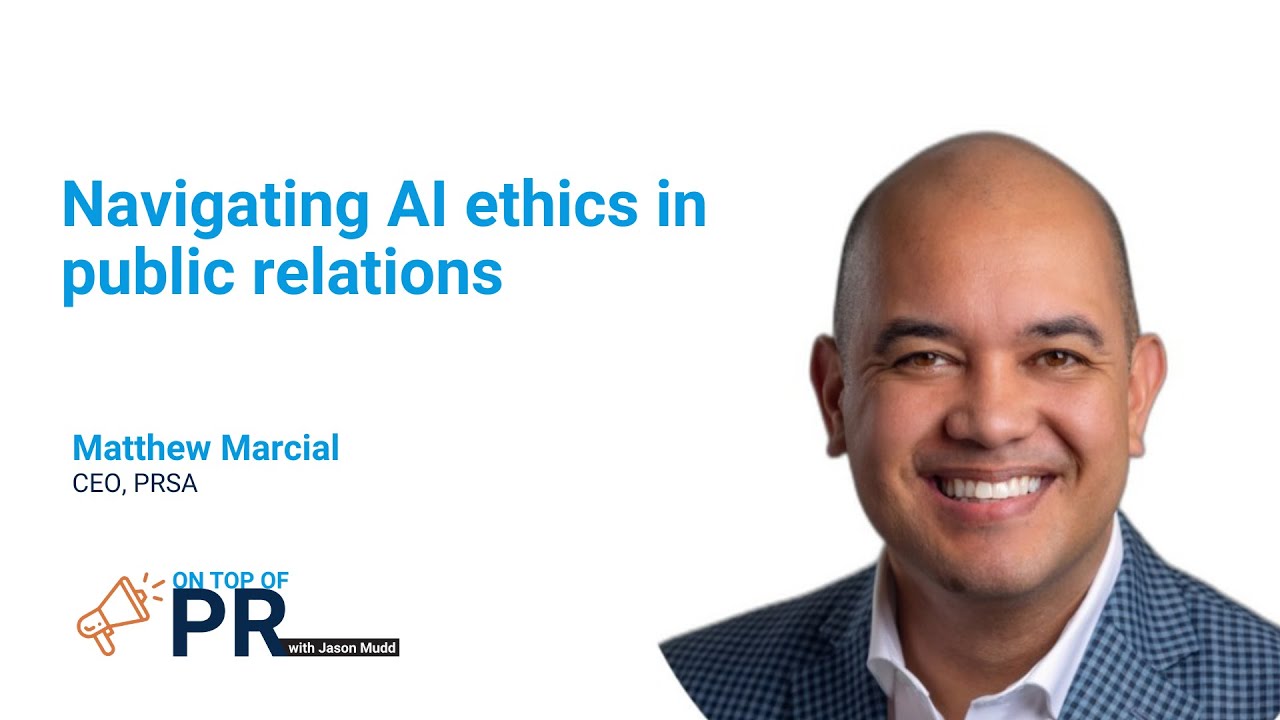
For him, the discussion belongs alongside a broader ambition: connecting communications expertise with other business professionals. He has described opportunities for people outside traditional PR roles to learn skills that help them manage relationships, workplace questions and organizational reputation. His own experience crossing industries gives that ambition a recognizable origin.
He has also taken the conversation to chapters. During a November 2025 visit to Knoxville, he discussed relevance, growth and the importance of local communities to the member experience. In August 2026, PRSA appointed Michele Kuziola to lead sales and business development. Marcial linked the hire to expanding offerings and building partnerships that serve members. The language of welcome still requires a business model.
The saxophone is also on the résumé
Outside work, Marcial plays the saxophone and likes cooking, grilling and barbecue. He has described himself as a music enthusiast and a foodie. In his 2025 account of family life, he and his wife had two school-age boys and a daughter in college. There are other schedules competing with the executive calendar.
These details give the professional story a little breathing room. A life organized around other people's development also has room for dinner and music. The resort job, the conference floor, the campus association and the accreditation exam are connected by a recurring willingness to learn what people need and how the work gets done.
Marcial's next chapters will have to be judged by the programs, relationships and decisions they produce. For now, one choice offers a clear view of his approach. Having acquired the authority to lead a professional association, he took on the discipline of learning its profession. A new title arrived in March. The homework continued through December.