When Crayton Webb bought Sunwest Communications in 2017, he promised to keep the name. He would keep the location and the account teams, too. For an executive finally getting a business of his own, it was a curious opening declaration: here is what I will leave alone. The company had spent 35 years becoming itself. Webb apparently saw little point in making its employees audition for the privilege of continuing to do their jobs.
Andy Stern, the founder, cared about that continuity. Sunwest had 16 employees whose average tenure was ten years. A buyer was acquiring client relationships, certainly, but also an office full of people who knew one another's habits. Stern stayed on as senior counsel. Webb got ownership without having to manufacture a history. The history came with the keys.
“I always wanted my own thing,” Webb said at the time. That desire had taken the scenic route. He had been a television journalist, a communications director, a mayoral chief of staff and a Mary Kay executive. By the time he became an agency owner, he had worked on several sides of the conversation between an institution and the people deciding whether to believe it.
There is a useful distinction here between being recognizable and being trusted. Recognition can happen in an afternoon. Trust involves remembering what someone did last year. Webb's career offers a way to watch that slower transaction: a familiar face changes jobs, accumulates obligations and eventually buys a firm whose existing relationships are part of its value.
A reporter crosses the desk
Webb graduated from Willamette University with a BA in 1994. His broadcast career took him through Oregon, Idaho and Texas, covering politics. In Dallas, he worked as an investigative reporter for KTVT, CBS 11. Television gave him an early place in the machinery of public reputation: the questions, the interviews, the decisions about what viewers would hear.
He later became communications director at United Way of Metropolitan Dallas. From 2002 to 2005, he served as chief of staff to Dallas Mayor Laura Miller. The move put a former reporter inside an office that reporters wanted to question. It also made communications inseparable from government work, where an answer can involve competing interests long before it involves a microphone.
Mary Kay hired him in 2005, initially in government relations. He subsequently became director of corporate social responsibility and corporate communications, then vice president. His remit grew to global media relations, reputation management, public relations and crisis communications across nearly 40 markets. The local reporter's audience had become an international one.
Each job changed the responsibilities attached to a sentence. A journalist needs to establish what happened. A public official's office must explain its decisions. A corporate communicator has to speak for an organization while considering how its words will land in different places. Reading Webb's career through those assignments makes his later interest in reputation understandable without pretending that every move was part of a plan.
- 01 Broadcast news
- 02 United Way
- 03 Dallas City Hall
- 04 Mary Kay
- 05 Sunwest
The trees behind the talking points
At Mary Kay, Webb launched Pink Changing Lives, a corporate social responsibility strategy that organized the company's philanthropy into a program with global reach. One tangible connection from those years led him to the Arbor Day Foundation. Through that partnership, Mary Kay helped plant 100,000 trees in the Bitterroot National Forest.
When the foundation invited Webb to join its board in 2017, he called the decision a “no-brainer.” He and his wife, Nikki, have four children, and he has described their efforts to pass along a love of nature. Trees offer a pleasingly literal version of the long view: something planted now has work to do after the meeting ends.
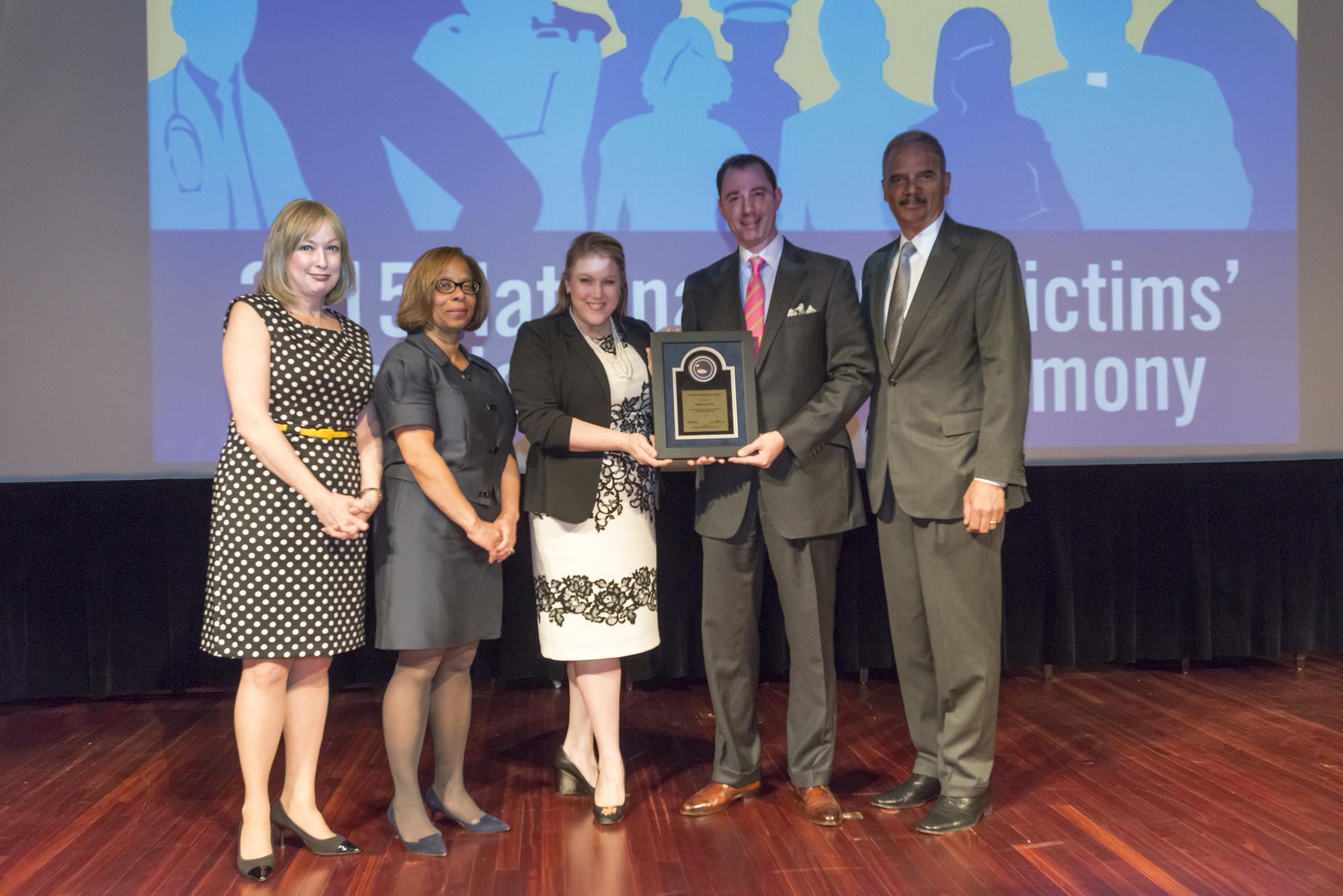
His civic commitments also include past board chairmanships at Dallas Area Habitat for Humanity and the YMCA of Metropolitan Dallas. In 2015, he and Kirsten Gappelberg accepted the federal Allied Professional Award on Mary Kay's behalf. The photograph of that ceremony catches him holding an actual piece of hardware, a welcome change from the abstract vocabulary of reputation.
The distinction between a company's actions and its explanation of them matters throughout this career. A communications strategy can organize a story; it still needs something to organize. The trees are a useful example because the underlying activity can be counted. One hundred thousand is an awkwardly large number to fit on a business card, but a fairly good answer to the question of what a partnership produced.
Planted through Mary Kay’s partnership with the Arbor Day Foundation.
Buying a firm, inheriting a room
Webb's acquisition of Sunwest came in September 2017. Stern had founded the business in 1982, bringing his own background in journalism and government, including work as a staff assistant to President Gerald Ford. The two men had a recognizable professional overlap. They also shared ties to Dallas civic organizations.
Webb set a growth target: $5 million in revenue within five years, with the ambition of putting Sunwest among North Texas's five largest PR firms. The agency reported reaching that revenue benchmark in 2021. That is a historical company milestone, rather than a measure of Webb's personal wealth. It also supplies a concrete test of the ambitions he brought to the purchase.
In 2021, Sunwest acquired Shiroma Southwest. In 2022, Webb and Michael Lunceford launched LuncefordWEBB, a dedicated government relations practice. In 2023, Sunwest bought Spaeth Communications, with Merrie Spaeth joining to lead communications training. These were additions with different functions: an established agency, government counsel and preparation for interviews, presentations and testimony.
There is a human complication behind any acquisition announcement: the people arriving have an office culture of their own. Webb has spoken about the challenge of bringing teams together while making clients comfortable with the transition. It is a practical concern for someone whose first acquisition promise was continuity. Growth creates more relationships to maintain, even when the press release makes the transaction look neatly finished.
- The handoffWebb buys Sunwest from Andy Stern.
- A bigger agencyShiroma Southwest joins; $5M benchmark reached.
- Government counselLuncefordWEBB launches.
- Practice before the microphoneSpaeth Communications joins Sunwest.
The owner still has questions
Webb hosts Reputation Matters, Sunwest's podcast about public image and the people who build, protect or test it. In a 2024 conversation with Texas Tribune CEO Sonal Shah, he explored trust in journalism and the pressures on nonprofit news. The subject suits a former reporter who now makes his living advising people likely to appear in the news.
In May 2025, he interviewed Dallas sportswriter Brad Townsend about sports journalism, the Mavericks and the fallout from the Luka Dončić trade. Webb's questions focused on preparation, access and the relationship between reporters and the people they cover. A basketball transaction becomes, in that conversation, an opportunity to examine what an organization understands about its audience.
An October 2025 episode brought a more personal connection: Jim Acosta. Webb and Acosta had worked together at CBS 11, and Acosta had been in his wedding. Webb disclosed the friendship to listeners. He then asked about the boundary between journalism and advocacy, and about the media's responsibility for public division. Friendship did not eliminate the uncomfortable questions.
That episode gives the career story a small loop. The agency owner is interviewing an old newsroom colleague about a profession they once shared. The conversation is warm, occasionally teasing and willing to disagree. Familiarity makes the questions more interesting because listeners can hear two people with history trying to work through a present argument.
A compliment meets the copy desk
Public recognition has supplied Webb with its own miniature communications lesson. In November 2019, after being named to D CEO's Dallas 500, he wrote on LinkedIn that “humbled” was overused, then used it to describe his inclusion. D Magazine editor Tim Rogers noticed. Dallas had produced an honor and, almost immediately, a vocabulary dispute.
Rogers's objection was that Webb meant honored. The piece also described Webb as someone who took his calls and wore suspenders. It was a friendly correction with a sharp pencil: a communications executive's celebratory word choice had become the story. Few professions are granted such frequent opportunities to have their own work demonstrated back to them.
Other recognition followed: the Dallas Business Journal's Most Inspiring Leaders award in 2021 and the YMCA's Theodore P. Beasley Distinguished Leadership Award in 2022. The distinctions sit alongside less ceremonial details. In a public post, Webb described his oldest son Nelson taking an internship at Sunwest, with an arrangement the owner particularly enjoyed: Nelson did not report to him.
The family detail makes his management philosophy easier to picture. He has spoken about supporting employees' home lives and about keeping communication open while an answer is still being worked out. “Hope isn't a strategy,” he said in a 2021 interview. It is a short enough phrase to survive the journey from advice to practice, where someone still has to make the call.
“We live in a reputation economy.”Crayton Webb, 2017
A larger room, a lower temperature
Webb joined the Texas Lyceum as a director in 2018. His assignments included work on its poll and public conferences. He became president in 2025, when the nonprofit, nonpartisan leadership organization launched a national Campaign for Civility. By 2026, he was its chairman. The campaign brought his interest in public communication into a deliberately wider arena.
He urged elected officials to “disagree without being disagreeable,” and asked citizens to consider their own conduct, too. The appeal leaves room for passionate argument. Its demand is that people keep the argument from becoming an attack on the person making it. Coming from someone who has worked in a newsroom, a mayor's office and corporate communications, the request has several possible audiences.
There is no shortage of occasions to practice. A client may want certainty before certainty exists. An employee may be trying to manage responsibilities at home. An old friend may have an opinion worth challenging. A company may have been sold while its staff are wondering what Monday will look like. Webb's public work repeatedly returns to the people on the receiving end.
The 2017 purchase remains a useful place to end because it makes that attention concrete. He wanted ownership, and he wanted growth. He also began by telling a long-serving team which parts of their working lives would carry forward. Before Sunwest had a new story to tell about its new owner, its new owner gave the people inside it something specific to believe.
Keep the conversation going
Webb’s work, public profiles and conversations.
Meet Webb at Sunwest ↗Crayton Webb on LinkedIn ↗Crayton Webb on X ↗LuncefordWEBB Government Relations ↗Watch: Webb in conversation with Jim Acosta ↗Watch: Brad Townsend and the Mavericks’ reputation ↗Listen to Reputation Matters ↗Webb’s Arbor Day Foundation connection ↗Read: the Dallas vocabulary dispute ↗The Texas Lyceum’s current leadership ↗Read about the Campaign for Civility ↗