A boat can inherit a surprising amount of somebody else’s thinking. Convert an offshore supply vessel into a diving vessel and the old arrangement comes along: spaces intended for cargo or tanks must accommodate a different working life. Robbie Champagne had spent enough of his own working life offshore to have an opinion about that. He wanted to start with the diving.
In 2017, his Houma company, C-Dive, took delivery of DSV 217, a 185-foot saturation dive support vessel built for that purpose. The oil-field market was in a downturn. Boats elsewhere were being laid up. Champagne was accepting delivery of a new one. It was an expensive-looking answer to a very practical question: what should a vessel look like when the people doing the job get to help write the brief?
The question suited his background. Robert “Robbie” Champagne III had been a tender, a diver, a supervisor and a manager before becoming a founder. His business education included the deck beneath his feet. The route to ownership passed through the equipment, the crews and the tasks that a customer eventually sees bundled into a day rate.
First, learn the deck
After completing his U.S. Navy enlistment, Champagne returned to Louisiana and joined American Oilfield Divers as an entry-level tender. In commercial diving, that is a working apprenticeship. Tenders support the divers, learn the equipment and handle the umbilical connecting the person underwater to the operation above. The beginning of a diving career takes place largely out of the water.
Champagne moved through the offshore ranks. By the mid-1990s, his career had shifted toward project management and, subsequently, management of a diving division. His experience included American Oilfield Divers, CEANIC, Stolt Offshore and Chet Morrison Contractors. A job once understood from a diver’s position now had to be understood through schedules, crews and the requirements of an entire project.
That progression matters to the later vessel decision. A supervisor and a project manager encounter different versions of the same delay. One sees equipment and people waiting; the other sees the work plan slipping. Champagne had occupied both positions. It is a useful background for someone eventually deciding which equipment deserves a company’s capital.
He founded C-Dive in Houma in 2008. The company’s own account describes its beginning as three people working out of a marsh. It is a pleasantly unpolished origin for a business whose later vocabulary would include marine construction, environmental services and offshore decommissioning. Before the longer descriptions came the smaller crew.
A new hull in an old market
C-Dive acquired its first dive support vessel, Ms. Kerci, in 2013. Champagne’s company was growing while the offshore market around it was becoming harder. That contrast is worth keeping in proportion: buying equipment and finding work for it are separate accomplishments. Owning a boat creates a continuing obligation to keep the boat useful.
For DSV 217, Champagne worked with local marine architects Tommy Parfait and Dan Duplantis. The resulting design began with the vessel’s intended assignment. Instead of making machinery fit spaces inherited from an offshore supply boat, the team could plan those spaces into the hull. The beam was widened to 44 feet to support stability during diving operations.
“By constructing a newbuild, we were able to design the DSV to fit its purpose.”
Robbie Champagne, on DSV 217
That is a wonderfully restrained explanation for commissioning 185 feet of steel. “Fit its purpose” sounds like the standard one might apply to a good cupboard. At sea, the cupboard also needs propulsion, moorings, a crane, diving equipment and room for people to work around one another.
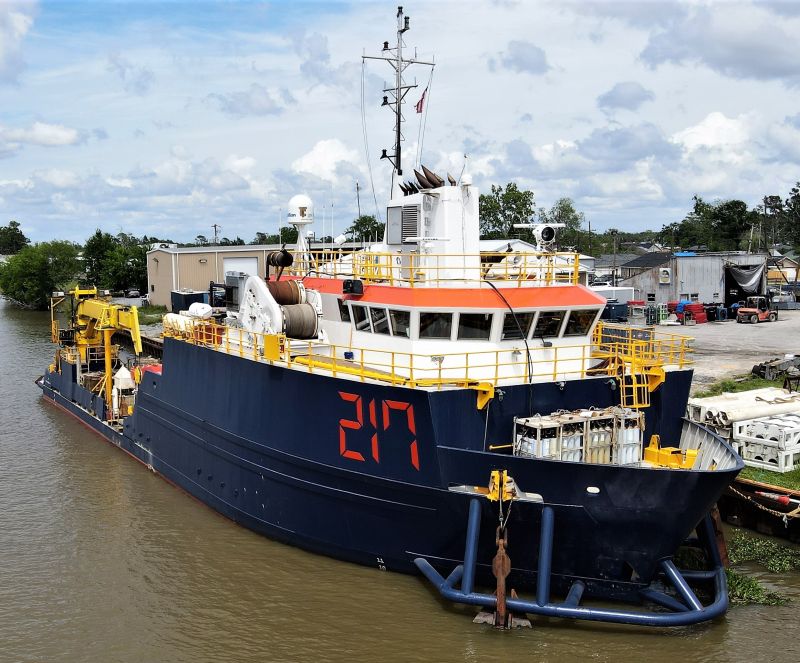
The vessel incorporated a six-person saturation system rated to 1,000 feet, a 12-foot moon pool and a 30-ton crane. Its clear aft deck measured 65 by 44 feet. These details describe a workplace rather than a leisure boat: access, lifting capability and room to arrange equipment were part of the proposition.
The delivery announcement identified inspections, decommissioning, repair, maintenance and subsea construction as intended work. That breadth helps explain the investment. Champagne was commissioning a vessel for several kinds of assignments within the offshore economy. A customer might be maintaining infrastructure, changing it or preparing to remove it.
There was expansion on shore, too. In a public post, Champagne announced another 200 feet of dock space and 15,000 square feet of building space at the Houma operation. The planned uses included training, reception and storage. Even growth had an equipment list. Somewhere to teach the next crew belonged alongside somewhere to put the next load of gear.
The machinery behind the money
By 2023, C-Dive had become Champagne Energy and Environmental Solutions, or CEES. The change reflected a business extending beyond diving. Its services included marine construction, pipeline work and environmental activities. The founder’s surname was now attached to a description broad enough to accommodate the work the company had taken on.
There is a financial counterpart to that change of name. A 2025 economic assessment recorded company revenue of $1.8 million in 2008 and $110 million in 2024. Those are company figures, spanning sixteen years of operating history. They measure the scale of the business rather than Champagne’s personal wealth.
The same account describes financing through the USDA Business and Industry Guaranteed Loan Program as support for purchasing vessels and offering competitive day rates. Champagne called it “a hand up, not a handout.” His choice of words gives the transaction a practical character: outside help was part of building an operating business.
Equipment decisions and financing decisions meet in that day rate. A vessel must be capable enough to do the work and economical enough for a customer to hire. Capital, maintenance and utilization all enter the calculation. The new hull was the visible part of a less photogenic arrangement involving lenders, repayment and repeat business.
Champagne’s outlook also leaves room for different kinds of customers. Alongside oil and gas pipelines, the company’s work has included power cables for offshore wind. In 2025, it was considering support for subsea data storage facilities. That last possibility was an area under consideration, rather than an announced completed project. The distinction matters in a business where the equipment must follow actual assignments. His public comments about adapting to changing priorities suggest an interest in finding fresh uses for the capabilities already assembled.
That flexibility gives the broader company name some substance. A crew able to handle subsea construction has skills that can serve different infrastructure projects. Champagne’s stated approach allows the business to consider those projects while continuing the pipeline and vessel work on which it was built.
Uncover. Cut. Lift.
Champagne’s name also appears on something smaller than a ship, though hardly small in ambition: a patent for a seafloor pipeline removal system and method. Granted in November 2024 and assigned to C-Dive, it names Edward Trahan, Philip Thibodeaux, Robert Champagne and Marc Olivier as inventors.
The system brings together a trenching device, a subsea shear and a grapple. Pressurized water uncovers buried pipe. The shear cuts it into sections. The grapple lifts those sections for recovery onto a barge. The patent describes arranging the work as a single-pass operation, reducing the need for additional boats and barges.
- 01UncoverWater jets expose the pipe.
- 02CutA subsea shear makes sections.
- 03LiftA grapple recovers the sections.
Simplified illustration of the patented method.
A patent establishes a documented invention; it does not, by itself, measure commercial results. What makes this one interesting in Champagne’s story is the problem it chooses. Offshore infrastructure eventually has to be dealt with at the end of its working life. The engineering task continues after the original production task has finished.
There is a family resemblance between that sequence and the boat. Both concern the arrangement of work. Put the right tools in the right relationship and an operation can be designed differently. The vessel addressed the space above the water. The patent addressed a sequence below it.
A wider assignment in 2026
In March 2026, CEES joined Edison Chouest Offshore. The management team remained in place. For Champagne, the move put the company he founded inside a larger marine group, with offshore decommissioning a central part of the combination’s purpose.
Then, on May 1, Chouest announced completion of its acquisition of the Alliance business from Helix Energy Solutions Group. Alliance would be integrated into Champagne Energy Solutions, or CES. The announcement named Robbie Champagne as CEO of CES and described services spanning plug and abandonment, subsea intervention, marine logistics and infrastructure removal.
His stated ambition at that point concerned bringing teams and capabilities together to improve service for clients. The job had widened again. The former tender was now responsible for a business combining several parts of an offshore project, from intervention to the logistics and removal work surrounding it.
Amid those changes, Champagne’s interest in people entering the trade provides a smaller, more personal detail. In 2024, he spoke about enjoying conversations with the next generation of divers after thirty years in oil and gas. It is an apt interest for someone whose own career began with learning the deck before joining the dive rotation.
The trajectory is easy to trace through company names, vessels and transactions. Its more revealing thread is the work itself: learning how an operation runs, taking responsibility for more of it, then acquiring or designing the equipment to change how it runs. In Champagne’s case, one particularly clear expression of that thinking is still 185 feet long. It began with the decision to give the diving its own boat.