The first rung in commercial diving is called tender, a title that sounds gentler than the work. The tender handles equipment, helps operate decompression chambers, watches the deck, and tends the umbilical that carries air, communication, and a route home to the diver below. Robert “Robbie” Champagne III began there after completing his U.S. Navy enlistment and returning to Louisiana. Long before a company carried his name, someone else’s safety ran through his hands.
He advanced into the dive rotation, then supervision, project management, and management of a Gulf dive division. Each move widened the frame. A diver sees the task. A supervisor sees the team and conditions. A project manager sees vessel time, equipment, client expectations, weather, and cost arriving at once. By 2008, Champagne had accumulated enough of these overlapping views to make a go of his own company in Houma. He called it C-Dive.
The titles in between are unusually physical. His recorded career includes work as a diver, saturation diver, supervisor, and project manager with companies including American Oilfield Divers, CEANIC, and Stolt Offshore, followed by leadership of diving operations at Chet Morrison Contractors. Saturation diving is less an aquatic adventure than an industrial routine conducted under extraordinary rules. The diver travels to the job in a closed bell, works at depth, and returns to a pressurized living chamber aboard the vessel. A crew on the surface maintains the environment around the clock. Every valve, handoff, and line belongs to a chain that is only as sound as its least attentive moment.
That chain helps explain why Champagne’s later decisions remained grounded in people as well as machinery. A project can be drawn as a schedule, but offshore it arrives as a group of specialists sharing tight quarters and trusting one another’s checks. Equipment layout affects fatigue. Deck space affects movement. Vessel stability affects the working day. Accommodations affect the hours between shifts. Someone who has occupied several positions in that chain reads a boat differently from someone admiring it at the dock.
There is no romance in the way the story actually compounds. C-Dive grew by scrutinizing costs, recapitalizing, and buying assets that could earn their keep. Its first vessel, the four-point anchor DSV Ms. Kerci, arrived in 2013. The company expanded while the Gulf’s oil-and-gas market was slowing, a useful reminder that a downturn is never a single weather system. For some, it is a wall. For a prepared operator, it may reveal the machinery sitting behind the wall.
The price of an old habit
By the middle of the next decade, Champagne had a precise complaint. The Gulf’s four-point saturation dive support vessels were commonly offshore supply vessels converted for the job. Conversion is practical, thrifty, and sometimes ingenious. It also preserves the original hull’s assumptions. Machinery moves into spaces designed for tankage. Dive systems fit where they can. Crew and deck arrangements inherit yesterday’s geometry.
Champagne wanted the geometry to begin with diving. With local marine architects Tommy Parfait and Dan Duplantis, he designed a 185-foot vessel around the mission. C-Dive widened the beam to 44 feet for stability. It created a clear aft deck measuring 65 by 44 feet. A 12-foot moon pool sat at the center. Built-in equipment included a six-person saturation system rated to 1,000 feet, decompression chambers, dive control, a hyperbaric rescue chamber, and a 30-ton crane. Staterooms, galley, laundry, and storage occupied the main deck. The boat would not apologize for what it was.
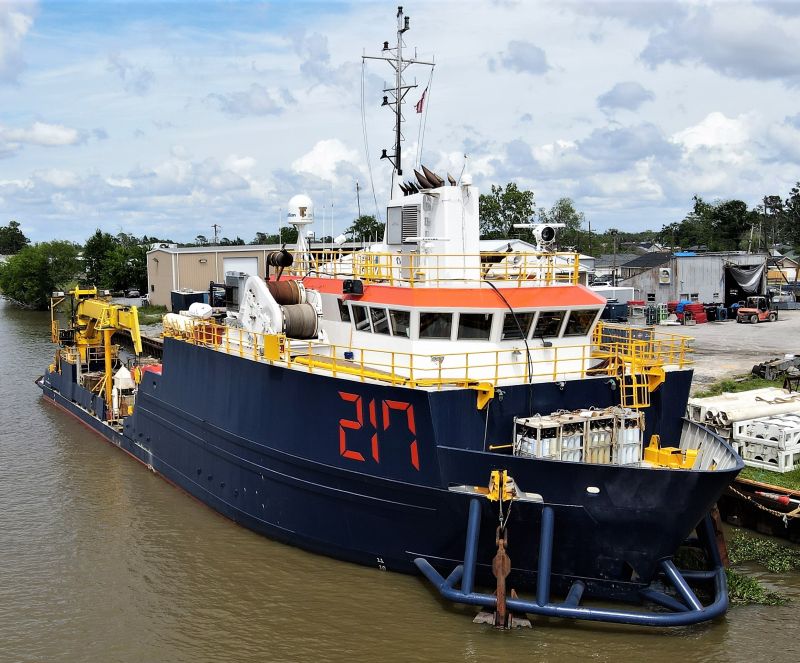
The timing supplied the wit, if not the comfort. DSV 217 was delivered in spring 2017, when much of the offshore support market was cold-stacking boats. Champagne’s answer to surplus vessels was a new one. This sounds irrational only if every boat is interchangeable. His bet rested on the opposite idea: a fit-for-purpose vessel could work more safely and efficiently, improve life offshore, and stay relevant while older designs carried compromises from another age.
By constructing a newbuild, we were able to design the DSV to fit its purpose.Robert Champagne on DSV 217
The phrase “fit its purpose” is almost comically modest beside 185 feet of steel. Yet it captures Champagne’s style. The aim was not novelty in the abstract. The boat had to support pipeline and riser work, installations, repairs, inspections, platform removal, debris clearance, and well plugging. It had to give divers, life-support technicians, deck crews, and vessel crews a coherent place to work. The innovation was simply refusing to begin with the wrong room.
Purpose also had a number: 1,000 feet. At that depth, the vessel is not merely transport parked above a job. It is the diver’s workshop, hotel, communications link, pressure system, rescue plan, and route back to ordinary atmosphere. DSV 217 gathered those roles into one design. Its four-point anchoring arrangement used bow and stern anchors deployed by double-drum winches. Its control center brought mooring, life support, and diving operations within the same working environment. The deck carried enough room for the tools and materials that subsea construction demands. Champagne’s blank sheet was crowded, but crowded on purpose.
A working system for 1,000 feet
The saturation system lets divers live under pressure between shifts, avoiding repeated decompression. DSV 217’s central moon pool, control systems, chambers, rescue equipment, crane, and deck plan were designed as one operating environment.
A company grows into its name
C-Dive did not remain only a diving contractor. It added saturation capability, remotely operated vehicles, construction, inspection, pipeline abandonment, platform work, and environmental services. In 2017, Champagne announced that the company had added 200 feet of dock space and another 15,000 square feet of building space at its Houma facility. The new room was meant for training, reception, and storage. Growth, in his public vocabulary, was measured in places where people could learn and equipment could go.
In 2023, the business became Champagne Energy & Environmental Solutions, or CEES. The rebrand followed the work rather than preceding it. By 2024, CEES operated four dive support vessels, a 260-foot lay barge, and a mobile fly-away saturation system. All were reported under contract well into the following year. The company that began with a diver’s initial had become broad enough to need a longer name.
Starts at the deck plate
Champagne joins American Oilfield Divers as an entry-level tender, then moves into diving.
C-Dive begins in Houma
Experience in supervision and project management becomes an owner-operated company.
DSV 217 reaches the Gulf
The purpose-built saturation vessel turns an operating conviction into a physical asset.
C-Dive becomes CEES
A new name reflects a wider set of energy and environmental services.
A larger platform
CEES joins Edison Chouest Offshore, with Champagne continuing in leadership.
Champagne’s public comments turned increasingly toward continuity. After three decades in oil and gas, he said he particularly enjoyed talking with the next generation of divers. The observation fits the tender-to-founder arc. Commercial diving has a visible ladder, but it also has a hidden curriculum: judgment about when conditions are wrong, respect for the crew whose work makes a dive possible, and fluency in the difference between a clever shortcut and a foolish one.
His connection to Houma is professional and civic. In 2024, Champagne served as royalty for the Krewe of Terreanians, one of the city’s longstanding carnival clubs. It is a detail with Louisiana proportions: the founder who put a 1,000-foot saturation system into the Gulf also took his turn in a local tradition built to proceed at parade speed.
The next chapter arrives by acquisition
In March 2026, CEES joined Edison Chouest Offshore. The transaction placed Champagne’s diving and decommissioning operation inside a larger Louisiana marine group with vessels, shipyards, ports, logistics, and subsea capabilities. The existing CEES management team remained. Champagne said he felt energized and expected exciting developments soon.
One arrived quickly. In May, the Chouest Group completed its acquisition of the Alliance business from Helix Energy Solutions Group and announced that Alliance would be integrated into Champagne Energy Solutions. As CEO, Champagne welcomed the team and described a combination designed to deliver safer, more efficient work. The resulting platform spans plug and abandonment, subsea intervention, marine logistics, and infrastructure removal. A career that began by supporting one diver’s trip below the surface now helps coordinate an end-to-end system for late-life offshore assets.
There is a temptation to read DSV 217 as the climax because boats photograph better than integration plans. But the vessel is more useful as a key. It reveals the same pattern that runs through Champagne’s career: begin close to the work, see the whole operating system, and spend heavily only when the design changes what the organization can do. The expensive choice was not merely buying steel. It was refusing to carry an inherited constraint into the future.
Now that future includes a much larger organization. Scale will bring different rooms, different trade-offs, and probably more acronyms. Champagne enters them with an unusual credential: he once stood on deck with a diver’s umbilical in hand. The distance from tender to CEO is vast. The line between them is surprisingly direct.