The company anniversary began with an unusually elaborate travel arrangement. Robert Österlund gathered Xacti staff from Brno, Helsinki and Boca Raton, flew them to Savona, Italy, and put them on a Mediterranean cruise. Nearly a hundred people were involved. The itinerary included Barcelona, Ibiza and Marseille. There was karaoke. A business that had started in 2002 with a handful of people had acquired enough moving parts to require a ship.
He recalled the trip in November 2013, after Xacti’s tenth anniversary. It is a useful place to begin with the founder and CEO of Worklio. Before the payroll systems, the integrations and the operator’s manual, there was an entrepreneur trying to bring a scattered software company together in one place. For a few days, at least, the international operation had a common departure time.
A bigger boat for the software business
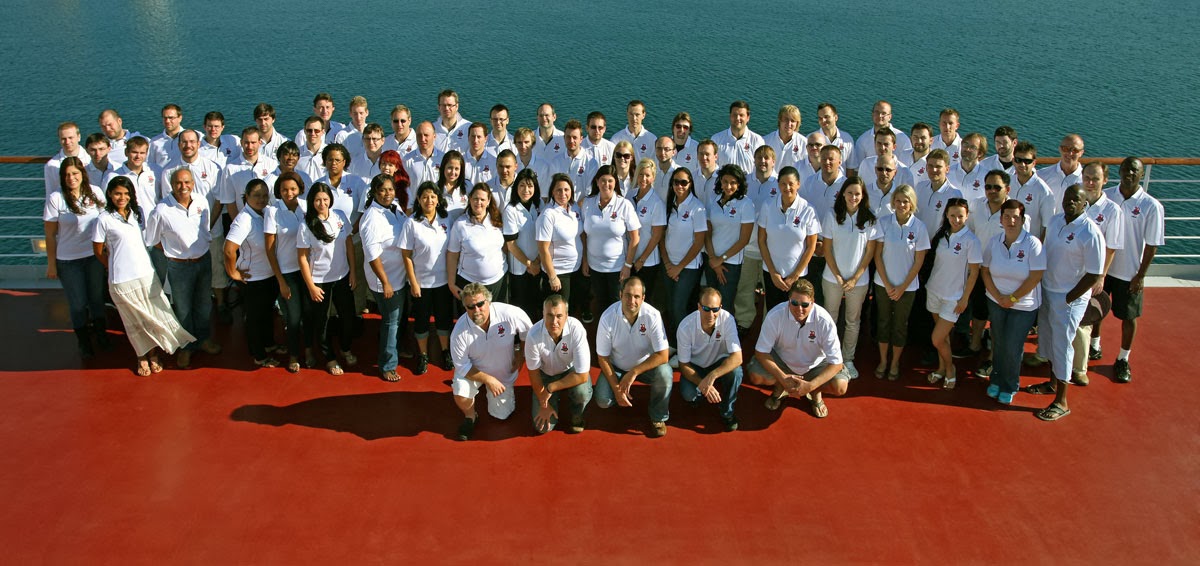
The photograph from that anniversary trip has the pleasing lack of ceremony of a company outing. White polo shirts, sunglasses, a railing, water behind everyone. The team fits into the frame, though only just. It looks like a holiday photograph that has accidentally become an organizational chart.
The voyage also gives a sense of the business he had already built. Xacti’s work ranged across mobile software, security products, cloud storage, utilities and online marketing. These were products people encountered while trying to get something else done: save a file, protect a computer, find something online. Much of their usefulness depended on removing small, recurring irritations.
That earlier chapter matters because Worklio is sometimes easiest to understand through its technical vocabulary. APIs. Human capital management. Embedded payroll. Österlund’s career supplies a more ordinary starting point. He had spent years around software that people expected to work without requiring much thought. Eventually, he turned toward a category in which a missed expectation could spoil someone’s Friday.
When the files followed you home
In 2013, he was writing about Inbox Storage, a service for synchronizing files across computers and devices. It offered access through a desktop application or a browser, with mobile applications as well. The promise was familiar to anyone who has emailed a document to themselves: the file should be where you need it, without a small expedition through the wrong machine.
Another product, Online Vault Backup, had started in 2010 and expanded from Windows into Mac and mobile platforms. His November 2013 account described support for Windows Phone, BlackBerry and Android. The list now reads like a display case from a recent technological civilization. At the time, it represented the practical work of following customers from one device to another.
In May 2014, he announced PCRx Backup for Nokia’s X Android phones. Later that month, his blog reported that PCRx Registry Cleaner would accept bitcoin. Those are specific snapshots of his working world: distribution channels, operating systems, payment methods, backup tools. He was moving among the details that determined whether a product could reach a customer and be useful once it arrived.
There is a continuity here, though payroll would raise the stakes. A backup service earns its place by preserving something its user cares about. A payroll system must preserve accuracy while moving money, information and obligations through a sequence. Both ask the customer to trust a process that is mostly out of sight. The comparison helps explain the appeal of the work; it cannot make the two jobs equally forgiving.
The employer crosses to the other side
Österlund’s payroll experience began on the employer’s side, funding payroll before building the systems behind it. That is a consequential vantage point. An employer encounters the finished obligation first: people must be paid. The software builder then has to unpack everything hidden inside that apparently straightforward instruction.
Worklio’s project began in 2014, with an ambition to connect payroll and the surrounding workforce functions. Worklio LLC was established in 2017, and live payroll followed in 2018. The sequence leaves several years between the initial idea and the recurring responsibility of actual paydays. In this line of work, a launch begins the education.
He was also working with people whose history extended beyond the new company. CTO Radek Voltr had built software with him since 2002. The continuity makes the transition less like a fresh cast assembling for a new venture, and more like an established group taking on a different operating problem.
The geography persisted too. Worklio developed an engineering operation in Brno while serving American payroll businesses. In 2020, its account of the Brno office described engineering, quality assurance and security teams working from Spielberk Office Park. It identified the time difference with the American East Coast as useful for releases and support. Coordination had become part of the product’s delivery.
The customer wanted to keep the front door
DecisionHR was an early test of the proposition. Its announcement described a Florida professional employer organization with close to 30,000 worksite employees choosing Worklio after monitoring its progress for more than a year. This was a customer with an existing operation, established relationships and a reason to examine a replacement carefully. Novelty alone would have been a rather expensive selection criterion.
FrankCrum supplied a particularly clear expression of what came next. In May 2021, it chose Worklio for a business serving 4,000 client companies and 70,000 worksite employees. Its plan was to integrate Worklio with MyFrankCrum, its own customer and employee portal. The technology underneath could change while the relationship at the front remained recognizably FrankCrum’s.
For Österlund, the arrangement reaches into the economics of software. He has asked why a platform should send its customers elsewhere when they need payroll. A scheduling or industry-specific product already occupies a place in the customer’s working day. Sending that customer to another service introduces another relationship, another destination, another opportunity for someone else to become indispensable.
“what if the payroll just stayed inside the product?”
Robert Österlund, on LinkedIn
The appeal is easy to describe. The execution belongs to the long list underneath it. Payroll has to be calculated, funded, delivered and reconciled. Taxes have their own requirements. A software company can keep its branding, but its payroll operation still needs the machinery that makes the promise credible. Worklio’s business sits in that gap between what the customer sees and what the provider must do.
There is an amusing concession involved for a founder: another company may get the visible credit. Worklio’s current website offers APIs, webhooks, a testing sandbox and white-label interface options. Those choices give partners different ways to build their own experience. The commercial achievement is partly measured in how comfortably somebody else’s name can sit on top.
The patience behind the pay run
By July 2026, Worklio reported more than $35 billion in cumulative payroll and tax payments. The word cumulative matters. It describes money processed over time, rather than revenue, a valuation or a balance in the founder’s account. Payroll businesses invite large numbers; understanding which number is being counted is part of understanding the business.
Company-reported, July 2026
Worklio also describes itself as entirely owned by founders and employees, with approximately $20 million invested by the founders and no venture capital sought. The company ties that decision to continuity for partners. Its stated ambition is to build a business that lasts a hundred years. That is a long planning horizon for a product whose immediate credibility must be renewed each payday.
Ownership cannot, by itself, establish reliability. It does tell a partner something about who gets to make decisions and whose timetable may influence them. For Österlund, the visible choice has been to keep building within that structure. The ambition is expressed through control of the company as well as through the reach of its software.
Ten years, bound in paperback
In 2026, Österlund put his operating experience into Payroll Unlocked, a 388-page paperback published by Worklio Press. Its full title promises a playbook for running, scaling and monetizing modern U.S. payroll. It is addressed to people responsible for the operation: payroll leaders, controllers, HR colleagues, founders and product teams.
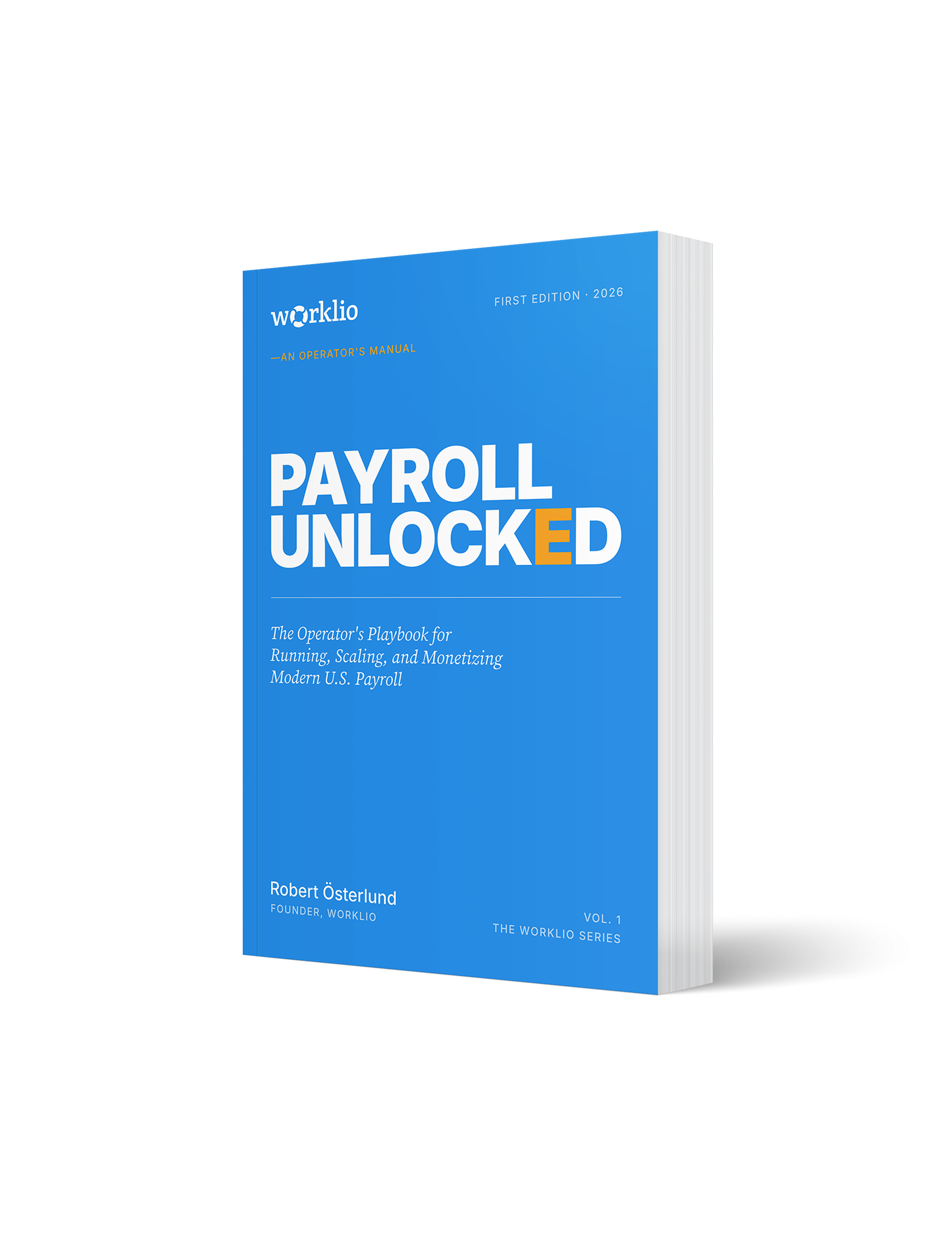
The contents include production scenarios, oversight checklists, procedure templates and training material. There are sections on building a payroll business and on the economics behind it. A reader is invited to think about staffing, support, money movement and failure as parts of the same operation. The intended setting seems closer to a working desk than a shelf reserved for founder memoirs.
“I wrote the book I wish I’d had when I started,” he said when announcing it. The sentence supplies a modest explanation for a substantial project. Experience has a habit of arriving after the decision that required it. A practical manual is an attempt to move some of that knowledge forward in time.
The distance from the Mediterranean cruise to the payroll manual is considerable, but the same coordination problem runs through both. People are in different places. Systems have to connect. Somebody has to account for the details before everyone else can enjoy the result. On the ship, the reward included Barcelona and karaoke. In payroll, an entirely uneventful Friday will do.