The robot knew it was tired. Its battery had slipped below a preset level, so it stopped at the next navigational node, calculated a route back to base, travelled there and connected itself to a charger. The year was 1986, when a machine returning home without a handler still sounded a little like science fiction. Robert W. George II was one of the engineers named on the patent.
That small act of robotic self-preservation is a good place to enter George's career. He is better known now as Bob George, the longtime chief executive associated with Brillouin Energy and its pursuit of low-energy nuclear reactions. But before hydrogen, nickel and calorimetry entered his professional vocabulary, there were mobile robots with beacons to find, obstacles to avoid and batteries to mind.
The technologies sit decades apart. The operating problem barely moved. How do you take a difficult physical system, make its behavior repeatable, protect the useful ideas inside it and turn a prototype into something a customer can trust? George has spent more than forty years living inside that question. It is less glamorous than invention and more consequential than the launch party.
First, teach the robot to come home
George studied mechanical engineering at the University of New Hampshire. By the mid-1980s he was working with Denning Mobile Robotics in Massachusetts, a company that built autonomous machines long before warehouse robots became familiar scenery. His name appears across a compact portfolio of inventions filed on the same day in May 1986.
One system let a vehicle sense coded signals from a beacon and calculate its position. Another divided a sensor's field of view into sectors, then chose a clear path around whatever blocked the original route. A third combined sensors for intrusion detection. The recharge system gave a mobile robot the practical good sense to stop roaming before it ran out of power.
These were team patents, not solo performances, and that detail matters. Hardware rarely rewards the myth of the lone genius. George worked among electrical, mechanical and software problems that had to meet in one moving object. He later ran Denning as chief executive, an early example of the role he would repeat: the engineer who could also occupy the commercial side of the table.
After Denning came other technology ventures. Public biographies place him in the chief executive chair at Imagineering International in Nashua, New Hampshire, and Commerce Direct Systems in Napa, California. He also became a managing director of Grosvenor Financial Partners, working on licensing, joint ventures, mergers, acquisitions and strategic partnerships. The titles changed. The seam between product and market remained.
“The invention is one system. The company required to reproduce, finance and distribute it is another.”A lesson written across George's career
Then, put a business around a contested experiment
Brillouin Energy began in January 2009 with founder and electrical engineer Robert Godes at the technical center. The two Roberts are easy to confuse and professionally quite distinct. Godes developed the company's theory, its Hydrogen Hot Tube reactor and its Q-Pulse control technology. George and finance executive David Firshein provided what Brillouin calls critical support at the beginning. George became the chief executive, the commercial counterweight beside the inventor.
The company's subject is low-energy nuclear reactions, or LENR, the contested field historically associated with “cold fusion.” Brillouin says short, high-power electrical pulses applied to hydrogen held in specially prepared metal layers can produce controllable heat. The wider scientific history demands caution. Cold-fusion claims have faced deep skepticism since 1989, and no commercial LENR reactor operates today. Brillouin's results are company claims developed through experiments, technical reports and outside evaluation, not settled scientific consensus.
George's job was not to settle the physics personally. It was to create a path by which the work could be tested, funded, protected and, if it survived those tests, licensed. In 2012, he and Godes began discussing the program publicly after saying their control system could start and stop the reaction and hold it in a steady state. George spoke about the awkward realities alongside the technical ambition: financing was difficult, patent protection was uncertain, higher-temperature work still lay ahead and the intended customers were third-party manufacturers.
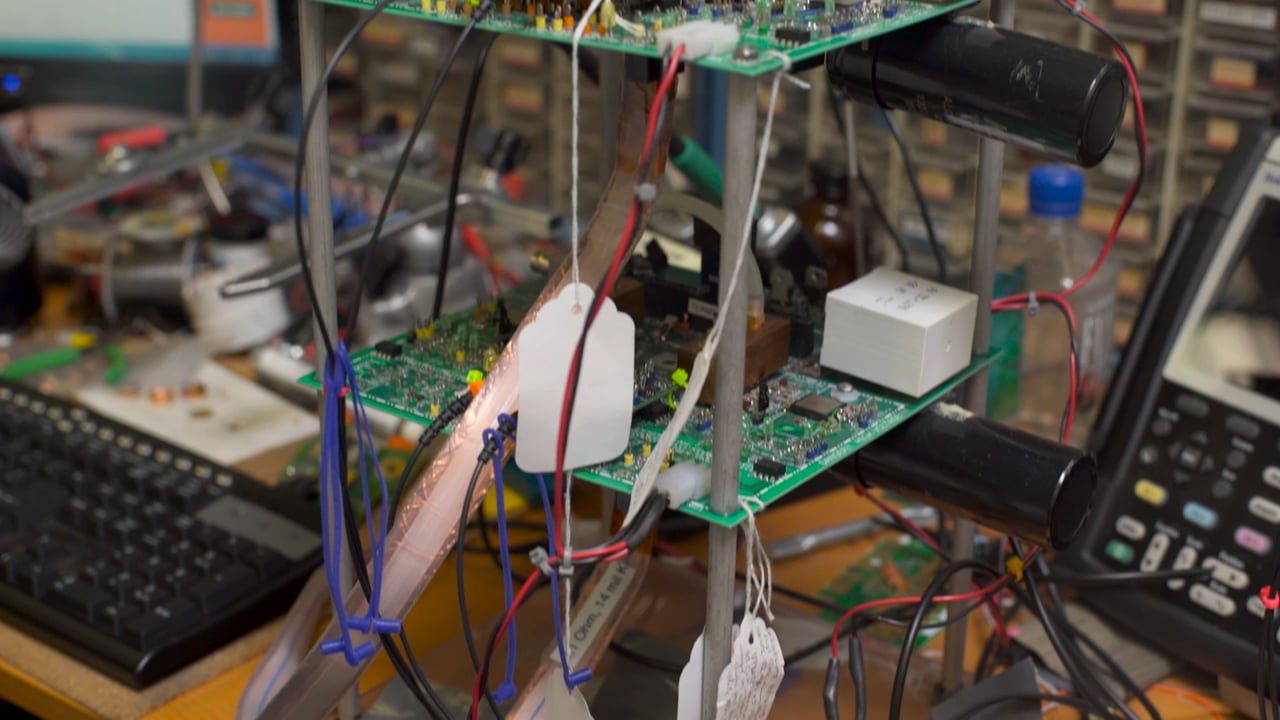
That licensing choice is revealing. Building a new energy technology is expensive enough; building every factory that might use it is another species of expense. Brillouin's plan was to develop the know-how, secure intellectual property and transfer designs to established manufacturers. George had spent years in exactly this territory. The business model treated industrial partners as part of the product architecture.
Robert Godes is Brillouin's founder, CTO and primary reactor inventor. Robert George is the mechanical engineer and longtime executive who worked on commercialization, financing, licensing and corporate development.
A long experiment needs a long company
Brillouin's program accumulated the documents that long-horizon hardware companies use to make progress legible. George co-presented work on controlled electron capture and commercialization at the ICCF-17 conference in 2012. In 2014 he co-authored a paper with Godes and SRI International researchers Francis Tanzella and Michael McKubre. Its abstract said the team had run more than 150 experiments using two cell and calorimeter designs.
SRI later conducted a multiyear technical program involving Brillouin's Hydrogen Hot Tube. Its 2018 final report was addressed to Bob George as chief executive, Godes as chief technology officer and Firshein as chief financial officer. In the meantime, Brillouin announced a $7.75 million Series B round in 2017. The company reported European patent progress, commercial licenses and, in 2022, a public demonstration at the ICCF24 Solid-State Energy Summit.
Each milestone came with a qualification that a sober reader should keep in view. A patent protects an invention; it does not independently prove every performance claim. A financing round indicates investor commitment; it does not settle physics. A technical evaluation can improve confidence in measurement; it does not turn a disputed field into consensus overnight. George's career at Brillouin unfolded in the gap between those truths and the company's stated ambition.
There is an operating lesson in that gap. Long experiments need gates that are specific enough to resist wishful thinking: a higher temperature, a steadier output, a cleaner measurement, an outside test, a manufacturable core. They also need a financing story honest enough to admit that each gate may reveal another. George's public language repeatedly returned to control, licensing and third-party production. Those are not laboratory results, but they are mechanisms for keeping the laboratory accountable to a future use. A founder can adore the phenomenon. An operator has to ask who will build it, who will verify it, what exactly will be licensed and which result earns the next dollar. In disputed science, those questions do not guarantee truth. They make evasion harder.
The quiet technology is the operating system
By 2026, Brillouin was describing a new phase. Its Emeryville operation had moved toward an integrated platform combining manufacturing, testing and high-frequency data capture. The company appointed Greg Knight executive chairman in May and said the aim was faster iteration and production readiness. Its current leadership page names private-equity executive Chester Aldridge as chief executive.
The precise timing of George's transition is not stated there. A California corporate-record aggregation updated in 2025 still listed Robert W. George II as CEO, and a 2026 conference abstract also used the title. The careful reading is that George was Brillouin's longtime chief executive through its research-heavy years and that the public leadership structure has since evolved as the company emphasizes commercialization.
That evolution fits the pattern of his working life. Technologies change phase, and the organization has to change with them. The person who can help an idea survive its experimental adolescence may eventually hand the next phase to operators built for factories, supply chains and strategic customers. A title is not the whole contribution. Sometimes the more revealing unit is the distance travelled.
George travelled from a New England robot that could find a charging dock to a California reactor company trying to find its market. Along the way came product design, patents, chief executive roles, financial partnerships and years spent representing a technology that invited both hope and argument. The through-line is neither fusion nor robotics. It is navigation.
See the obstacles. Locate the beacon. Preserve enough power to continue. Build a route home. In the old patent drawings, those instructions belonged to a robot. In the rest of Robert George's career, they look remarkably like management.