Rob McClelland had spent years helping agricultural businesses explain why someone should buy from them. When he helped launch Meristem Crop Performance in May 2020, he offered a remarkably short explanation of his own: “This is just math.” Four words, with considerably less decoration than an advertising executive is usually permitted.
The proposition was to shorten the journey between a manufacturer and a farmer. Fewer steps in the distribution chain, Meristem argued, could mean less expense arriving at the farm gate. McClelland, an agricultural economics graduate who had built a career in marketing, was putting the two halves of his working life on the same invoice.
His earlier company would eventually become Curious Plot. He had helped build it under a name that included his own, Farmer, Lumpe + McClelland, and led it through growth, a sale to Land O’Lakes and the acquisition of another agency. Now the assignment had changed. Instead of helping a client describe a business, he was helping construct a different way of doing business.
A degree with a long afterlife
McClelland graduated from Ohio State in 1992 with a degree in agricultural economics. His career subsequently passed through advertising, consulting, technology and entrepreneurship. The sequence gave him several views of the same commercial problem: how to get something useful from the people who make it to the people who can use it.
Before FLM+, his roles included executive vice president at Agri-Growth, vice president at Meyocks & Priebe Advertising, and practice manager and senior consultant at BroadVision. He was also a founder and senior vice president of Adayana. Those are rather different business cards to carry through one career. Together, they put communication beside operations and technology beside the economics of a customer’s decision.
In 2013, Ohio State’s College of Food, Agricultural and Environmental Sciences Alumni Society named him a Distinguished Alumnus. By then, FLM+ had more than 50 professionals and offices extending beyond its Columbus headquarters. His college subject had followed him into a business where understanding the customer meant understanding how agricultural money moved.
Three surnames, one particular audience
In March 2010, McClelland joined Phillip Farmer and John Lumpe to establish the structure described in the agency’s early growth story. They built the business without outside investors. Their chosen audience was specific: agribusinesses and rural communities, including agricultural commodities, trade associations and government clients. A specialist agency had to know more than how to make an attractive advertisement.
The service list grew to 18 practice areas. Advertising sat alongside brand strategy, social media, learning and training, digital work and application development. This was a broad assortment for a firm serving a defined market. It let the agency work on both the message and the machinery needed to deliver it.
Asked about success in 2013, McClelland put the emphasis on execution. “We show up and be there for our clients,” he said. The grammar has the agreeable roughness of something said aloud. It is also a workable service promise. Clients can forgive a sentence that arrives slightly rumpled more easily than a team that fails to arrive at all.
“We show up and be there for our clients.”
Rob McClelland, 2013
Recruitment was part of that work. When Laurie Fleck joined as a vice president in 2011, McClelland singled out her mentoring, strategic thinking and enthusiasm. He described an ambition to bring experienced industry people together with emerging talent. Fleck would later lead the company herself. The early hire became part of the agency’s longer history.
An agricultural agency moves into a tractor building
In February 2015, Land O’Lakes announced it was acquiring FLM+’s assets. The cooperative saw a fit between the agency’s services and its own agricultural businesses and member co-ops. For McClelland and his partners, the deal put the company they had built inside a much larger agricultural organization.
The following year brought an unusually apt change of address. FLM+ planned to move its Twin Cities operation from Wayzata into Minneapolis’s North Loop, at the TractorWorks Building. The building had once been a John Deere factory. A firm selling modern agricultural thinking would do so in premises with actual agricultural machinery in their past. Sometimes a landlord supplies the metaphor free of charge.
There was a practical calculation underneath the pleasing symmetry. The Wayzata office had about 25 employees, and the new space offered room for roughly twice that number. McClelland said the agency had outgrown its capacity and wanted better access to creative talent. The company then employed around 70 people across its locations. The move was a recruitment decision expressed in square feet.
Agricultural economics
acquires FLM+ assets
public launch
Following the crop toward the consumer
In 2017, FLM+ acquired Harvest PR & Marketing and became FLM Harvest. Harvest brought experience with grower organizations, commodity boards and food associations. McClelland described the acquisition as a way to develop a food practice rooted in farming while adding expertise in reaching consumers. The audience was moving farther along the food chain.
He discussed the deal with Chuck Zimmerman on ZimmCast that July. The conversation also covered the changing digital environment facing agribusiness and agencies. His business had to translate between people who grew food, organizations that represented them and people who encountered the result as something to buy. Each audience needed a different explanation.
By early 2018, FLM Harvest was winning work from AgriGold, the seed business, following an agency review. The assignment included supporting the brand’s growth with marketing communications. Other work for parent company AgReliant Genetics covered seed treatment and precision agriculture. These were products and decisions close to the subjects McClelland would later sell through Meristem.
That spring, FLM Harvest introduced a website presenting the company as both agency and consultancy, with more than 80 team members. Its range ran from consulting and advertising to digital work, public relations and media. Growth had enlarged the service menu, while agriculture remained central to the business.
The price of explaining things
Another 2018 project revealed how much of McClelland’s work involved making an existing system understandable. He was concerned that officials entering a new administration did not necessarily understand producer-funded checkoff programs. An effort to tell their story brought together eight initial groups representing products as varied as honey, pork, watermelon and cranberries.
A checkoff’s work could be familiar to the people paying into it and obscure to someone outside the industry. McClelland was working on that gap. The project placed different commodities together in an attempt to explain a shared institutional idea. Even a well-established agricultural program still had to make its case to a new audience.
In January 2019, Farm Journal selected him to lead its new Data-Driven Performance Marketing division. The remit included Business Intelligence, Digital Solutions and Content Services. It joined information about customers to the means of reaching them. After the years of agency building, he was now responsible for a business explicitly organized around making marketing perform.
Meanwhile, the company he had previously led continued its own evolution. In July 2021, FLM Harvest became Curious Plot under president and CEO Laurie Fleck. The rebrand preserved the agency’s ownership, leadership, clients and services. McClelland’s place in that history belongs to the founding and earlier leadership chapters, before the current name went on the door.
The economist returns to the invoice
Meristem’s May 2020 public launch paired McClelland with crop-input veteran Mitch Eviston. The company said it had already spent a year pilot-testing on more than half a million acres with hundreds of Corn Belt growers. Its argument combined product performance with a simpler route to market. The aim was to help American farmers compete by taking expense out of the supply chain.
That November, the company put forward a particularly concrete example: soybean seed treatment. Meristem argued that bundling treatment into the seed price could make the separate costs difficult to judge. McClelland wanted growers to see the components of the bill. The company offered treatment alongside replant protection, addressing both price and the risk of changing a familiar purchasing habit.
Meristem’s estimated saving from its proposed seed-treatment approach, announced in November 2020. A historical company estimate, not a measured result for every farm.
The savings figure was a sales claim attached to a particular offer, rather than a universal result. Its significance in McClelland’s story is the level of detail. He was asking customers to examine a line item, compare alternatives and decide whether the arithmetic justified changing suppliers. An agricultural economics degree can have a surprisingly long working life.
Still making the case, microphone included
At the 2026 Commodity Classic, McClelland spoke with AgriTalk’s Chip Flory about Meristem’s patented Bio-Capsule Technology. The subject had moved from the distribution chain to the company’s system for delivering biological products. His role remained public-facing: explain what the business offers and why a farmer should consider it.
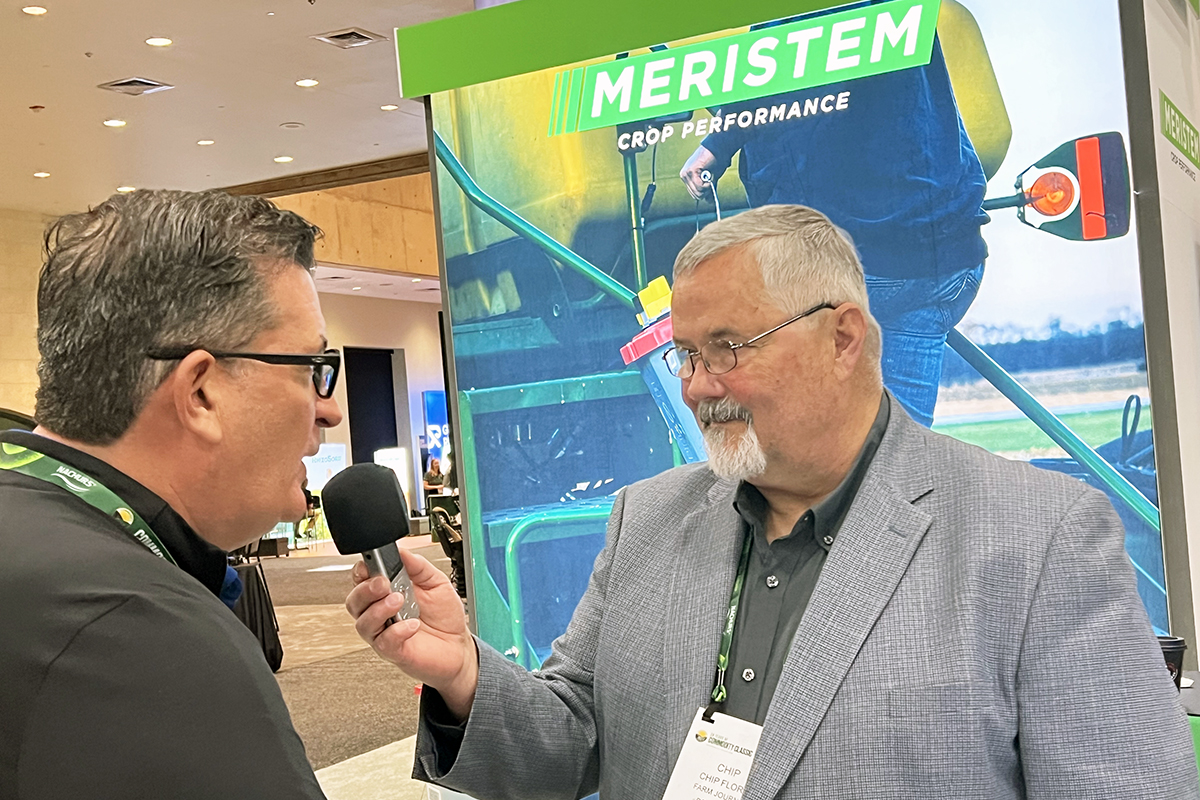
He now serves as Meristem’s president and chief marketing officer. The title carries both responsibilities in plain view: running a business and making its offer understood. His route there took him through consulting, agency ownership, cooperative ownership and agricultural media. Each supplied a different way to look at the distance between a product and its customer.
Curious Plot carries on the agency story. Meristem carries McClelland’s more direct bet on how agricultural inputs should reach a farm. Across the changes of company and title, his pitch has become easier to state: give the customer something useful, explain the cost, and make the work hold up when the customer starts counting.