A cup of coffee can be an inexpensive way to discover that two people should never do business together. Rob Katz and Kevin Boehm needed four hours to reach the opposite conclusion. They had expected a brief meeting. By the time it ended, they were considering a restaurant. For men who already knew how much trouble a restaurant could cause, this was an unusually productive failure to watch the clock.
Katz had been running Chicago nightclubs. Boehm had opened restaurants elsewhere and wanted to come to Chicago. Each had something the other wanted to understand. A mutual introduction put them at the same table; a shared appetite for the business kept them there. The partnership dates to 2002. Their first restaurant, Boka, opened in 2003.
The easy version of this story would begin with a business plan and end with an award. Katz's career offers a more interesting route. It starts with learning how people behave when they go out, passes through kitchens run by people with strong opinions, and eventually requires its founders to let other people do jobs they once insisted on doing themselves.
Before dinner, there was a sound check
Katz came from Vancouver to Chicago in 1987 for work in options trading. His entry into hospitality was rather less formal: a roommate who owned a bar needed help making drinks. Katz helped out, liked the work, and kept going. A shift behind the bar became a different working life.
His venues included Elbo Room, Katacomb, and Waterloo. The bands that played his rooms included Dave Matthews Band, Stone Temple Pilots, and the Smashing Pumpkins. Long before he was associated with restaurant chefs, he was putting musicians in front of audiences.
There is a continuity here, even though the equipment changes. Someone has to choose the talent, make the space work, and persuade strangers to spend an evening together. A live room gives its operator immediate feedback. People stay, leave, listen, talk, order another drink. Much of the evening's success depends on decisions made before the doors open.
By the time he met Boehm, Katz wanted to move toward restaurants. He brought years of experience with the social machinery of a night out. The next stage would give that machinery a kitchen, and the kitchen would make demands of its own.
The owners had homework, too
Boka began with chef Giuseppe Scurato. In 2007, Giuseppe Tentori, who had worked at Charlie Trotter's, took over the kitchen. His arrival changed the level of expectation inside the restaurant. In Katz's telling, the owners had to improve their own work to keep pace with their chef.
Tentori earned Food & Wine's Best New Chef recognition in 2008. Boka received its first Michelin star in 2010. Those milestones gave the restaurant an audience beyond its neighborhood, but the more revealing development happened inside: the people who owned the business were learning from someone they had hired.
Later, Lee Wolen would take the kitchen into another chapter, alongside a redesign of the restaurant. The name on the door survived changes in cooking and atmosphere. That is a demanding kind of ownership. It requires enough conviction to give a restaurant an identity and enough flexibility to let that identity develop.
Katz's role becomes clearer through those relationships. He is a restaurateur who helps assemble the conditions for a chef's work. The chef brings a point of view. The owners have to make an evening around it, then keep that evening functioning through thousands of ordinary decisions.
- 1987Katz arrives in Chicago
- 2003Boka opens in Lincoln Park
- 2010Girl & the Goat opens
- 2019Outstanding Restaurateur award
A goat arrives, followed by a crowd
With Stephanie Izard, the partnership faced a different problem: people were already watching. Girl & the Goat opened in 2010 after Izard's Top Chef win. A television audience could create an opening-night crowd. Keeping those diners interested would require a restaurant with a life beyond the show.
Izard wanted somewhere casual and fun, with an open kitchen that let her participate in the room. Katz and Boehm supported a restaurant built around her cooking and personality. The branding avoided leaning on Top Chef. Television explained some of the attention; the team wanted the restaurant to earn its own place.
The preparation was extensive, including roughly 30 front-of-house training sessions. The first months also brought the sort of equipment problems that never appear in a reservation confirmation. Izard remembered a walk-in cooler that did not work. A full dining room is a pleasing sight until one considers everything that must go right behind it.
For Katz, this was also the point at which the size of the opportunity began to outrun the way the company was organized. A restaurant can become busy faster than its owners become good at sharing responsibility.
The company hidden behind the dining rooms
In the early years, Katz and Boehm handled an extraordinary range of work themselves. Ordering, checks, deposits, payroll, unglamorous repairs: ownership came with an elastic job description. Their familiarity with the work helped them understand the business. It also made handing it over difficult.
After Girl & the Goat, they began building the corporate support and common procedures that a collection of separate restaurants needed. Delegation became part of the job. Distinct dining rooms could keep their character while the company behind them acquired more consistent ways of working.
By January 2020, the group had nearly 20 restaurants, bars, and coffee shops and almost 2,000 employees. At that scale, the promise made to a guest depends on people the guest will probably never meet. Recruiting, training, accounting, and management all take a turn carrying the plate.
Abby Kritzler's career offers a close view of that change. She joined Landmark as a server assistant in 2007. In 2011, she requested a meeting with Katz and Boehm to discuss ideas for the company. They hired her as their executive assistant, and she soon became executive director. Today, she is also chief culture officer.
It is a useful detail in a business often described through its founders. An employee asked for a conversation, and that conversation changed her responsibilities. The expanding company needed people who could help shape it. Listening inside the organization became as consequential as reading the room outside.
Sometimes the building gets a vote
Momotaro showed how complicated a long-held ambition could become. Katz and Boehm had wanted to open a Japanese restaurant for years. When they finally developed an old West Loop building, the structure needed more steel and reinforcement than they had expected. The schedule slipped. Experience did not exempt them from construction.
They worked with designer AvroKO and opening chef-partner Mark Hellyar. Upstairs and downstairs offered different possibilities. The izakaya could have its own menu and a louder mood. The building helped determine how those experiences would fit together.
“Sometimes the building tells you what you’re going to do.”
Rob Katz, discussing Momotaro in 2015
The observation captures an owner's practical imagination. A floor plan can encourage certain kinds of gatherings and frustrate others. Design has to survive contact with the structure and with the people who will use it. Even an appealing idea needs somewhere sensible to stand.
Katz's attention to property belongs in the same story as his attention to talent. A chef, a room, and a neighborhood have to make sense together. The process leaves ample opportunity for a beautiful drawing to acquire a very expensive correction.
Two partners, with room for a joke
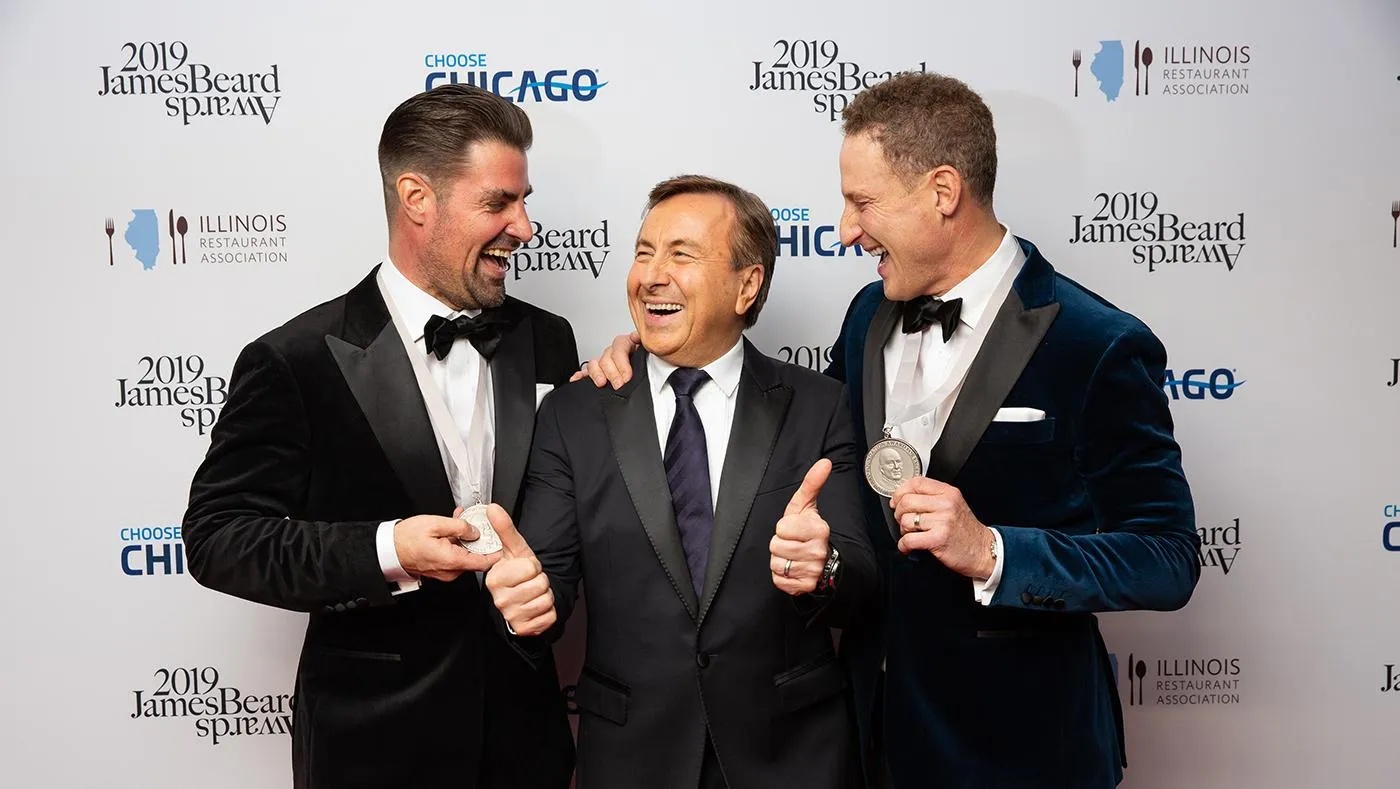
In 2019, Katz and Boehm won the James Beard Foundation's Outstanding Restaurateur award. The category recognized the work of running restaurants, a shared achievement that suited a partnership so often discussed in the plural.
They have resisted making that partnership sound solemn. Asked how they met, Katz once offered eHarmony as the explanation before giving the real version involving mutual friends. Asked when he knew it would work, he joked that he still had not found the moment. Boehm has described them as best friends who agree often and push each other.
Katz's Chicago loyalties also extend to sports. After the Cubs won the 2016 World Series, he and Boehm helped mark the end of the team's famous curse with roasted goat prepared by Izard at Wrigley Field for Theo Epstein and other executives. Sometimes a restaurant group's contribution to civic history comes with carving utensils.
The next room, and the room that reopened
By 2026, the partnership's work stretched well beyond Chicago. In late June, BOKA opened Momotaro, Alla Vita, and the cocktail bar Middleman in Nashville's Wedgewood Houston neighborhood. The two restaurant names had established Chicago lives. Their new setting showed how the group's approach had evolved to include taking existing concepts into another city.
Back home, Brian Lockwood had joined as a chef-partner in 2025 and opened Gingie in March 2026. A kitchen fire interrupted its first days. The restaurant reopened on August 29 after five months. Some employees had been able to move into other BOKA concepts during the closure, a concrete use for the organization built behind the individual dining rooms.
The reopened restaurant's mural gained a phoenix. It was an apt addition, although the less picturesque details mattered just as much: places for employees to work, resources for rebuilding, and a team able to put service together again.
Katz's career keeps returning to the relationship between a particular room and the people around it. The music venues, chef partnerships, corporate hires, and new openings each add another version of that question. Who belongs here? What will they need? What will make the evening work? His business has grown around answering it, one set of doors at a time.
Keep the conversation going
Profiles & company channels
Interviews & further reading