Rob Frechette has a title that sounds as if it ought to come with a pulpit: Chief Partner Evangelist. In March 2026, Spot AI gave him the job of carrying a particular gospel to the people who install security cameras. Its first commandment is wonderfully inconvenient for a camera business. Do not begin by selling more cameras.
Begin with the ones already on the wall. Ask what the customer needs to know. Then place intelligence above the hardware so the footage can be searched, interpreted and turned into action. This is Frechette's argument, repeated across posts, calls and miles of travel. The lens has had a long reign. The question is coming for the throne.
His credibility with partners rests on a useful change of chair. Before joining the San Francisco software company, Frechette had sat on the reseller side of the table. He sold enterprise security at Verkada from 2023 to 2024. Then he became Director of Sales at Biztec, the West Virginia-based integrator whose work spans physical security, access control and managed IT. He knows the seduction of the new box, the anxiety of the customer handoff and the unhappy silence that follows when a promised feature lives on someone else's road map.
“The next decade won't be defined by who sells the most cameras, the most hardware.”Rob Frechette, on joining Spot AI
A convert who remembers the old church
Frechette's career did not begin with video AI. A public professional history reaches back to Frechette Consulting in 2009 and includes an East Coast sales role at Artemis Pet Food, then business development work at IdeaPros. The path is sales-shaped rather than engineering-shaped. It taught him to look at technology from the cash register outward: who controls the account, who owns the outcome and who gets called when the thing refuses to work.
That last question has become one of his favorite provocations for partners: do you actually control the outcome for your customer? The formulation is cannily chosen. A reseller may control an installation and still depend on a manufacturer for the fix. If the answer to a compliance problem or safety gap requires a six-month wait, ownership begins to look ceremonial.
His Biztec period supplied the practical scenery. The company took teams to industry gatherings, including Verkada One in Denver, where the conversation ranged from partner portals to connectors for legacy equipment. Frechette appeared there with colleagues Brent Null and Jennifer Morang. The conference photograph is ordinary corporate evidence - badges, branded backdrop, everyone politely arranged - but the lesson underneath matters. Integrators live among mixed estates, inherited systems and customers who cannot replace everything at once. Compatibility is less romantic than invention and often more valuable.
At Spot AI, Frechette argues for a different bargain. The partner keeps the relationship. The customer's existing cameras need not be ripped out merely because a new software layer has arrived. An integrator can build a solution around the desired result instead of a manufacturer's replacement schedule. “Enterprise freedom” is the phrase he uses. Grand language, perhaps, for a collection of cameras and cables. Anyone who has discovered that their data cannot leave a closed system may permit him the flourish.
The field is where the pitch gets edited
For someone selling software intelligence, Frechette is remarkably attached to physical presence. In July he condensed a week into three numbers: four partner meetings, three states and more than 6,000 miles. He had spent part of it traveling with Spot AI co-founder Rish Gupta. The useful conversations, he wrote, happened in meetings but also in airports, on drives and over meals. Strategy got sharper in the seams.
The week ended in Miami, where Frechette, Gupta and Walker Rice took in a World Cup match. Frechette thanked the police, venue staff and security professionals who made the experience feel orderly and safe. It was a fitting leisure activity for a person whose working life concerns the machinery behind situational awareness. Even the football came with an operations note.
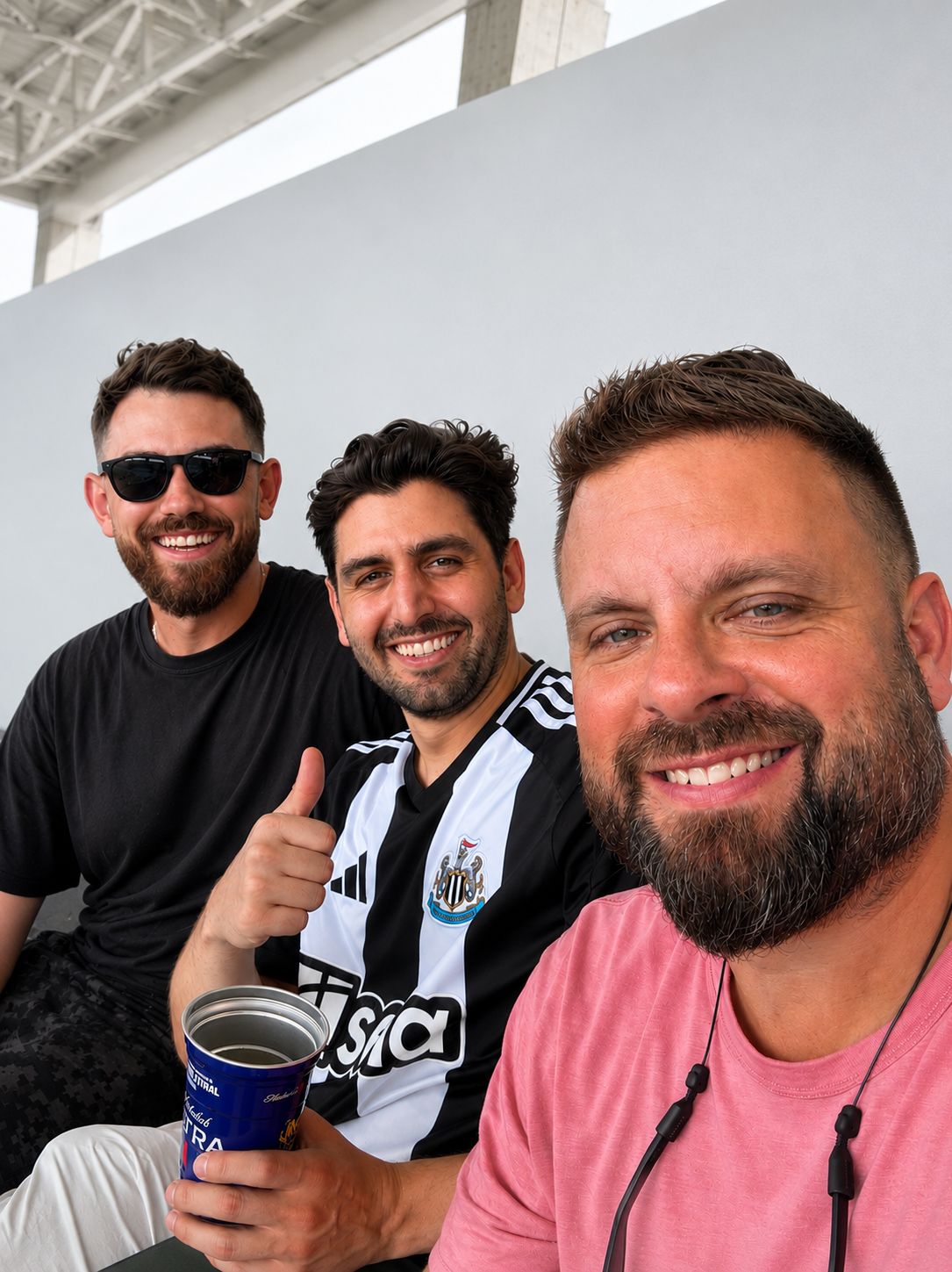
The picture catches the operating style better than a studio portrait would. Three people, close to the lens, wearing the remains of a long week lightly. In Frechette's account, showing up is not decorative. It is how a vendor learns what its partners will actually risk in front of a customer.
Retail has footage. It needs answers.
Retail has become Frechette's clearest demonstration case. A modern store can have cameras at the entrance, the register, the stockroom, the loading dock and the parking lot. Each view is technically useful and practically lonely. The harder problem is the handoff: connect activity outside with behavior inside, separate the urgent from the merely unusual and put the right piece of evidence in front of a person before attention expires.
Frechette talks about repeat vehicles in a lot, after-hours activity, self-checkout walkouts and refunds processed with no customer present. These are examples, not a catalogue of magic tricks. Their common ingredient is context. A line crossing is easy to count. Understanding what is happening inside a building, and why it matters to this operation, is the more ambitious sale.
He calls the software performing this work an “AI coworker.” The label does useful marketing labor: it moves the product away from passive analytics and toward a participant that watches, prioritizes and escalates. It also raises the standard. A coworker is judged by whether the work becomes easier, not by whether a bounding box appeared around a person on screen.
“The opportunity is not simply to replace them. The opportunity is to make them intelligent.”Rob Frechette, announcing his move to Spot AI
There is a larger sales thesis tucked inside that sentence. Video can move beyond security into operations. The same system that helps review an incident can surface patterns, support a safety process or show a multi-site operator what keeps happening at 4 p.m. The camera stops being an expense justified by a future bad day and becomes a source of everyday questions.
That expansion changes the partner's economics as well as the customer's vocabulary. Hardware arrives, is installed and eventually ages. Software can deepen as a team asks better questions. Frechette's recurring theme is that the installer should participate in that continuing value instead of waiting for the next replacement project. It is a tidy theory of recurring revenue, though its success depends on a decidedly untidy skill: understanding each customer's operation well enough to build something worth renewing.
A salesman's eye for the experience
Frechette's curiosity about products is visible beyond his own category. During a business trip, he took six Waymo rides over two days and counted 97 minutes in the cars. He praised the calm, consistent flow and clean interface, then FaceTimed his wife, Miranda, and his daughter mid-ride so they could see it too. The detail is revealing: a product impressed him enough that the demo became a family call.
He notices both the technology and the feeling it produces. That is a salesperson's useful bias. Buyers rarely purchase an architecture in the abstract. They purchase fewer frantic searches, quicker answers, a less awkward call to the customer. Frechette's public style is energetic and occasionally combative, but the argument underneath is stubbornly practical. When something breaks, can you fix it now?
His network also travels with him. He has publicly credited former colleagues and recruited Jennifer Morang to Biztec after working with her at Verkada. At Spot AI, his posts repeatedly feature Gupta, colleagues including Emily Otero and the partners he is trying to bring along. The evangelist title suggests one person with a microphone. The evidence looks more like a person building a choir, one flight delay at a time.
The bet above the lens
Frechette has arrived at Spot AI at a precise moment in physical security. Camera fleets are enormous, AI language is everywhere and customers have learned to be suspicious of both the rip-and-replace proposal and the miraculous demo. His task is to make a middle path credible: preserve useful infrastructure, add a flexible intelligence layer and let the partner build around the customer's question.
That path will be tested in ordinary ways. Does it integrate? Does it reduce noise? Can a partner make money without surrendering the account? Can a store manager get an answer before the incident report becomes archaeology? The future of the category will be decided less by declarations about AI than by repeated answers to those small, expensive questions.
Frechette is a fitting messenger because he has occupied several seats in the room. Seller, reseller, sales director, now vendor evangelist. He understands why each side wants control and why the customer is unimpressed by the organizational chart. His proposition is concise enough for a sticker on a flight case: keep the cameras, free the road map, own the outcome. Then get on the next plane and see whether a partner believes you.