The useful thing about a fuel pump is that it leaves very little room for poetry. A driver arrives, selects a grade, watches the dollars advance and departs. Rob Elam, who studied cultural anthropology and English literature, chose this stubbornly prosaic machine as the place to conduct a climate experiment. His wager was not that millions of people would become fuel chemists. It was that a better option, made visible and convenient, could enter an old habit without demanding a new life.
Elam founded Propel Fuels in Seattle in 2004, after his own entry into biodiesel had begun rather like home brewing. The operation moved from co-op-style distribution to selling fuel to car dealerships. Then he left his day job and committed himself to the business. In an early interview, he reduced its purpose to six brisk words: “Our mission is simple: fill tanks with biodiesel.”
Simple missions tend to acquire complicated plumbing. Propel helped station owners install pumps, advised businesses moving into biodiesel and worked on production projects. By 2007, the company was mapping potential Seattle locations and arranging to place its green-and-white pumps at existing stations. The physical strategy contained the cultural one: do not exile cleaner fuel to a remote shrine for the already converted. Put it beside the place where everyone stops.
“We’re not asking customers to radically change their behavior.”Rob Elam, on Propel’s retail approach, 2007
A field guide to ordinary choices
The route to that idea was agreeably crooked. Born in Davis, California, and raised in Minnesota, Elam learned trout fishing from his grandfather in the Sierra Nevada. He later said his fondest memories and best friendships all carried a wilderness component. In his twenties he worked for Outward Bound. Corporate work at 3M followed, then internet-era communications in Seattle. As an anthropology major, he was drawn to the web less as machinery than as a place where communities might form.
He founded FORM Communications in 2001, working across brand, marketing and data. Three years later came Propel. The common thread was not a particular industry. It was attention to people: what they notice, what they trust, where they gather and what they will actually do on an unremarkable weekday.
That last question mattered because low-carbon transport was crowded with elegant futures and awkward presents. Elam argued for the present. In 2009, responding to the shortcomings of ethanol and the pace of cleaner vehicle development, he said the work had to come “out of laboratories and out of ivory towers” and into the hands of consumers. Propel’s co-location model let it build, own and operate renewable-fuel equipment on space at conventional stations. The station owner gained another offer; the driver gained a choice.
California offered a larger stage. Propel began expanding there in 2008, and in 2009 moved its headquarters from Seattle to Sacramento. Elam was blunt about the calculation: California was a vast fuel market with policies and public purchasing that favored alternatives. A state rule could establish a direction. A pump still had to convert that direction into gallons.
The move also showed Elam’s willingness to follow the conditions rather than romance the place where a company began. Seattle had supplied the experiment, early customers and the first public locations. California supplied scale. When Propel later shifted its office from Redwood City to Sacramento in 2015, Elam put the reasoning in one sentence: “The low carbon economy is being defined in Sacramento.” Proximity to policymakers was useful, but Propel still spoke in the dialect of retail - margin, volume, retention and whether a driver came back. At the time of that move, the company reported 43 E85 locations and 36 advanced-diesel locations across California and Washington. It was a network large enough to reveal patterns, but small enough for each choice of corner and customer to matter.
The pump learned to count
Propel did more than install equipment. It accumulated knowledge about the market around it. The company studied station locations, customer behavior, carbon reductions and real-time pricing. Surveys conducted with an independent research firm between 2012 and 2014 gathered 1,007 individual responses. In 2015, Propel reported that customers in its studies selected low-carbon fuels over petroleum three-quarters of the time, while half filled exclusively with Propel products.
The retail network was becoming a sensor. A transaction revealed more than a sale: the car, the neighborhood, the price, the fuel and the probability that a driver would return. Elam is named on patents involving the selection of alternative-fuel station sites and systems for reporting environmental savings from purchases. The anthropology major had arrived at an intensely quantitative question: where does a new habit take root?
Elam goes all-in on biodiesel and co-founds Propel Fuels.
Propel shifts its headquarters from Seattle to Sacramento after expanding into California.
Elam returns to day-to-day leadership as CEO and refocuses the company on California.
Diesel HPR launches at 18 Northern California stations.
Propel announces an electric-charging plan alongside its liquid-fuel network.
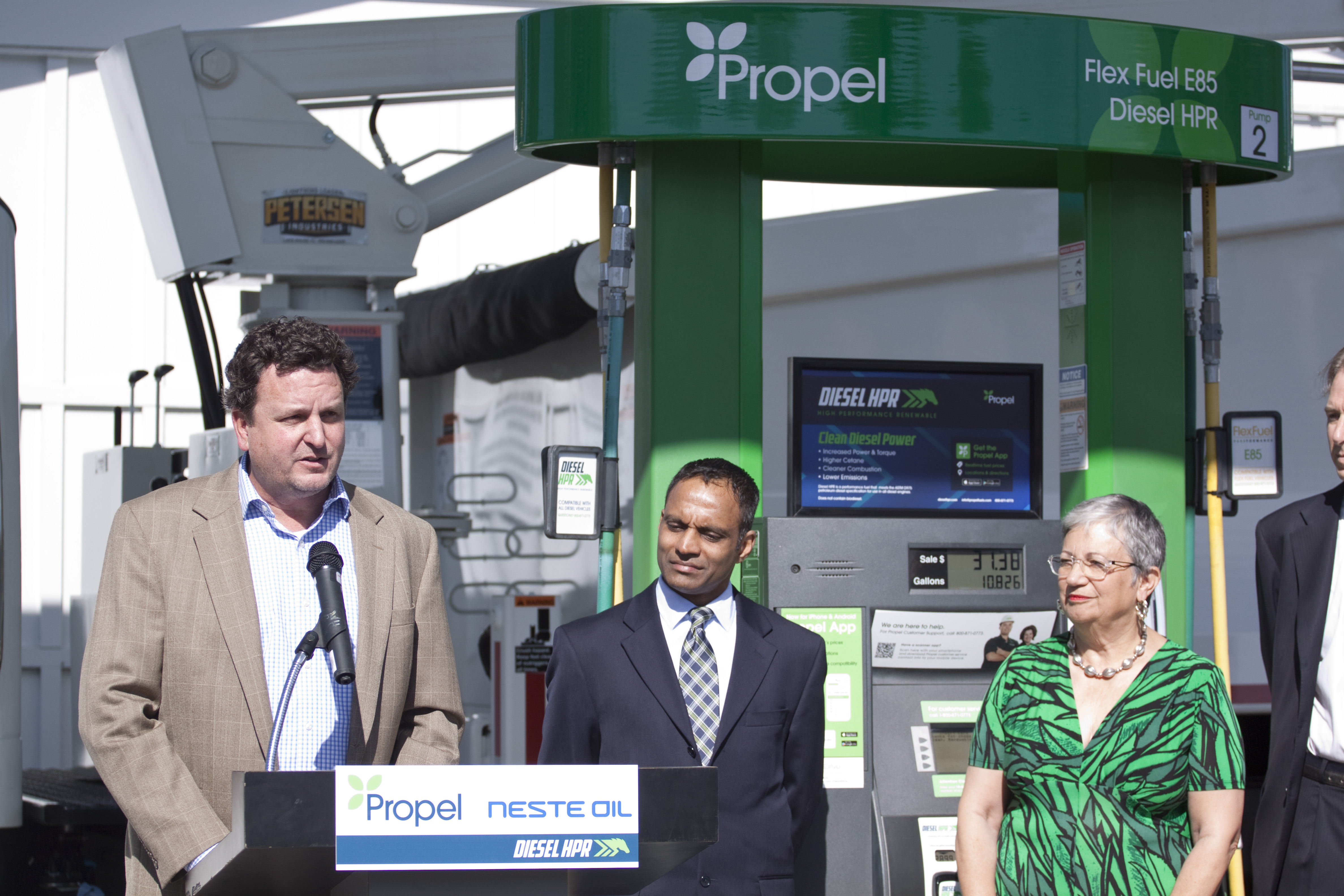
The range widened. Propel sold E85 and advanced diesel, launched renewable Diesel HPR with Neste Oil at 18 Northern California sites and contemplated electric charging. In announcing an EV network in 2019, Elam described electricity not as an enemy of the company’s original fuel business but as the next customer choice. The product could change. The retail question remained.
Rivers run through the résumé
Elam’s attachment to outdoor places did not remain an origin-story ornament. He served nine years on the Native Fish Society board, from 2010 to 2019, and chaired it through 2016. When he stepped down, the organization credited his “dogged approach” to difficult decisions, his mentorship during leadership transitions and his work on campaigns involving Sandy River salmon, barbless fishing and healthy forests.
There is an appealing consistency between those board years and the fuel business. Both required translating stewardship into institutions, budgets, alliances and repetitive work. Elam once identified poet Gary Snyder as an environmental hero for the combination of sustainability, simplicity and humor. His own humor surfaced in less solemn places. Asked his favorite meal in 2005, he praised sushi and added that Minnesota had not offered much of it growing up, “unless you count lutefisk.” He also made a public pitch to Stephen Malkmus of Pavement to try a biodiesel car. Climate advocacy has endured worse recruiting tactics.
“Fresh air has been good to me, so I figure I should do my part for future generations.”Rob Elam, 2005
The value of invisible machinery
By 2017, Propel had something larger companies wanted: not merely pumps, but a worked-out understanding of how renewable fuels could be sold in California. Phillips 66 began evaluating an acquisition and entered due diligence. The deal ended in 2018. Propel later alleged that Phillips 66 had taken confidential data, strategies and business intelligence disclosed during that process and used them to build a competing renewable-fuels operation.
Propel sued in California state court in February 2022. Phillips 66 denied wrongdoing. After a five-week trial, a jury found for Propel in October 2024, awarding $604.9 million in compensatory damages and finding the conduct willful. In July 2025, the court added $195 million in exemplary damages. The final judgment entered that August totaled $833 million, including $33.3 million in prejudgment interest.
Trial-court judgment · August 2025
How $833 million was composed
Amounts are rounded. Phillips 66 denies wrongdoing and filed a notice of appeal in November 2025. The judgment is not presented here as a final appellate outcome.
The trial judge rejected Phillips 66’s post-trial motions in October 2025. The company filed its notice of appeal the next month and its opening appellate brief in July 2026, so the litigation is not over. In March 2026, the case received a Benchmark Litigation Impact Case Award. Elam used the occasion to move the subject from one plaintiff to a larger class of builders: Propel’s team, he said, had stood firm for “the rights of innovators everywhere.”
His choice of the word team fits a less visible part of his record. Native Fish Society colleagues described a leader who built relationships and helped younger staff and board members handle succession. Propel itself has moved through several versions of leadership. Elam stepped away from day-to-day command around 2010, then returned as CEO in 2014 and reorganized the business. Founding mythology likes an uninterrupted captain on the bridge. The documented career is more useful: departure, advisory work, return, repair. It suggests that persistence is not simply remaining in one chair. Sometimes it is knowing which chair the work requires, then sitting down again when the organization needs it.
Courtroom figures naturally overwhelm the smaller details that precede them. But the disputed value was born in those details: a site model refined, a customer pattern observed, a regulatory meeting understood, a retail decision repeated until it worked. Physical infrastructure announces itself in steel and concrete. Operational knowledge hides inside sequence and judgment. It is machinery that cannot be photographed.
The green nozzle, still ordinary
Elam has described himself as opinionated, and the record agrees. Early in Propel’s life he complained about greenwashing, doubted that established oil and auto companies would lead the necessary change, and preferred the language of values and sustainability to a narrower environmental identity. Yet his company’s most persuasive argument was never a speech. It was an available product with a price on it.
That is the durable idea in his story. Grand transitions are assembled from mundane encounters. Policy enters a station permit. Chemistry enters a nozzle. Data enters a location decision. Conviction enters the five minutes between pulling in and pulling away. Propel’s history is messy, unfinished and now legally consequential. It is also proof that an ideal becomes useful only after somebody gives it an address.
A child learns the value of clean water beside a trout stream. An anthropology student becomes interested in online communities. A communications entrepreneur starts brewing fuel in Seattle. A green pump appears next to the old ones. Twenty years later, lawyers debate the ownership of everything learned along the way. The line is not straight. It does, however, lead somewhere.
Keep going