A child sees a hologram on Star Trek. Years later, the child is a software founder explaining how an engineer might use a headset to repair an oil drilling machine. Ripal Vyas has described both ends of that journey. The television image seemed like magic; the industrial application involved cloud services, connected equipment and an expert helping from somewhere else. Growing up, in this version of the story, means giving the magic a maintenance schedule.
That distance between a dazzling demonstration and a working business runs through Vyas's career. He founded Softweb Solutions, led it through its acquisition by Avnet, and subsequently started Twelvefold, an AI venture studio. The technologies have changed. The recurring subject is how to fit them into the world already in use, with its equipment, employees, customers and inconvenient existing systems.
There is a temptation to tell a technology founder's story as a procession of inventions. Vyas's public work offers a more interesting sequence: connect the pieces, help people understand them, and work out what they are good for. A sensor has something to report. Software has to make the report useful. Someone still has to decide what to do on Monday morning.
A software company with three addresses
Vyas studied computer engineering at L.D. College of Engineering and earned a master's degree in computer science at the Illinois Institute of Technology. His professional geography would eventually connect the American Midwest, Texas and Ahmedabad. Those locations mattered to the business he built: Softweb combined software development with work in artificial intelligence, data platforms and the Internet of Things.
He founded Softweb in 2004. By December 2018, its team had delivered more than 1,400 projects for 600 clients. About 500 employees worked across Dallas, Chicago and Ahmedabad. Those are figures from a particular moment in the company's life, rather than today's headcount. They describe the scale of the business when a longstanding partner decided it wanted a closer relationship.
On December 12, 2018, Avnet announced an agreement to acquire Softweb. Vyas was identified as CEO and owner. The commercial logic was unusually legible: Avnet brought hardware capabilities and a broad technology distribution infrastructure; Softweb brought software, AI and data services. The two businesses had already worked together. Acquisition gave that relationship an organizational home.
The deal closed that December. Vyas subsequently became Avnet's vice president of intelligent software solutions, working across the company to find applications for its software capabilities. A founder who had built a business around emerging technologies was now helping an established hardware organization put those technologies to work.
The useful part comes after the connection
To understand the work behind that transaction, go back to Ahmedabad in September 2017. At the Gujarat Chamber of Commerce and Industry, Vyas gave a talk on the industrial Internet of Things. His subject included using connected equipment to gather information, then analyzing it to identify and address production problems. The setting was a business chamber; the point was a practical industrial task.
That same month he addressed the Ahmedabad Management Association on emerging scenarios in AI. Nirma University also recorded a visit in which he discussed futuristic technology and its implications for the legal industry. His speaking engagements crossed professional boundaries: manufacturing, management and law each had reasons to ask what software might change.
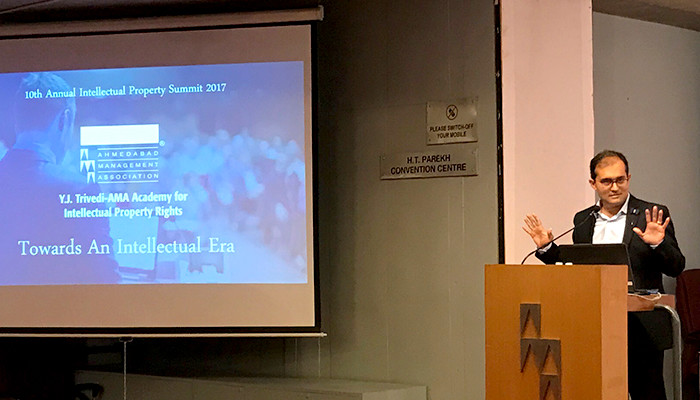
Earlier that year, he had spoken at the 10th Annual Intellectual Property Summit. Afterwards, he wrote about being struck by the gap between the pace of technological innovation and the readiness of existing law. Open source, proliferating content platforms and AI made the discussion more complicated. Software could travel quickly; the rules governing its ownership had rather more luggage.
These appearances add texture to the company milestones. Vyas was spending time translating technical possibilities for people whose work would be affected by them. The audiences were different, but each faced a version of the same problem: an unfamiliar capability had arrived, and someone needed to explain its consequences in terms the room could recognize.
Before buying another device
In March 2018, Vyas published advice for businesses implementing IoT. He warned against concentrating on technology while leaving strategy underdeveloped. Existing devices could sometimes be reconfigured for a business process, and established systems could still yield value. The practical question came before the shopping list.
He also emphasized management commitment. Connecting an organization requires time, resources and patience. An idea may start with a product or research team, but wider adoption needs support from the people responsible for the business. The project has to survive the journey from an interesting experiment to a change in how colleagues work.
His advice on expansion was similarly measured: deploy across the organization once the outcome is predictable and the risks have been addressed. There is an appealing lack of theatre in that prescription. Predictability rarely gets the best table at a technology conference. It does, however, have something to recommend it when a production line depends on the result.
- Set the strategyDefine the business purpose.
- Secure supportCommit people and resources.
- Scale with confidenceMake the outcome predictable.
The advice gives the acquisition story a useful foundation. Software expertise includes knowing which changes are necessary, which equipment can remain useful and when a system is ready for more responsibility. That work is harder to photograph than a new gadget. Its consequences tend to show up in whether the gadget remains in service.
Sixteen teams, five days
After the Avnet acquisition, Softweb organized IoTConnectNXT, a five-day hackathon scheduled to begin in August 2019. The event brought together 150 participants in 16 teams. Business developers, analysts, architects, designers, programmers and quality specialists were invited to build solutions using the company's IoTConnect platform.
Each team was to present a demonstration, a business presentation and supporting documentation. Hardware and development tools would be supplied. The format asked people to account for both the technology and the business around it. A working prototype needed an explanation of whom it would help and how.
Vyas described the event as a chance to experiment with IoT alongside cloud computing, AI and machine learning. His stated purpose was hands-on experience developing tools that could simplify complicated business processes. The programme also included games and prizes. Even an industrial software platform can benefit from giving its users a deadline and a little competitive mischief.
The hologram gets a job
In July 2020, Vyas returned to the childhood Star Trek memory in an article about industrial augmented reality. His team, he explained, had begun developing HoloLens applications as an early Microsoft development partner. He was interested in the headset as part of a larger system, connected to cloud services and information from equipment.
His example was deliberately concrete. An IoT-enabled drilling machine sends information to the cloud and flags an issue. An engineer visits it and uses remote assistance to consult an off-site specialist. The headset is one part of that chain. The useful result depends on the machine, the data and the people being able to work together.
On his instinct with new technology“how it will integrate with existing systems.”
Ripal Vyas · July 2020
That is a revealing description of his technical interest. He starts looking for the connections while the product is still new. In the article, he considered applications in machine operations, assembly, design and training. The childhood image survives, but it now has colleagues to call and information to retrieve.
Strategy survives the software update
By October 2021, Vyas was writing about what a digital-first business actually requires. His recommendations included developing a coherent strategy, adopting faster prototyping and decision-making, and obtaining detailed input from customers. Technology adoption, in his account, needed to reach the way an organization made decisions.
He urged companies to pay attention to customer experience before altering services. He also argued for flatter structures, adapted to an organization's circumstances. These are operating choices with human consequences: who gets heard, who can approve an experiment, and whether the customer recognizes the improvement once it arrives.
Read alongside his earlier IoT advice, the emphasis is consistent. A business needs a reason for the technology and a way to absorb it. The products available to managers will change more often than the need to understand a customer. A new interface can shorten a task; it cannot choose the right task on its own.
Another company, a different map
Vyas's later work includes Twelvefold, a venture studio focused on generative AI. Its model brings founders together with people who can help validate ideas, build products and support operations. The studio describes a sequence from ideation through validation and development to scaling. Company building itself becomes a shared activity.
A current example is Locaition Matters, where he is listed as AI Vision Lead through Twelvefold. The team brings together geospatial specialist Matt Felton, commercial real estate operator Lizzy Douglas, engineering leader Ayush Patel, investor David Hicks and legal adviser Ajay Mago. Its product, Curated Intelligence, is designed to let users ask location questions in ordinary language.
This is a different collection of pieces from a connected drilling machine: maps, property information, location expertise and an AI interface. Yet the practical ambition is familiar. People with a business question should be able to reach the technical capability that helps answer it. The connection has to make sense at the user's end.
From Softweb's three-city operation to a venture studio working on new AI businesses, Vyas's career keeps returning to that meeting point. The entertaining part may begin with a hologram. The enduring work starts when someone asks what it can do, what it must connect to, and who will find it useful.
Follow the connections
Explore Vyas’s writing, professional profile and company work.
- Ripal Vyas on LinkedIn ↗
- Facebook profile ↗
- Twelvefold venture studio ↗
- Softweb Solutions ↗
- Locaition Matters and its team ↗
- Avnet’s December 2018 acquisition announcement ↗
- Vyas on industrial augmented reality ↗
- His advice on implementing IoT ↗
- His digital-first strategy article ↗
- His reflections on the 2017 IP summit ↗