Rick Greenberg has a useful recommendation for anyone trying to understand his tastes: put on Curtis Mayfield. His listening stretches from gospel and bluegrass to 1990s hip-hop and Cuban danzón. He calls himself a music omnivore. For an executive whose working life involves making different specialists useful to one another, it is an agreeable extracurricular habit. The playlist already knows how to accommodate a change of tempo.
There is a more prosaic way into his story: six founders, nine clients, a rented conference room in New York. That was the beginning of Kepler in 2012. Greenberg was its founding CEO. Fourteen years later, on April 1, 2026, he became CEO of kyu, the collective that had bought Kepler eight years earlier. The small agency founder was now responsible for the larger organization that had once welcomed his company aboard.
Between those two appointments sits a question that has occupied much of his career. What happens when the tools available to marketers become more sophisticated than the organizations using them? Greenberg built a business around the work required to close that gap. Software could do more. Clients still needed people who could make sense of it.
Six people, nine clients, one awkward question
Kepler emerged from MediaMath, where Greenberg had led the Americas business as senior vice president. MediaMath supplied technology for buying digital advertising. It also had a team doing more involved work directly for advertisers. The arrangement created a delicate situation: a technology provider serving agencies was also providing services that could resemble an agency's own work.
Separating the services business offered a practical answer. Kepler's six founding employees held a majority stake; MediaMath retained a minority interest. The new business had its own management and ownership structure. Its initial clients, including travel search company Kayak, needed help with planning, execution and analysis around the technology they were using.
That origin is more interesting than the familiar startup tale in which an invention goes looking for a customer. Here, the customers were already asking for help. Kepler's opening proposition was to organize a company around that request. The software and the service could have different owners and different responsibilities, while still working closely together.
Greenberg entered the venture with experience across several sides of marketing: brand work at Procter & Gamble and Unilever, consulting at Rosetta, then advertising technology at MediaMath. His degree was in intellectual history at the University of Pennsylvania, completed in 1993. The career that followed moved through brands, advice and software before arriving at the job of connecting them.
Early growth came from a business already doing the work, then finding more clients who needed it.
The job between the machines
By June 2013, Kepler had sixteen employees and eighteen accounts. Its work extended beyond display advertising into search, video and social media. It was also pursuing consulting assignments, helping clients think about how different marketing activities fitted together. Getty Images, an early customer, used the agency for regression analysis, customer segmentation and setting return thresholds.
Greenberg was wary of remaining a specialist in a single channel. “If you're not going multi-channel, you're a point solution,” he said. The commercial argument was straightforward: a client has a business to run across many places where customers spend time. An agency organized too narrowly can answer its own small question while leaving the client's larger one untouched.
Hiring presented its own complication. He wanted people comfortable solving problems without tidy instructions, able to move between technology, analytics and product strategy. That description helps explain the company he was trying to assemble. Expertise mattered, and so did the ability to translate it. A room full of specialists needs a shared language, preferably one the client can understand.
In 2014, Greenberg argued that multiplying technologies would increase demand for an expert intermediary. Older agency methods would come under pressure, but people who could help clients use the new tools would still have a job. It was an argument against treating the purchase of software as the end of organizational change. Someone still had to work out the responsibilities, the process and the decisions.
Years later, in a FreeWheel video conversation with colleague Kevin Cahn, the subject was again the connection between technology, data and consumers. The vocabulary around advertising had kept evolving. The recurring task was recognizable: make the parts work together well enough that a brand could understand and reach the people it hoped to serve.
A client deserves to see the bill
The technical conversation came with an ethical one. In July 2017, Greenberg publicly challenged agencies over kickbacks and opaque trading practices. He asked clients to examine rebates, incentives and who was actually managing their campaigns. His concern extended beyond the headline fee to the chain of companies doing the work underneath it.
Outsourcing might be worthwhile if the results justified the cost, he argued, provided the client knew what was happening. That is a modest sounding condition with considerable force. It gives a client the ability to judge the arrangement. Without it, even a reassuring performance report can leave unanswered questions about how the money travelled.
“You deserve to know where your $ are going.”Rick Greenberg, 2017
His tone was sharper than the soothing language agencies often use about partnership. He invoked the film Network and urged clients to demand answers. For a business selling expertise in complicated systems, transparency is a revealing test. The more difficult the machinery becomes to understand, the more consequential the explanation becomes.
A later Kepler study with Vanson Bourne explored changing expectations among senior marketers. It examined technology, agency relationships and transparency together. Those subjects belong in the same conversation: buying more complicated services requires clearer ways to assess them. Greenberg's business case for an intermediary also carried a responsibility to explain what that intermediary was doing.
The acquisition that became a longer conversation
In April 2018, Kepler joined kyu. At the time, it had 170 staff and offices in New York, San Francisco, Chicago and Philadelphia. Its clients included American Express, Fidelity and J.Crew. It had also built the Kepler Intelligence Platform, or KIP, to connect data, campaign operations and insights across marketing channels.
For Greenberg, the attraction included the chance to work with people whose specialties complemented Kepler's. Understanding motivation, developing models and making creative work were connected activities. A collective containing different kinds of expertise could bring more of that work into the same conversation. Kepler contributed the ability to put marketing into operation and measure what happened.
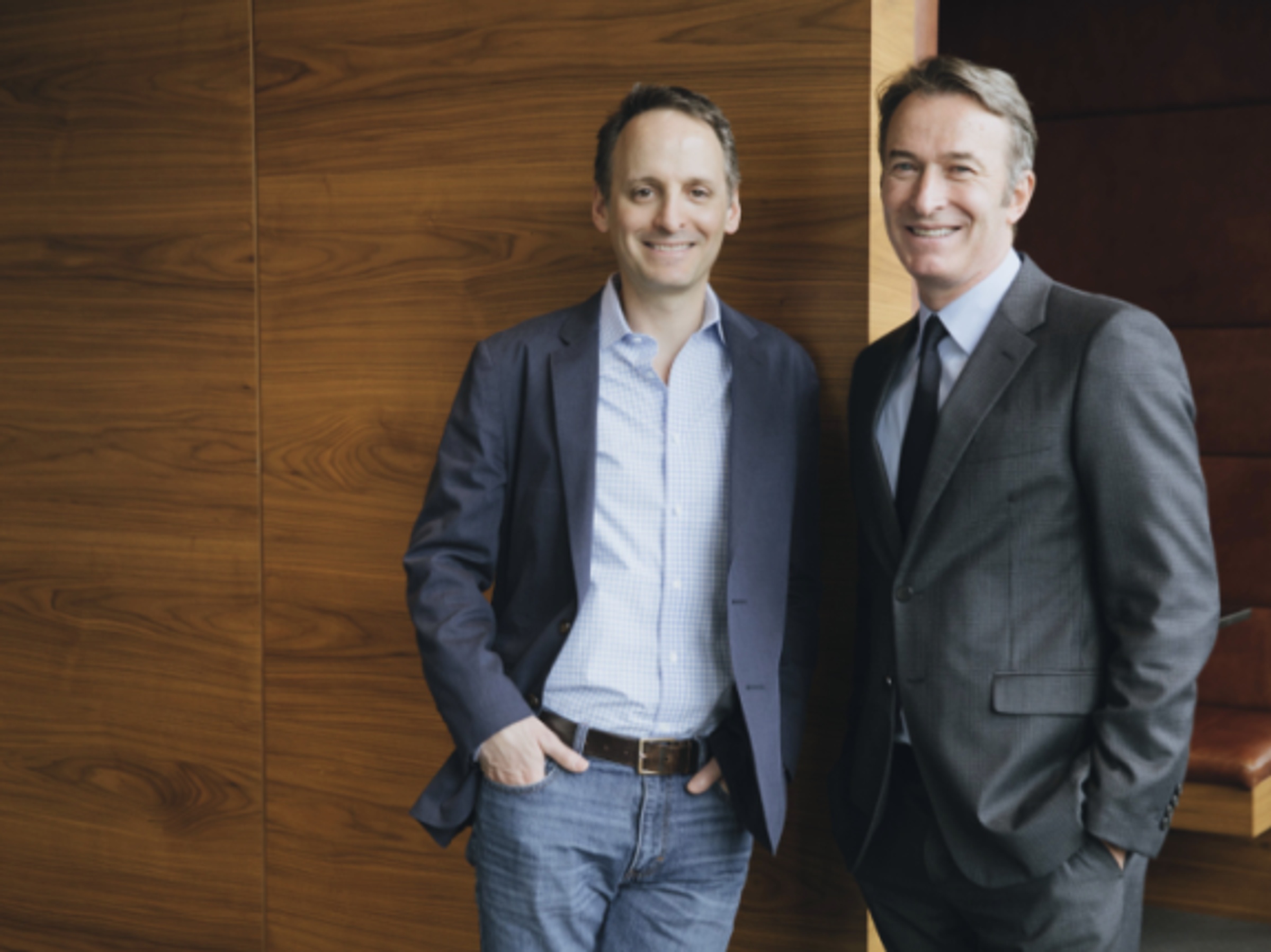
There is a pleasing circularity to that photograph of Greenberg and Michael Birkin. Birkin founded kyu in 2014. In 2026, Greenberg succeeded him as CEO, while Birkin became chairman. A relationship that began with an acquisition eventually became a leadership succession. The buyer's organization became the founder's next operating challenge.
The intervening years included a broader remit. Greenberg became CEO of kyu Pulse in 2024 and president of kyu in 2025. Pulse brought together eight businesses spanning data, design, creative work and execution. When publicly launched in April 2025, it retained each company's identity and leadership. Cooperation had to happen among businesses that continued to have names, histories and leaders of their own.
Keeping the other players audible
That arrangement makes Greenberg's fondness for music a useful point of reference, although he has not presented a playlist as a management manual. In his 2020 essay, he described choosing music to suit the energy he wanted. He recommended Mayfield's early solo albums with the directness of somebody mildly astonished that a reader might need persuading.
The essay also thanked colleagues, clients and partners for what they were accomplishing together. Its interest lay in shared effort, rather than a solitary executive's routine. This is a recurring feature of his public language: the company is something people build together, and its achievements belong to the people doing the work.
Kepler's own succession provided another example. Co-founder Remy Stiles became global CEO in November 2025, after leading North America. Greenberg publicly welcomed the appointment and credited her contribution from the company's beginning. Their partnership went back to MediaMath. The next phase of his career therefore included watching a fellow founder take responsibility for the business they had helped create.
- 2012Co-founds Kepler
- 2018Kepler joins kyu
- 2024Leads kyu Pulse
- 2025Becomes kyu president
- 2026Becomes kyu CEO
A bigger room, with more to connect
His appointment to lead kyu put him at the head of a collective described at the announcement as twenty-four companies, including IDEO, SYPartners, Sid Lee and Kepler. The assignment now reaches beyond the media agency he founded. It encompasses businesses with different professional traditions and different ways of approaching a client's problem.
Artificial intelligence is part of the next brief. The leadership announcement placed particular emphasis on combining human intelligence and AI across the group. Greenberg's stated interest in entrepreneurial innovation and the people inside the collective gives that brief a familiar shape. The tools are changing again. Their usefulness still depends on the work people do around them.
From the rented conference room to the collective, his career has repeatedly returned to that organizational question. Who needs to speak to whom? What should they understand together? Where can one person's expertise make another person's work better? A larger organization supplies more possible answers and considerably more opportunities for a meeting.
Greenberg's musical range offers a cheerful closing image: gospel next to bluegrass, hip-hop within reach of Cuban dance music, Mayfield ready for another turn. He has made room for all of them. His working life has involved a similar appetite for bringing different capabilities into play. The next task is to give that larger group something worth playing together.
Listen, watch, read on
- Rick Greenberg at kyu
- Medium
- Kepler
- His 2026 appointment
- The 2012 founding interview
- Listen: Time4Coffee interview
- Watch: FreeWheel Innovators
- Read: His music essay
Career details updated October 23, 2026.