Remy Stiles considered getting an MBA. Then there was the matter of the education already arriving at her desk. Kepler was growing, her responsibilities were multiplying, and the business itself was supplying a curriculum. Client relationships. Teams. Operations. Decisions with consequences. She stayed with the practical course. Years later, the company she had helped start made her its global CEO.
That small fork in the road makes a useful entrance to her story. Executive biographies tend to arrange the past into a tidy staircase, each job preparing its occupant for the next. Stiles’s route looks more like learning the building while helping put it up. The client work came first. The larger responsibilities followed. The title eventually caught up.
In November 2025, she took charge of Kepler globally, after leading North America. Thirteen years had passed since the company’s founding. There is a particular kind of authority that comes from remembering the early version of a business: what customers needed, which habits helped, where the awkward joins were. Her career has unfolded across precisely those joins.
The classroom with paying clients
The founding team met at MediaMath, an advertising technology company. In 2012, Stiles, Rick Greenberg and their fellow founders started Kepler around a perceived gap between technological capability and the strategic help brands needed to use it. Advertising was acquiring new machinery. Someone still had to make it useful to the people paying the bills.
Stiles concentrated on building Client Solutions. It was an education in the part of a technology business that has to answer another person’s questions. A campaign may be technically elaborate; the client still needs to understand what it is supposed to accomplish. That relationship between explanation and execution would remain central as her remit widened.
Her later responsibilities included the chief strategy officer role, the company’s rebranding, expansion in Costa Rica and its relationship with parent organization kyu. These are quite different kinds of work. A rebrand concerns how a company presents itself. A new location concerns how it operates. A parent relationship concerns how it belongs to something larger. Together, they describe an executive learning to connect the business.
Her own account of working across kyu emphasizes exchanges between people: collaborating on client projects, sharing knowledge and taking part in educational sessions. The network includes firms with different specialties. For Stiles, that proximity offers a way to learn from colleagues whose expertise begins where her own ends. There is something pleasingly unceremonious about a senior executive treating the next office as a classroom.
A larger company, a closer chair
When Stiles became North America CEO in January 2022, Kepler described the region as a media and consulting operation spanning the United States, Canada and Costa Rica. She had also managed the integration with Infectious Media, which joined the group in December 2020 and extended its international capabilities. Growth had acquired a geographical dimension.
The interesting part of that expansion is the practical work underneath the map. People, technology and processes had to operate together. In 2022, Stiles described winning a global account within two weeks of the hard integration. An acquisition announcement can be completed in a morning. Making the resulting organization useful to a customer is a rather longer assignment.
By January 2025, she was explaining why some brands wanted a closer relationship with an agency even as the largest advertising groups pursued greater scale. Her argument allowed room for a customer who might be modest in one company’s portfolio and consequential in another. Attention, in this version of the agency business, is part of the product.
Kepler’s arrangements could put its buyers alongside a client’s own marketing team. Customers could also inspect platform setups directly. Those are concrete expressions of a relationship that agency language often leaves pleasantly vague. Partnership becomes easier to picture when someone can pull up a chair, open the same system and see the work.
The view from the other side of the table
That interest in the client’s position shows up again in her leadership decisions. In February 2026, Kepler announced Emily Maxey as executive vice president, client partner. Maxey had held marketing roles at FILA, Adidas and Gap. She joined other senior colleagues with experience inside brands, including Camm Rowland and Jim Halliday.
Stiles explained the value of that experience in straightforward terms: people who have occupied the client’s chair understand its demands. There is a useful check on agency self-importance here. The work has to survive the client’s internal conversations, competing priorities and business questions. A clever presentation only travels so far on its own.
Maxey’s own account adds a human detail. She had met Stiles while building a marketing team and agency collective, then worked with Kepler as a client before joining it. The relationship crossed the table. For a leader whose early job was building Client Solutions, it is an apt connection: someone who had experienced the partnership chose to work inside it.
Science gets a seat beside soul
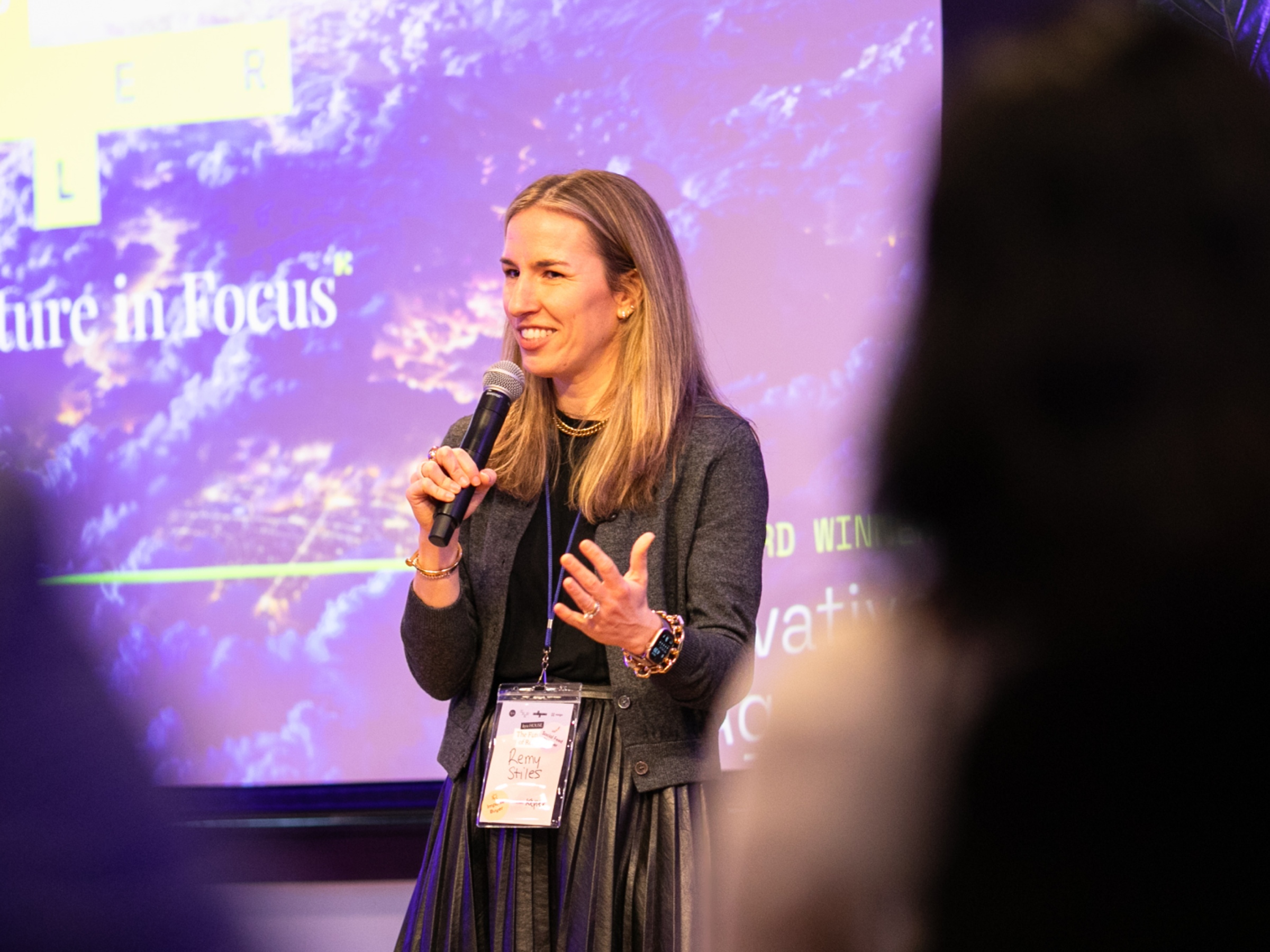
In February 2025, Stiles joined Kepler colleague Abby Bunting and C2’s Jesse Gainer at kyu House for a session about the relationship between data and human connection. Participants considered whether their decisions had been guided by analysis or feeling. An advertising industry gathering had briefly become an examination of its own instincts.
“Media and creative are just so intertwined these days,” Stiles said. Her point was that marketers need both analytical and emotional understanding. Data can inform the decision; the experience still has to mean something to a person. An exquisitely targeted advertisement has a fairly limited social life if nobody cares about it.
Kepler Creative, developed under her leadership, sits within that effort to connect media and creative work. Her public discussions of AI have focused on getting useful work done, including moving creative into the formats campaigns require. The business problem is recognizable: ideas must travel across channels, and the work of adapting them can become its own substantial production.
At the Future of Retail gathering a year later, Stiles returned to connections. A customer’s experience runs through stores, websites, media and other encounters with a brand. Her emphasis was on how those touchpoints fit together. The customer does not pause at a doorway to admire which department owns the next interaction.
How does it all connect?
Making room for the next arrival
Her work on Kepler Academy gives the learning theme another dimension. The free training and mentorship program was designed to improve access to digital marketing for underrepresented candidates. It offered an entrance into a business whose terminology alone can make a newcomer suspect that everyone else received a secret handbook.
In March 2022, Stiles described an eight-week course with hands-on campaign experience. Two cohorts had graduated, and more than half of the graduates had found jobs in digital media, technology platforms or analytics. That figure belongs to that early stage of the program. Its significance is concrete: training was already connecting some participants to employment.
Her public recognition has included the entrepreneur category of the 2023 AdMonsters and AdExchanger Top Women in Media & Ad Tech awards. In reflecting on that honor, she emphasized continuing to take feedback and improve while running a larger business. The language of learning had survived the promotion into leadership.
Her recommended listening offers a lighter glimpse of that appetite: How I Built This and The Who What Wear Podcast appear among her picks for Pacvue’s Women in Commerce series, alongside the leadership network Chief. Business building and fashion make a reasonable pair for someone working where commercial decisions meet taste. Both involve paying attention to what people choose, and to the stories they tell about those choices.
“Kepler is incredibly personal to me.”
Remy Stiles, on becoming global CEO
The global job arrives
The November 2025 announcement made the scale of her responsibility explicit. Kepler had won 14 additional North American clients that year, and Stiles moved from running that region to leading the global company. She described a close personal attachment to the company. It is a founder’s response to a new title, with the years of shared work still attached.
The global work continued to change around her. In March 2026, Toby Hack joined as CEO for EMEA and APAC, reporting to Stiles. In April, she was named to the PMW International Powerlist. In May, Kepler announced it was Pacvue’s first agency partner for an Ads in ChatGPT pilot. The sequence mixes people, recognition and experimentation.
The May pilot put the agency in the position of learning alongside clients in a new advertising environment. Stiles described their interest in gaining firsthand experience while shoppers were using conversational tools to explore brands and decisions. It echoes the founding problem at MediaMath: a technology creates possibilities, and customers need help working out how to use them. The machinery changes faster than the underlying need for judgment.
In June 2026, Kepler received Digiday’s Most Innovative Media Agency award for a second consecutive year. The company linked that recognition to its work connecting audience insight, activation, creative and measurement through Kip, its technology platform. For Stiles, the award arrived during the first year of the global appointment, with the organization still adding capabilities around her.
Those developments do not resolve the questions facing an agency as technology changes. They make the job more tangible. Someone has to choose the leaders, decide what deserves testing and ensure the organization can explain its choices to clients. The executive with the long memory now has to keep making room for unfamiliar work.
Stiles’s route offers a less theatrical account of becoming a CEO than the usual master plan. She built a client team, took on strategic projects and stayed as the organization grew more complicated. The MBA she considered remains a revealing detail. Her education kept happening inside the business. Now the classroom includes the world.